Top LLM Examples for Business in 2026: How to Choose the Right Model
Large Language Models (LLMs) now sit behind chatbots, search, coding tools, document processing, and internal assistants. The choice of model changes quality, cost, speed, and risk, and no single model is best at everything. Many teams use more than one, and route each task to the model that fits it.
This guide compares the leading LLM examples as of October 2026: what each is built for, how you can access it, and where it fits. Model names and versions change quickly, so check each provider’s documentation for the current release before you commit. If you are looking for how businesses use LLMs in practice, see our guide to real LLM examples used in production.
LLM Examples at a Glance (October 2026)
| Model family | Developer | Access | Often chosen for |
|---|---|---|---|
| ChatGPT / GPT | OpenAI | Hosted (app and API) | General-purpose writing, coding, analysis, and the broadest tool ecosystem |
| Claude | Anthropic | Hosted (app and API) | Long documents, coding and agent work, safety-sensitive tasks |
| Gemini | Google DeepMind | Hosted (app and API) | Multimodal input, long context, Google Cloud and Workspace use |
| Llama | Meta | Open weights | Self-hosting, fine-tuning, data control |
| Mistral | Mistral AI | Open-weight and hosted | European provider, multilingual work, efficient open models |
| DeepSeek | DeepSeek | Open weights and hosted | Cost-sensitive reasoning and coding |
| Qwen | Alibaba Cloud | Open weights and hosted | Multilingual use, coding, flexible model sizes |
| Command | Cohere | Hosted and private deployment | Enterprise search and retrieval-augmented generation |
Open-weight models can be run on your own infrastructure, which gives you more control over data, but you take on hosting and maintenance. Always check each model’s license terms before commercial use.
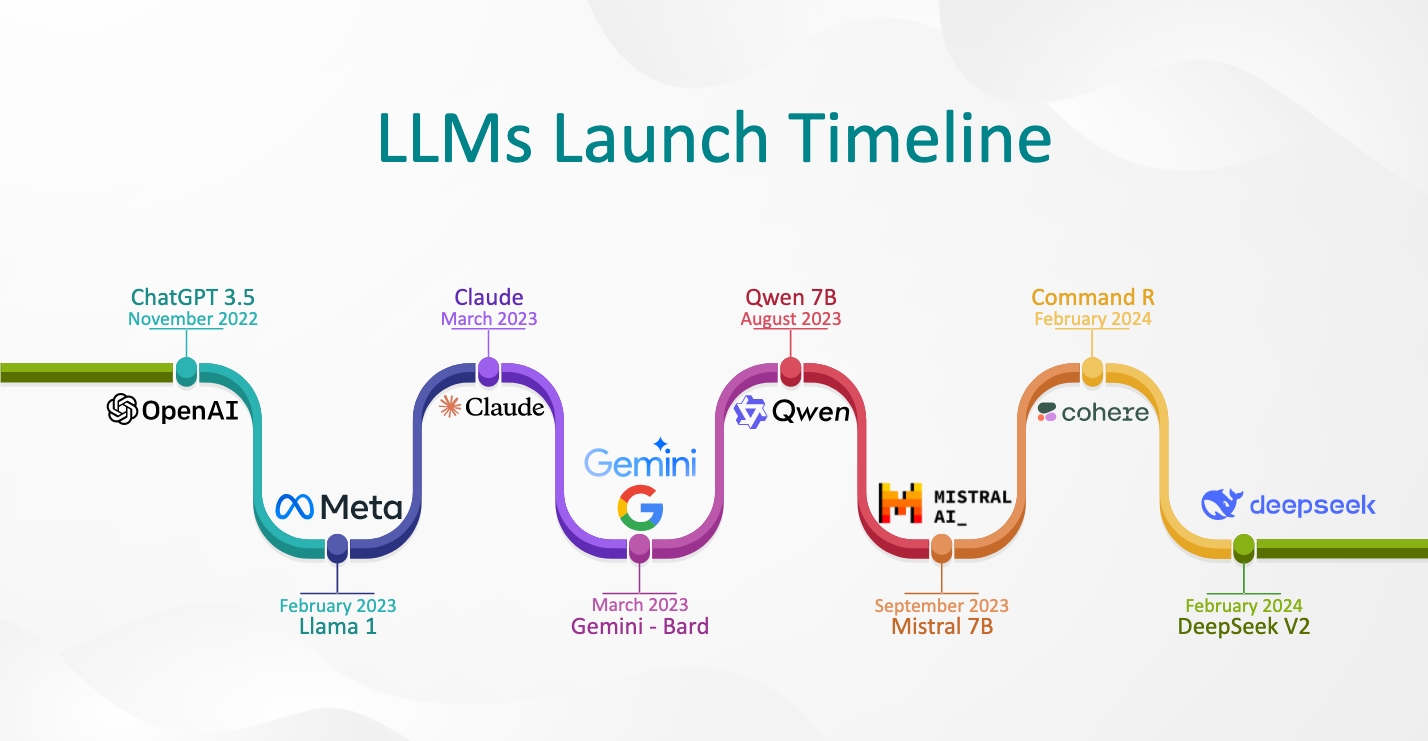
1. ChatGPT (OpenAI)
ChatGPT is OpenAI’s conversational AI, powered by its GPT family of models. As of October 2026 OpenAI’s current generation is the GPT-6 family, with several variants for different cost and capability levels, and older GPT-5 models remain available in some places. It is a versatile choice for writing, coding, analysis, tutoring, and multimodal tasks.
Developer: OpenAI
Key Capabilities:
- Strong general-purpose performance across writing, coding, and reasoning.
- Multimodal input and output on supported models.
- A large ecosystem of integrations, tools, and developer support.
Differentiator: The broadest ecosystem and the most familiar interface for business users.
2. DeepSeek
DeepSeek, a Chinese AI lab backed by the hedge fund High-Flyer, publishes open-weight models known for strong reasoning and coding at a low cost per token. Check DeepSeek’s site for the current release, since the lineup has changed repeatedly.
Developer: DeepSeek (High-Flyer)
Key Capabilities:
- Reasoning, math, and code generation.
- Open weights, so teams can self-host.
- Low-cost API access.
Differentiator: Cost-efficient reasoning and coding, and the option to self-host. If you use the hosted service, review where your data is processed and your compliance requirements first.
3. Qwen (Alibaba Cloud)
Qwen is Alibaba Cloud’s family of open-weight and hosted models, available in sizes from small to very large. The current generation is Qwen 3.x. It is proficient in code and in many languages beyond English, and it suits teams that want flexible model sizes. Qwen is the model family, and QwQ is a separate reasoning model.
Developer: Alibaba Cloud
Key Capabilities:
- Text and multimodal models in many sizes.
- Strong coding and multilingual performance.
- Open weights for self-hosting.
Differentiator: Wide choice of sizes and strong multilingual coverage.
4. Llama (Meta)
Llama is Meta’s family of open-weight language models. The current family is Llama 4, with larger and smaller variants, and earlier versions such as Llama 3.1 and 3.3 remain widely used for fine-tuning. Llama is released under Meta’s own license, so check the terms before commercial use.
Developer: Meta
Key Capabilities:
- Open weights that can be hosted and fine-tuned on your own infrastructure.
- A range of sizes, including small models for efficient deployment.
- Broad community tooling.
Differentiator: Control over data and customization, in exchange for hosting and maintenance work.
5. Claude (Anthropic)
Claude is Anthropic’s family of AI models, with a focus on safety and reliability. It comes in tiers: Fable and Opus for the hardest work, Sonnet as a balance of capability and speed, and Haiku for fast, lightweight tasks. As of October 2026 the current models are Claude Fable 5.1, Opus 5.5, Sonnet 5.5, and Haiku 4.5.
Developer: Anthropic
Key Capabilities:
- Long-context document analysis and detailed reasoning.
- Strong coding and agent workflows.
- Vision analysis and multilingual support.
Differentiator: Safety focus, long-context comprehension, and a clear tier structure for cost and speed.
6. Mistral
Mistral AI, a French company, offers both open-weight and hosted models. Its current large model is Mistral Large 3, an open-weight mixture-of-experts model, alongside smaller and mid-sized models for efficiency. Mistral is often considered by teams that want a European provider or strong multilingual performance.
Developer: Mistral AI
Key Capabilities:
- Open-weight options for customization and self-hosting.
- Efficient mixture-of-experts designs.
- Models for code, vision, and general use.
Differentiator: European provider with efficient, customizable models.
7. Gemini (Google DeepMind)
Gemini is Google DeepMind’s family of multimodal models. The current generation is Gemini 3.x, with fast Flash models and larger Pro models, and some newer models in limited access. Gemini handles text, images, audio, and video, supports very long context, and connects closely to Google Cloud, Vertex AI, and Workspace.
Developer: Google DeepMind
Key Capabilities:
- Native multimodal input.
- Long context for large documents and codebases.
- Tight integration with Google Cloud and Workspace.
Differentiator: Multimodal strength and Google ecosystem integration. Check Google’s documentation for current model names and availability.
8. Command (Cohere)
Cohere builds the Command family for enterprise use, with a focus on retrieval-augmented generation, search, summarization, and classification. It emphasizes grounded answers and citations, and offers hosted and private deployment options. Check Cohere’s documentation for the current model names.
Developer: Cohere
Key Capabilities:
- Retrieval-augmented generation for enterprise knowledge.
- Summarization, classification, and entity extraction.
- Multilingual models and private deployment options.
Differentiator: Enterprise focus on grounded, source-backed answers.
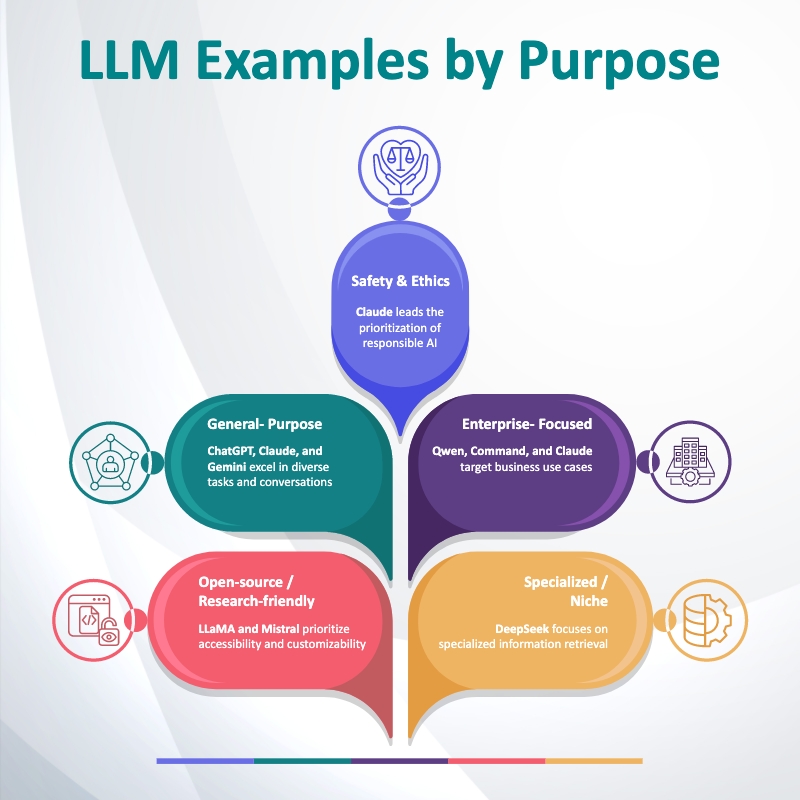
Summary of LLM Examples
- General-purpose models: ChatGPT, Claude, and Gemini handle a wide range of tasks and conversations.
- Enterprise-focused models: Command, Claude, and Qwen are often considered for business workflows such as search, document analysis, and customer service.
- Open-weight models: Llama, Mistral, Qwen, and DeepSeek can be self-hosted and customized.
- Safety-sensitive work: Claude is known for its focus on safety and long-context document work.
- Cost-sensitive reasoning and coding: DeepSeek and the smaller tiers from the major providers are common picks.
How to Choose the Right LLM for Your Business
Test candidates on your own tasks, not on public benchmarks alone. These criteria matter most:
- Task fit: coding, document analysis, customer support, search, or multimodal work favor different models.
- Cost: price per token, plus how many tokens your workflow really uses.
- Context length: how much text the model can read at once, which matters for long documents.
- Data and compliance: where data is processed, whether the provider trains on it, and whether you need a private or self-hosted deployment.
- Latency: how fast responses must be for your users.
- Reliability and oversight: how the model behaves on edge cases, and where people should review outputs.
- Ecosystem: the integrations, tooling, and support you will rely on.
Many teams use several models and route each request to the best fit through a gateway. See our guides to LiteLLM for routing and AWS Bedrock models for multi-model access on AWS. If data control matters most, read our guide to private LLM deployment, and if cost and latency matter, see small language models.
End Note
The LLM landscape changes every few months, and the right choice depends on your task, your budget, and your data rules. Shortlist two or three models, test them on real examples from your workflow, and compare quality, cost, and risk before you commit. Keep people in the loop where mistakes are costly, since LLMs work best as an aid to your team’s judgment.
At Seaflux, we are AI and machine learning specialists helping enterprises worldwide. We build generative AI solutions across the major models, including fine-tuning and retrieval pipelines. To discuss an AI project where LLMs or smaller language models could improve your operations, schedule a meeting with us.
Frequently Asked Questions (FAQ): Get the Answers You Need
What are examples of LLMs?
Well-known LLM examples include OpenAI’s ChatGPT (GPT family), Anthropic’s Claude, Google’s Gemini, Meta’s Llama, Mistral’s models, DeepSeek, Alibaba’s Qwen, and Cohere’s Command. Some are hosted services, while others are open-weight models you can run yourself.
Which LLM is best for business use?
There is no single best model. ChatGPT is a versatile default, Claude is often chosen for long documents and coding, Gemini for multimodal work and Google integration, and Llama, Mistral, DeepSeek, or Qwen when you need to self-host. Test two or three on your own tasks before you decide.
What is the difference between open-weight and closed LLMs?
Closed models are only available through the provider’s app or API. Open-weight models publish their trained weights, so you can host and fine-tune them yourself, which gives more control over data but requires infrastructure and maintenance. Open-weight does not always mean open source, so check each license.
Can a business use more than one LLM?
Yes, and many do. Teams often send simple, high-volume tasks to a smaller, cheaper model and harder tasks to a stronger one, using a gateway to route requests. This can balance quality, speed, and cost.
How do I keep company data safe when using an LLM?
Review the provider’s data-use and retention terms, choose enterprise plans or private deployments for sensitive data, limit what is sent to the model, and keep logs and access controls in place. For strict requirements, a self-hosted open-weight model or a private cloud endpoint may be the better fit.
How often do LLMs change?
Often. Major providers release new models and versions several times a year, and older ones are retired. Build your systems so models can be swapped, and re-evaluate your choice regularly.
Is a bigger LLM always better?
No. Larger models are usually more capable but also slower and more expensive. For many business tasks, such as classification, extraction, or routine summarization, a smaller model performs well at a fraction of the cost, so match the model size to the task.

Aashutosh Mishra
Senior Marketing Executive