10 Real LLM Examples Used in Production (Not Just Demos)
Last year, a fintech client came to us after spending six months and $132K building an LLM-powered compliance assistant. It worked perfectly in testing. In production, it hallucinated regulatory thresholds on 17% of queries and nobody caught it for three weeks. That's not an edge case. That's the gap between demo and production that most teams hit, and almost no one writes about honestly.
Most articles explain Large Language Models (LLMs) using simple demos.
A chatbot answering FAQs.
A tool generating emails.
But production systems are very different.
They deal with:
- messy real-world data
- unpredictable user behavior
- latency and cost constraints
- hallucination risks
- system integration challenges
This guide focuses on how LLMs are actually used in production, across industries like healthcare, fintech, SaaS, and more, including critical applications like customer support automation.
If you're evaluating AI for your product, this will help you move from experimentation to real implementation of LLM in production.
What is an LLM? (Quick Overview)
A Large Language Model (LLM) is an AI system trained on massive datasets to understand and generate human-like language.
Popular platforms include:
- OpenAI
- Claude
- Gemini
- AWS Bedrock
- LiteLLM
While these tools power AI systems, the real value comes from how they are applied in real-world use cases and diverse LLM use cases, along with effective LLM cost optimization.
10 Real LLM Examples in Production
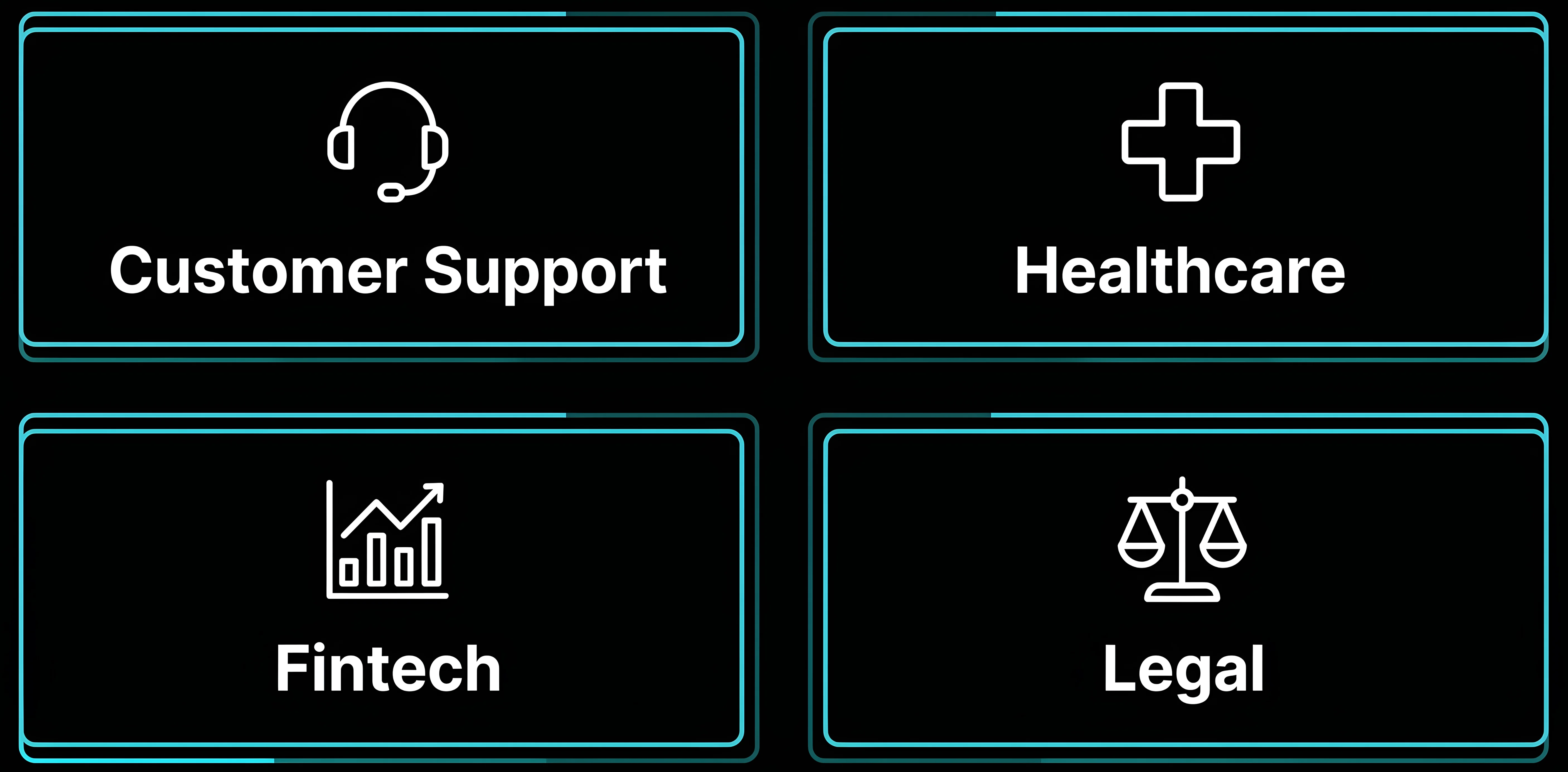
1. AI Customer Support Automation
LLM-powered chatbots are handling up to 70% of customer support queries, making customer support automation one of the most impactful LLM use cases today.
They:
- Understand intent
- Retrieve answers from knowledge bases
- Escalate complex issues
Typical stack:
- LLM + Retrieval-Augmented Generation (RAG)
- Vector database
- Backend integrations
Multi-language handling and context retention make these systems complex at scale when running LLM in production, where LLM cost optimization becomes important.
Real-world example:
See how we built a WhatsApp-based customer support system that automates queries and integrates with backend workflows →
If you're exploring customer support automation and other LLM use cases, this approach can be adapted to your product.
2. Healthcare Document Processing
In healthcare, the hardest part isn't getting the LLM to summarize a clinical note accurately, GPT-4o does that reasonably well. The hard part is that a 94% accuracy rate is unacceptable when the 6% error involves medication dosages. Every healthcare LLM system we've built has required a human-in-the-loop checkpoint for specific entity types, drug names, lab values, and procedure codes regardless of model confidence scores.
Healthcare platforms use LLMs to:
- Summarize patient records
- Extract structured medical data
- Assist in clinical workflows
These are some of the most impactful LLM use cases in healthcare, where precision and reliability are essential.
Challenge: Accuracy and safety are critical.
Real-world example:
See how we built an AI-powered health and fitness application using GPT-4o for personalized insights →
In healthcare AI, balancing personalization with accuracy is key.
3. Financial Risk & Fraud Analysis
In fintech, LLMs help:
- Explain transactions
- Generate audit summaries
- Support compliance workflows
Real-world example:
See how we developed an AI-powered crypto trading platform with real-time analytics →
Combining AI with real-time financial data pipelines creates strong competitive advantage and valuable AI automation examples.
4. AI Copilot for Internal Teams
Internal AI copilots assist:
- Sales teams (email drafting, CRM insights)
- HR teams (policy Q&A)
- Operations (data retrieval)
Most implementations start small and expand across departments, becoming strong AI automation examples and key enterprise LLM use cases in organizations.
5. Legal Document Review
LLMs are used to:
- Extract clauses
- Compare contracts
- Identify risks
Real-world example:
See how we built an AI system for legal research and contract automation →
AI can significantly reduce legal review time while keeping humans in the loop across legal LLM use cases.
6. LLM-Powered Search (RAG Systems)
Instead of keyword-based search, LLMs:
- Understand user intent
- Retrieve relevant content
- Generate contextual responses
Tools like Flowise are often used for prototyping.
Most systems start as prototypes and evolve into production-grade architectures within LLM application development workflows, powering many real-world AI applications.
7. Code Generation Assistants
LLMs help developers:
- Write code
- Debug issues
- Generate documentation
At scale, systems rely on Kubernetes for infrastructure management in LLM in production setups.
8. Personalized Recommendation Engines
LLMs enhance recommendations by:
- Understanding context
- Generating dynamic suggestions
- Improving engagement
Real-world example:
See how we built a scalable AWS-hosted content platform supporting personalization workflows →
Scalable infrastructure is critical for recommendation systems handling large user bases and advanced AI automation examples.
9. Voice + LLM Assistants
Voice-enabled AI systems combine:
- Speech-to-text
- LLM processing
- Text-to-speech
Used in:
- Customer service
- Ordering systems
- Virtual assistants
Real-world example:
See how we built a voice-enabled food ordering system using NLU →
Voice interfaces reduce friction and improve accessibility significantly.
10. Multi-Agent AI Systems
Advanced systems use multiple AI agents to:
- Collaborate
- Delegate tasks
- Execute workflows
Used for:
- Research automation
- Process orchestration
These systems require strong orchestration and monitoring layers for LLM in production.
Real Implementations vs Demo Project
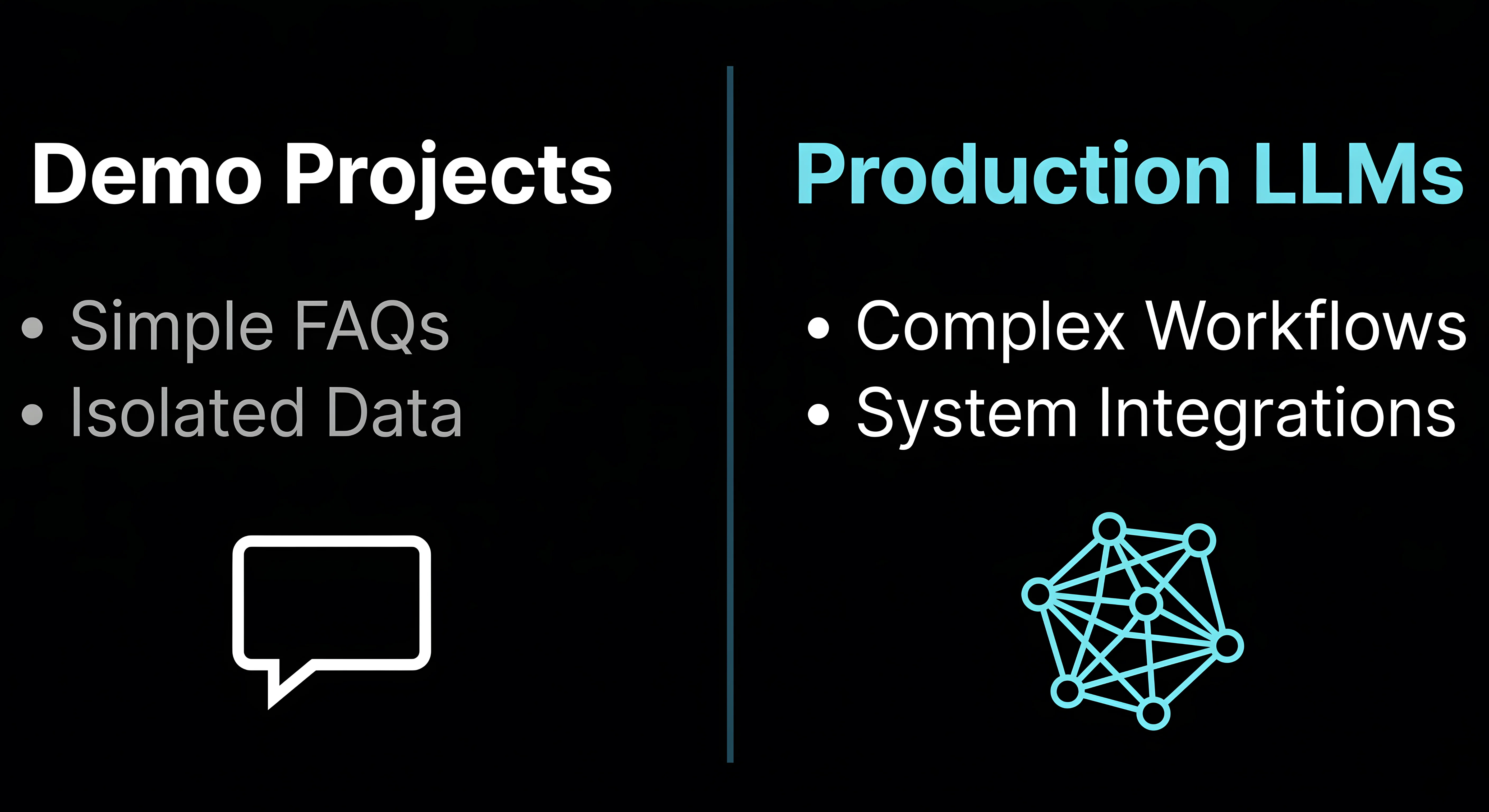
Most LLM content online focuses on demos.
Production systems:
- Integrate with real workflows
- Handle failures and edge cases
- Require monitoring and scaling
Explore more real-world implementations here
LLM Architecture in Production
Most systems follow this structure:

- Input layer
- LLM gateway (e.g., LiteLLM)
- Retrieval layer (RAG)
- Business logic
- Output generation
The real challenges include:
- cost optimization
- latency control
- hallucination handling
- reliability
Lesson Learned: Multi-Agent Systems Can Spiral Quickly
One of our early multi-agent implementations had no proper state management between agents.
The agents kept reassigning the same subtask to each other, looping over 40+ iterations without reaching a conclusion. This not only delayed responses but also resulted in a surprisingly high API cost for a single query.
We fixed this by introducing:
- strict iteration limits (capped at 8 cycles)
- shared state tracking between agents
- fallback conditions when confidence drops
Multi-agent systems are powerful, but without guardrails, they can become expensive and unpredictable very quickly.
When NOT to Use LLMs
LLMs are not always the right solution.
Avoid them when:
- deterministic output is required
- a rule-based system is sufficient
- data sensitivity is extremely high
Using LLMs unnecessarily increases cost without improving outcomes, especially in AI in production scenarios.
Build vs Buy: What Should You Choose?
Use tools like Flowise if:
- you are prototyping
- building internal tools
- testing ideas
Build custom solutions if:
- scalability is required
- workflows are complex
- integrations are needed
The right decision depends on your business needs, not trends.
Build Production-Ready LLM Systems
Most teams don’t struggle with ideas.
They struggle with execution.
Common challenges include:
- choosing the right architecture
- integrating AI into existing systems
- scaling beyond prototypes
At Seaflux.tech, we help businesses move from LLM experimentation to production-ready systems with strong LLM application development practices.
👉 Whether you're building:
- AI chatbots
- document processing systems
- voice assistants
- AI-driven platforms
We can help design and implement the right solution.
→ Book a consultation to evaluate your use case
Final Thought
If you're evaluating LLMs for your product, the first question to answer isn't which model to use, it's whether your data is clean enough to support it. The #1 reason LLM projects fail in production isn't the AI; it's that the underlying data has no lineage, no quality controls, and no governance. Before you pick a model, audit your data pipeline. That's the conversation we start with every client.
The real question isn’t:
“Can we use LLMs?”
It’s:
“Where will LLMs create measurable business impact?”
The companies succeeding with AI are not experimenting more. They are implementing smarter with AI in production.

Jay Mehta
Director of Engineering