Your supply chain
produces data.
SupplyPulse turns it
into decisions.
AI-powered predictive visibility, demand forecasting, and risk on your data, integrated with your existing stack, live in 8–10 weeks.
Fewer SLA misses for a US 3PL broker
ETA prediction accuracy
Annual savings, production-deployed
Weeks from data audit to go-live
From reactive fire-fighting to
decision-ready operations
A US-based 3PL broker managing 30,000 loads a month replaced static ETAs and manual check calls with a live predictive system. Delivered in 10 weeks.
Ops teams get ahead of delays, alerts fire before SLA windows close, not after the miss is recorded.
CX teams send proactive updates, customers hear about a delay from you, not when the window expires.
Dispatchers stop chasing carriers, live telematics replace the call queue that was eating hours every day.
Most supply chains are
built to report, not to predict
Six operational problems AI solves before they hit your P&L
ETAs calculated once, never updated
Delays surface after the damage is done
Hours lost chasing status updates
Demand swings that catch planning off guard
No single view across TMS, ERP, and WMS
Supplier risk is invisible until it hits
Recognise any of these? The demo walks through how a live predictive system addresses each one on real operational data.
See It in ActionOne platform, every layer
of your supply chain
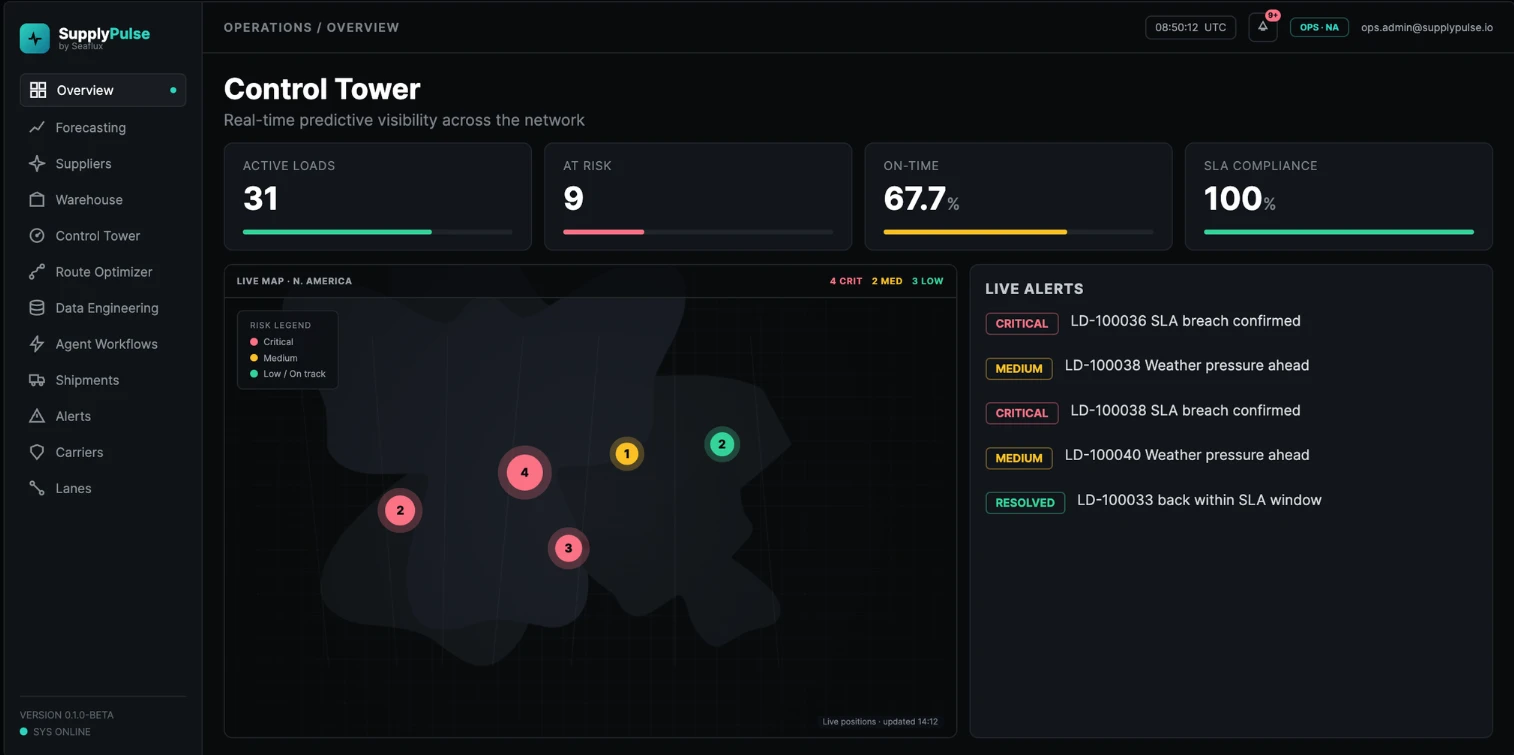
Predictive Visibility & Risk Alerts
Live shipment tracking with AI-driven ETA forecasting and dynamic risk scores, updated continuously, not calculated once.
From data audit to go-live
in 8–10 weeks
Discovery & Data Audit
Map TMS, ERP, and WMS stack. Assess data readiness.
Backend & Pipeline Setup
Build ingestion pipelines and unified data layer.
AI Model Development
Train ETA, risk, and forecasting models on your data.
Alerting & Live Integration
Connect alerts, escalations, and live TMS/ELD feeds.
Testing & Go-Live
Tune thresholds with ops team. Full production rollout.
Overlapping phases run in parallel; pipeline work begins while discovery is wrapping, models train while integration is being built. This is what compresses delivery to 8–10 weeks.
We don't pitch
AI strategies.
We ship working systems.
Any consultancy can produce a supply chain AI roadmap. Seaflux designs, builds, integrates, and deploys : one team, one accountability chain, production-ready in weeks, not quarters.
Production-deployed, not just proposed
The system on this page is live. 30,000 loads a month, 91% ETA accuracy, $620K in annual savings: delivered, not projected.
One team owns the full lifecycle
Pipeline to dashboard, data audit to go-live; no handoff gaps, no finger-pointing between separate data, ML, and dev teams.
Weeks to production, not quarters
Parallel workstreams compress a typical 6-month AI engagement into 8–10 weeks, without cutting corners on data quality or model accuracy.
Built on your data, not a generic model
Models trained on your freight lanes, SKUs, carriers, and supplier mix, not a pre-built template dressed up with your logo on the dashboard.
Enterprise-grade tools,
no proprietary lock-in
Every layer integrates with your existing systems, no rip-and-replace required.
Prediction & Intelligence
The models that power ETA forecasting, risk scoring, and demand planning
Data Infrastructure
Pipelines that unify ERP, TMS, WMS, and telematics into one queryable layer
System Integrations
Connects to your existing stack over REST APIs, no rip-and-replace
Dashboards & Alerts
The control tower interface and multi-channel alerting ops teams interact with daily
Cloud & Security
Infrastructure that scales with load volume and keeps multi-partner data protected
Our Clients
We understand that your success is our success, and that's why we are dedicated to providing you with top-quality service and software solutions.

Frequently Asked Questions (FAQ): Get the Answers You Need
We've had AI projects that went nowhere. How is this different?
Most AI projects fail at the data and integration layer, not the model layer. Seaflux starts with a discovery and data audit before writing a line of code, so we know what's usable and what needs fixing before committing to a delivery timeline. The system on this page is production-deployed and running on live freight data.
We already have a TMS and ERP. Do we have to replace them?
No. Seaflux builds on top of your existing stack over REST APIs. MercuryGate, Blue Yonder, SAP, NetSuite, we connect to what you already run and add a predictive layer on top. Your TMS stays the system of record. We make it smarter.
Our data is a mess. Can you still build on it?
Yes and we expect it. Every engagement starts with a data audit that assesses quality, lineage, and gaps. We build the data foundation in parallel with the first working version of the system, so data quality issues are solved as part of delivery, not treated as a blocker before work begins.
We're not a logistics company does this apply to us?
Yes. The same predictive layer that flags a delayed shipment for a freight broker also flags a stockout risk for a retailer or a supplier reliability issue for a manufacturer. Seaflux builds supply chain AI for logistics, retail, manufacturing, distribution, CPG, and pharma. The underlying problems of reactive visibility, fragmented data, and manual workflows are the same across all of them.
What does the 8–10 week timeline actually include?
Everything from discovery, data pipelines, model training, dashboard build, TMS/ELD integration, alerting setup, user access, threshold tuning with your ops team, and production go-live. Parallel workstreams compress what typically takes six months into ten weeks. The timeline is scoped during discovery and agreed before development starts.
How do we know the model will perform on our data, not just a demo dataset?
Because we train on yours. Models are built using your historical shipment records, carrier data, SKU transactions, or supplier history not a generic dataset dressed up for a demo. Accuracy is benchmarked against your own lanes and patterns during the testing phase before go-live, so you see real performance numbers on real data before the system is live.
Your Freight. Your Data. Your Predictive Edge.
Get a free assessment of where static tracking and manual processes are costing your supply chain the most, and what a predictive system would look like on your data.