Building MVPs with AI: A Fast, Practical Guide for Startups (2026)
Most AI MVPs take months and tens of thousands of dollars before anyone finds out if the idea actually works. There's a better way.
With today's pre-trained models, plug-and-play APIs, and lean deployment tools, a focused team can go from idea to working AI prototype in 48 hours — enough to test with real users, attract early interest, or walk into an investor meeting with something live.
This guide walks you through the exact process: how to pick the right use case, which tools to use at each layer, and how to structure your 48 hours so you ship something functional — not
just a slide deck.
Whether you're a founder validating a concept, a developer exploring AI tooling, or a product team evaluating what's possible — this is the fastest path from zero to working prototype.
Why Build an MVP AI App in 48 Hours?
Why rush? Isn't AI development complex?
Here’s the reality:
- AI development is becoming modular and accessible.
- You don’t need to train models; you just need to orchestrate them.
- Investors, customers, and partners care more about functional validation than polished design.
- Speed lets you fail fast, learn faster, and iterate better.
This is why many AI development companies now emphasize rapid prototyping and lean MVP development as part of their core service offerings. Developing an MVP with AI capabilities allows startups to demonstrate value quickly and gather early feedback. These practices align with the agile mindset of minimum viable product software development, where early testing leads to faster refinement. Building an MVP also helps reduce risk while achieving proof of concept. More importantly, rapid AI MVP app development helps bring products to market faster with real-time feedback loops.
Whether you're looking to test a new SaaS concept, build AI app functionality into an existing service, or launch a lean AI prototype, this development approach can give you a strong head start.
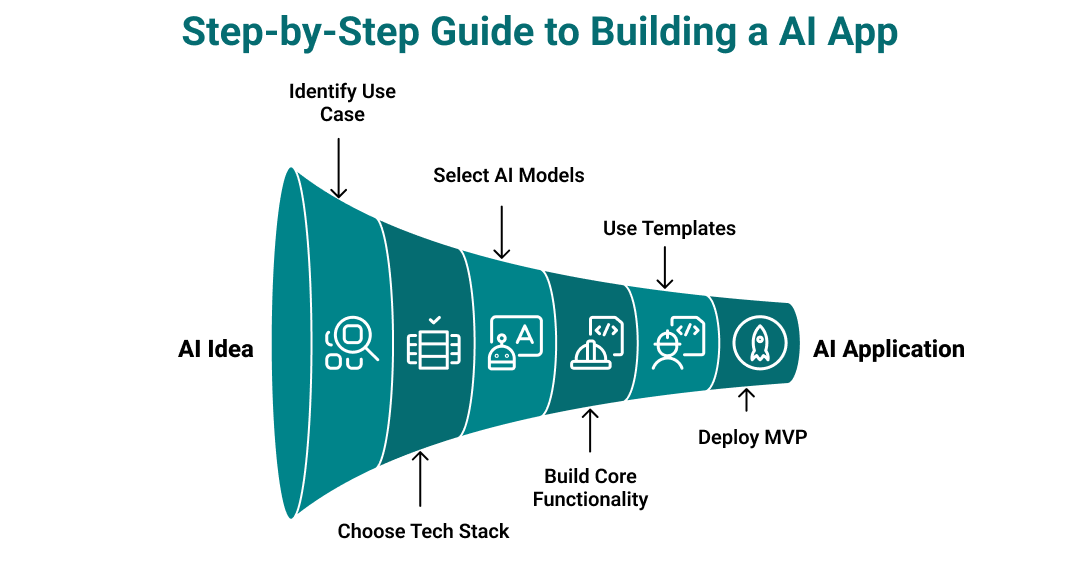
Step 1: Identify the Right AI Use Case
A 48-hour AI MVP succeeds or fails on problem selection. You need a problem that:
- Is narrow (solves one thing well)
- Can be tackled using existing AI tools or APIs
- Has real-world relevance for validation
These criteria are critical for effective MVP product development, especially under time constraints. Being strategic while building an MVP ensures that development efforts are focused on solving tangible problems that users care about.
Ideal use cases for rapid AI MVPs:
Step 2: Choose a Fast & Scalable Tech Stack
When building under pressure, your tech stack must prioritize speed, integration, and low setup cost.
Suggested Tech Stack:
How AI Coding Tools Have Changed MVP Development in 2026
Since 2025, a new category of AI-assisted development tools has dramatically compressed MVP timelines. Developers using these tools report 40–60% faster prototyping, and non-technical founders are now shipping functional MVPs without writing a single line of code.
Key tools worth knowing:
What this means practically: A single senior developer using AI coding tools can now deliver what previously required a team of three. For startups, this means lower cost and faster delivery — but architectural decisions and quality assurance still require experienced oversight.
At Seaflux, we use AI coding tools internally on every MVP engagement, which is part of how we keep timelines short and costs predictable.
Step 3: Select Pre-Trained AI Models and Services
You’re building an AI MVP; avoid model training. Use existing APIs or hosted models. These are ideal for quick and effective AI development without the overhead of building from scratch. This approach streamlines MVP development by reducing complexity.
If your goal is to build AI app functionality fast, these pre-trained services save time and deliver real-world results:
NLP (Text Tasks):
- OpenAI GPT-4 / GPT-3.5: Chat, summarization, parsing
- Cohere: Classifiers, embeddings, sentiment analysis
- Claude: Contextual Q&A or creative writing
Vision:
- Google Cloud Vision: OCR, label detection
- Replicate: Deploy Stable Diffusion, CLIP, ControlNet
Audio:
- Whisper (OpenAI): Speech-to-text
- AssemblyAI / Deepgram: Real-time transcription
Agents & Tools:
- LangChain: Tool integration, memory handling
- LlamaIndex: RAG for document querying
- LiteLLM: Easily switch between LLMs with one API
Tip: Use services like Hugging Face Spaces, Replicate, or Together.ai for instant model deployment.
Step 4: Build the Core Functionality (Working Demo > Perfect Code)
This is where you spend the most time. Start with the backend AI logic and then connect it to a basic UI. The key to building an MVP in such a tight timeframe is to prioritize working features over polished design. This fast, iterative approach is the essence of lean AI MVP app development, getting a working version into users’ hands as quickly as possible.
Suggested Development Flow:
- Input: Text field, file upload, audio recording
- Processing: Call your AI model/API with the data
- Output: Show summarized text, classified label, generated image, etc.
Example: Resume Ranking Tool MVP
from fastapi import FastAPI, UploadFile
import openai
from some_parser import extract_text  # Assumes you have a text extractor

app = FastAPI()

@app.post("/rank-resumes/")
async def rank_resumes(file: UploadFile):
    content = await file.read()
    parsed_text = extract_text(content)

    prompt = f"Rank this resume for a Data Scientist role:\n\n{parsed_text}"

    response = openai.ChatCompletion.create(
        model="gpt-4",
        messages=[{"role": "user", "content": prompt}]
    )

    return {"rank_score": response['choices'][0]['message']['content']}
Then use React + Tailwind CSS to build a simple file uploader UI and connect it to this API.
Tip: Stub out the frontend and backend structure first, then fill in the logic.
Step 5: Use Templates, Boilerplates & Low-Code Hacks
You're on the clock. Save time by using starter kits or low-code platforms.
Resources:
- Streamlit: Fast dashboards and AI demos (Python-only)
- Appsmith / Retool: Internal tool UIs in minutes
- Tailwind UI Kits: Prebuilt design systems
- Next.js AI Starter Templates: OpenAI starter kit by Vercel
- Open Source Repos: Look for “awesome-ai-apps” on GitHub
Tip: Search GitHub with keywords like “chatbot gpt nextjs” or “pdf summarizer fastapi” to find base projects.
Not Technical? No-Code AI MVP Options
If you're a non-technical founder, you don't need to wait for a developer to validate your idea. A new generation of no-code and low-code AI tools lets you build a functional prototype in days:
- Lovable - describe your app in plain English, get a working web app
- Bubble - visual app builder with AI plugin integrations
- Retool - internal tools and dashboards in hours
- Botpress / Voiceflow - build AI chatbots and voice agents without code
- Make (formerly Integromat) - connect AI APIs into automated workflows
These tools are ideal for a Proof of Concept or early user testing. When you're ready to move to a production-grade build, that's where a development partner like Seaflux comes in — rebuilding on a scalable foundation with the validation data you've already collected.
Step 6: Deploy the MVP & Make It Public
For APIs:
- Render: Deploy Python/Node APIs with autoscaling
- Railway / Replit: Fastest setup for full-stack apps
For Frontends:
- Vercel: Best with Next.js / React apps
- Streamlit Cloud: Share Python dashboards
For Feedback:
- Add shareable links: Make it easy for testers to try
- Include a bug form or feedback link
- Track metrics with PostHog or LogSnag
Bonus: Add a basic landing page using Framer, Carrd, or Typedream to explain what your MVP does.
48-Hour Time Breakdown (Sample Plan)
What Does an AI MVP Cost in 2026?
One of the most common questions founders ask before starting is: how much will this actually cost? The answer depends on complexity, the AI models involved, and whether you need custom data pipelines or off-the-shelf APIs.
Here's a practical breakdown based on real project scopes:
For context, industry data shows that startups that rush into development without a structured plan waste an average of $50,000–$150,000 building features users don't actually want. A scoped MVP prevents exactly that.
Testing & Validation
A working MVP means:
- AI outputs are functional (not perfect, but usable)
- There’s a clear value proposition
- Users can try it without hand-holding
- You’ve received real feedback (even from 3–5 people)
Use tools like:
- Hotjar / PostHog – for usage analytics
- Google Forms – for post-demo surveys
- Tally.so / Notion – to collect sign-ups or interest
Real-World Examples That Started As MVPs
How Seaflux Built an AI Document Processing MVP in 5 Days
A fintech client came to us with a manual loan document review process that took their team 3–4 hours per application. We scoped and built an AI MVP using GPT-4 and a FastAPI backend that extracted, classified, and summarised key data fields from uploaded PDFs automatically.
Result: review time dropped from 3–4 hours to under 10 minutes per application. The MVP was live in 5 days and used to secure their next funding round.
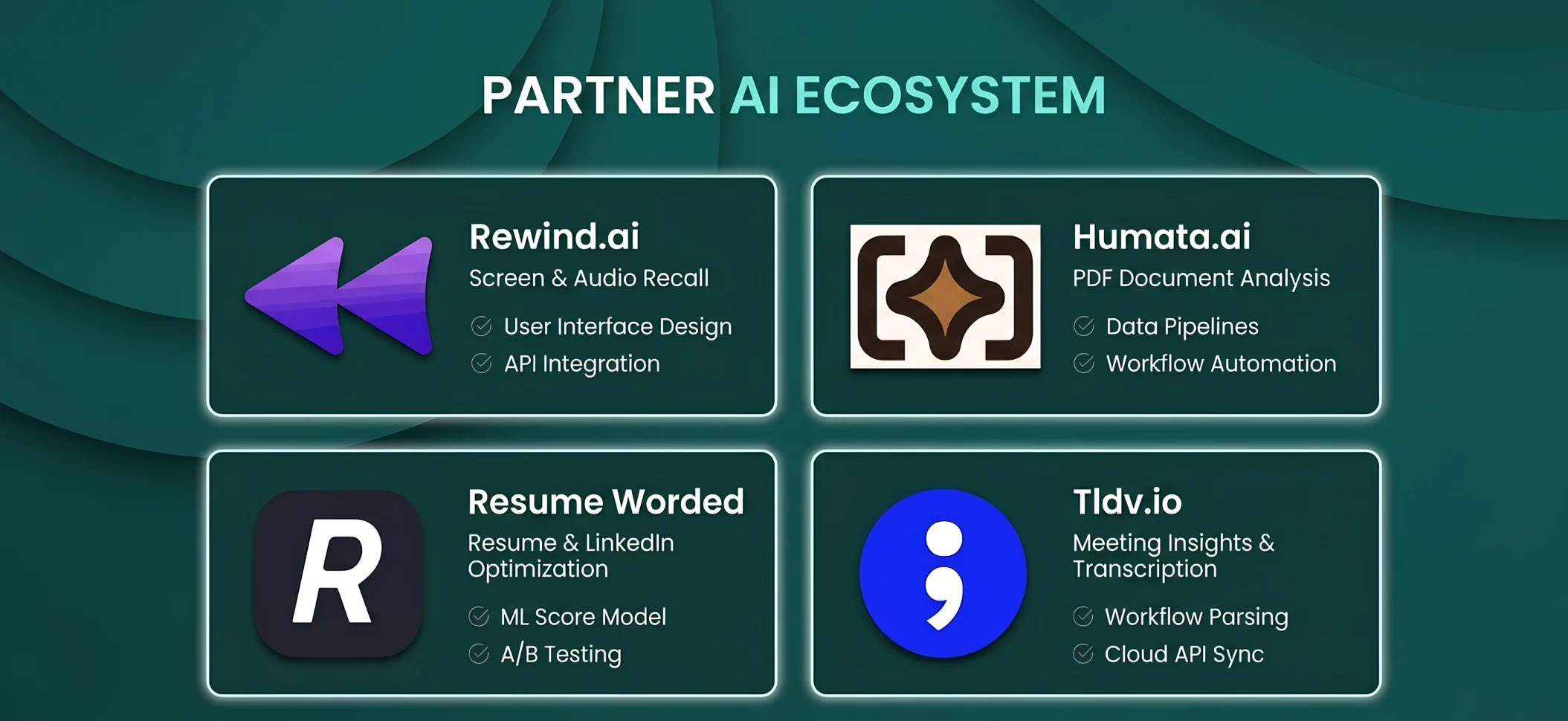
- Rewind.ai: Originally a Mac OS app that records screen + voice and lets you ask it questions
- Humata.ai : Began as a simple PDF Q&A interface
- Resume Worded: An AI resume grader with a simple score system
- Tldv.io: Transcribe Zoom meetings using Whisper
All of these started with minimal, focused MVPs, and now they’re growing startups.
Final Thoughts
Building an AI MVP in 48 hours isn’t about cutting corners. It’s about leveraging modern tools, rapid prototyping principles, and pre-trained intelligence to ship fast and learn even faster. The key to successful MVP development is having a clear goal, lean tech, and fast feedback loops.
You don’t need a team of engineers or months of AI development, just a strong idea, a tight scope, and the willingness to experiment.
Need Help Building Your AI MVP?
Seaflux is a trusted custom software development company offering tailored AI development services to help you prototype, build, and scale smart applications quickly.
From AI chatbots to recommendation systems and inventory tools, we deliver custom AI solutions designed for your specific goals, not generic platforms.
As a reliable AI solutions provider, we support startups and enterprises across industries like fintech, healthcare, and logistics.
Contact us or schedule a meeting to bring your AI idea to life.

Dhrumi Pandya
Marketing Executive