 Fintech
 Gulf
Gulf 20 Weeks
Multi-Vendor Travel Marketplace Development for B2B, B2C, and Vendor Management on One Platform
We built a scalable travel marketplace with B2B & B2C portals, real-time booking, vendor onboarding automation & multi-currency payments across 1,950+ airports.
Overview
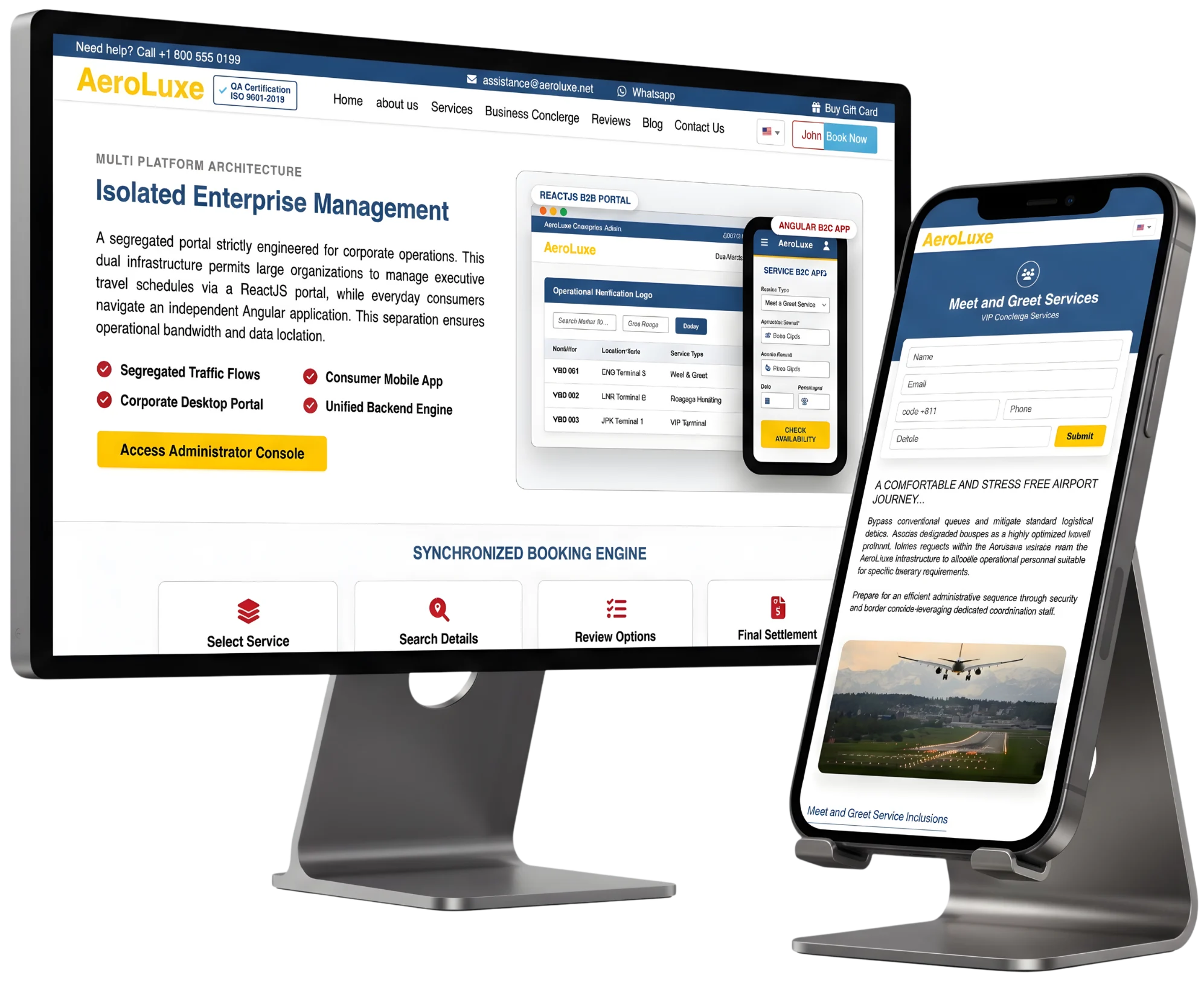
We engineered a unified digital marketplace that brings the full spectrum of airport concierge services onto a single platform. Passengers can browse, compare, and instantly book meet and greet packages, VIP airport services, fast track lanes, lounge entry, baggage handling, and ground transport all in real time, in their preferred currency. The architecture deploys three completely separate environments: a consumer-facing web application for individual travellers, a corporate portal for business accounts, and administrative panel for platform and vendor management. A microservices backbone keeps each environment isolated, ensuring that traffic peaks in one zone never affect performance in another.
The Challenge
Client Overview
Our client operates one of the world's largest airport concierge service networks, with ground service coverage spanning more than 1,950 airports across multiple continents. Despite their global reach, their infrastructure had not kept pace with their scale. Passengers had no self-service booking option, vendor onboarding required weeks of manual coordination, and corporate clients lacked consolidated billing or visibility into their travel spend. The client engaged us with a clear mandate: replace the fragmented, manual operation with a platform that could connect passengers directly to local service operators, bring new vendors online without back-office intervention, and give administrators real-time control over the entire network.
Key Pain Points
- Travellers had no unified portal to evaluate and book transit services across different regions within a global airport concierge network, forcing them to rely on email inquiries and manual coordination.
- Unpredictable checkpoint delays at security and immigration disrupted pre-booked concierge schedules, leaving ground operators scrambling to reassign staff and passengers missing time-sensitive connections with no real-time communication in place.
- Legacy systems used generic service configurations that could not accommodate the distinct logistical requirements of unaccompanied minors, large groups, or corporate executives.
- Price inconsistencies and varying service standards across airports made purchasing decisions confusing and eroded traveller confidence.
- Cross-border operations introduced multiple languages, fluctuating currencies, and region-specific compliance requirements that the existing infrastructure could not handle at scale.
- Ground vendors managed their baggage handling services and all other bookings manually, with no digital tools for capacity planning, scheduling, or payment reconciliation.
- System administrators had no real-time reporting capability, leaving financial performance and service delivery metrics visible only in retrospect.
- Processing international payments alongside sensitive personal travel data required strict compliance with global privacy regulations, making robust travel payment processing a non-negotiable requirement from the outset.
Our Solution
Technical Architecture
Booking Engine Module
Multi Platform Interface
Administrative Control Panel
External System Integrations
Automated Notification System
Vendor Onboarding Engine
Financial Processing and Invoicing
Data Security and Analytics
Why This Stack
Platform Capabilities
Functional highlights of the airport concierge system

Unified Service Ecosystem
All transit and concierge services fast track, lounge, meet and greet, baggage, and ground transport bookable in real time from one interface, in the user's local currency.

Global Accessibility
A single deployment serves operators across the Gulf, Europe, Asia, and the Americas with native multi-language support and real-time currency conversion, no regional reconfiguration needed.

Scalable Architecture
A microservices backend isolates B2C and B2B traffic flows independently. The same infrastructure that launched with the first vendor now supports a 1,950+ airport network without changes.

Real Time Notifications
Every booking event confirmation, vendor assignment, dispatch, and delay triggers instant SMS and email alerts via Twilio and AWS SES, achieving 99.8% delivery across 14,800+ notifications.

Advanced Analytics
Role-specific dashboards give administrators and vendors live visibility into booking volumes, revenue by service category, and capacity utilisation updated in real time, not end-of-day.

B2B Corporate Management
A dedicated corporate portal lets travel managers schedule employee trips, manage VIP bookings, and consolidate billing with role-based access controls across finance, management, and staff.

Secure Payment Gateways
Stripe, Ngenius, and PayPal handle multi-currency transactions under PCI-DSS Level 1 certification, with end-to-end encryption and full audit logging on every payment.

Tailored Passenger Experiences
Traveller profiles drive automatic service configuration, VIP routing, group capacity checks, and unaccompanied minor protocols activated at booking without any manual operator input.
Built with Modern Tech
We leverage cutting-edge technologies to build scalable, secure, and high-performance applications that grow with your business.
 Django
 Angular
 ReactJS
 WordPress
 MySQL
MySQL AWS SES
 Firebase
 Twilio
 Stripe
 PayPal
 Ngenius
 Zoho Bookings
Measurable Results
Real outcomes that transformed our client's operations and delivered significant ROI.

Airports Covered
Ground service providers active and bookable across six continents from day one of launch.

Operational Availability
Reservations processed and confirmations dispatched continuously across every global time zone.

Automated Onboarding
Deploying the vendor registration engine completely eliminated manual data entry tasks for new service partners within the B2B travel booking engine.

Integrated Platforms
Consumer app, mobile app, and corporate portal operating in sync within a single unified backend.
Project Delivery Approach
A proven methodology that ensures quality delivery, on time and on budget.
Requirement Analysis & Architecture Design
We mapped the client’s full concierge ecosystem across all operator types and geographic regions before writing a single line of code. This phase produced the microservices architecture blueprint, data isolation strategy, and payment flow specifications that guided the entire build.

Frontend & Backend Development
Engineering teams built both frontend applications Angular for consumers, ReactJS for corporate in parallel with the Django backend. A shared API gateway handled authentication and load balancing while keeping the data paths for B2C and B2B traffic cleanly separated.

API & Third Party Integration
We connected Stripe, Ngenius, and PayPal for payment processing; Zoho Bookings for capacity tracking; AWS SES and Twilio for notifications; and Matomo alongside Google Analytics for usage monitoring. Each integration was tested against live transaction volumes before acceptance.

Testing & Deployment
A full QA cycle covered load testing at projected peak booking volumes, GDPR compliance auditing, PCI-DSS certification checks, and cross-region latency benchmarking. The platform achieved 99.99% uptime from its first week of public operation.
