 FinTech
 USA
USA 16-20 Weeks
Bilingual AI Voice IVR on Amazon Connect for a Regulated US Fintech Lender
We built a bilingual AI IVR on Amazon Connect for a US fintech lender, automating 65% of calls while meeting PCI DSS, Reg E, and UDAAP.
Overview
We designed and delivered a natural language AI layer on top of an existing Amazon Connect IVR for a mid-size US fintech lender running a 24/7 bilingual (English/Spanish) customer support line. Before the project, every caller navigated a fixed DTMF keypad menu to reach basic services. After it, they simply say what they need. Card freezes, balance checks, travel notifications, and frequently asked questions all resolve through secure self-service. Agents handle only what genuinely needs a human. The regulatory controls that governed the original system, including PCI DSS recording pause, Regulation E dispute timestamping, and UDAAP wording approval, remain fully intact. A compliance governance console gives the lender's own team direct control over every word the assistant says, without waiting on engineering.
The Challenge
Client Overview
The client is a mid-size US fintech lender running a 24/7 bilingual customer support line across card services, account management, dispute intake, and general banking inquiries. Rapid customer growth had pushed inbound call volume well past what their agent team could comfortably absorb. Leadership knew automation was the right move but had consistently delayed IVR modernisation because of the regulatory complexity involved. They needed a partner who understood that the compliance constraints were the design brief, not the obstacle.
Key Pain Points
- Every caller navigated the same fixed DTMF keypad menu regardless of their request. Spanish-speaking callers had a particularly poor experience, with no natural language capability in either language and no way to speak their need rather than guess which number to press.
- A large share of inbound calls were simple automatable requests: balance inquiries, card freezes, branch hours, routing numbers. Each consumed the same agent time as a complex dispute or fraud case.
- Operations staff could not update IVR content without a full engineering release cycle and a compliance review that took weeks. A branch hours change required a developer, a deployment, and a written approval process with no defined SLA.
- Three regulatory obligations governed every word the IVR spoke: PCI DSS required recording to pause before any card number entry, Regulation E required the dispute clock to start at first IVR contact rather than agent connection, and UDAAP required all customer-facing wording to be compliance-approved before going live.
- There was no analytics layer on the existing IVR. The operations team could not measure intent accuracy, call completion rates, or compliance events. They were making decisions about one of their highest-volume customer touchpoints completely blind.
Our Solution
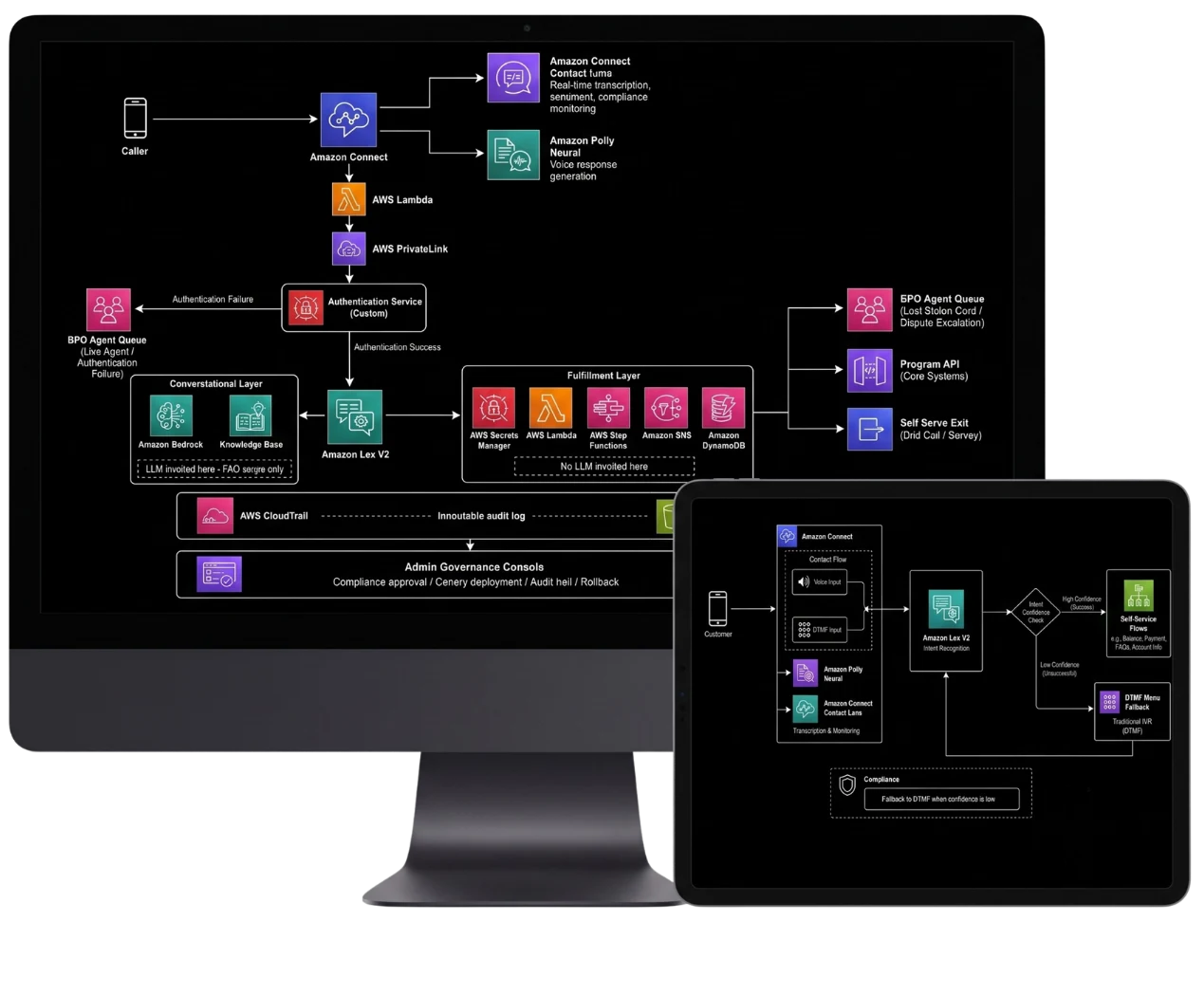
Architecture Overview
Natural Language Front Door on Amazon Connect
Hard LLM Boundary Architecture
Compliance-First Engineering
Program API Integration
Compliance Governance Console
Contact Lens Analytics and Accuracy Monitoring
Enterprise-Grade Architecture & Compliance
Built for highly regulated environments, balancing seamless bilingual experiences with uncompromising data security and strict compliance governance.

Natural Language and DTMF in One Flow
Callers speak or press at any point. Both inputs are handled simultaneously in a single Amazon Connect block with no separate routing logic required.

Bilingual at Full Parity
English and Spanish built natively with separate Lex V2 training sets using real native-speaker utterances, not auto-translated English. Both languages hit the same accuracy targets.

Hard LLM Boundary
Bedrock is scoped to FAQ only. Transactional flows never invoke the LLM. No account data, card number, or authentication credential ever reaches a language model.

PCI DSS Recording Pause
Lambda-triggered recording pause before every card and account number entry, with automated regression testing of this control in every build before deployment.

Regulation E Dispute Timestamping
Dispute contact timestamp written at first IVR touch, not at agent connection. Support ticket created with SLA timer at the moment of intent detection.

UDAAP Governance Workflow
Five-stage compliance approval pipeline with a mandatory written approval record. No unapproved wording can reach production. Full immutable audit trail in CloudTrail and S3.

One-Click Rollback
Any deployment can be reverted across Lex, Bedrock, and Connect prompt layers simultaneously in under five minutes. No code release, no engineering call required.

Real-Time Accuracy Dashboard
Contact Lens-powered weekly reporting on intent recognition rate, correct action rate, and wrong action rate per intent, with a continuous NLU retraining pipeline built in.
Built with Modern Tech
We leverage cutting-edge technologies to build scalable, secure, and high-performance applications that grow with your business.
 Amazon Connect
 Amazon Lex V2
 Amazon Bedrock
 Amazon Polly (Neural)
  AWS Lambda
 AWS Step Functions
 DynamoDB
 Amazon Connect Contact Lens
 AWS Secrets Manager
 AWS PrivateLink
 AWS SNS
 AWS CloudTrail
 AWS S3
 AWS S3
Measurable Results
Real outcomes that transformed our client's operations and delivered significant ROI.

Call Automation
Eligible call volume successfully automated through secure self-service, covering card services and FAQs without agent involvement.

Intent Accuracy
Intent recognition accuracy target successfully met against a 500-utterance golden test set covering both English and Spanish.

Response Time
Target IVR response time achieved for all self-service flows, strictly validated by load testing at 3 times the average peak volume.

Time to Market
Delivered full production from kickoff, establishing the natural language front door and all bilingual transactional operations.

Deployment SLA
Time required to move from compliance officer approval to 100% live deployment, including the canary monitoring window.

Rollback Speed
Full system rollback SLA met across all service layers without requiring any code change or engineering involvement.

Bilingual Delivery
Delivered English and Spanish at full parity from day one, complete with bilingual compliance controls and prompts.

LLM Data Exposure
Absolute architectural enforcement guaranteeing sensitive data, including card numbers and dates of birth, never reached the LLM.
Project Delivery Approach
A proven methodology that ensures quality delivery, on time and on budget.
Weeks 1-2: Discovery and Compliance Mapping
Reviewed the existing IVR script, call volume data by intent, and the three regulatory obligations governing the system. Established a 500-utterance golden test set in English and Spanish. Confirmed Program API sandbox access and resolved the IVR authentication service architecture question that had blocked earlier attempts.

Weeks 3-4: Architecture Design and LLM Boundary Definition
Designed the Amazon Connect Contact Flow structure, defined the hard LLM boundary between FAQ and transactional flows, and mapped every PCI DSS, Reg E, and UDAAP control to a specific technical implementation. Reviewed the full architecture with the client's compliance and IT security teams before any build work began.

Weeks 5-8: Core Build, Connect, Lex, and Bilingual NLU
Built the Amazon Connect Contact Flows, trained the Amazon Lex V2 bilingual model with native-speaker Spanish utterances, and developed the authentication Lambda. Ran the full golden test set at the end of this phase. English accuracy reached 93%. Spanish accuracy at 77%, on track for target.

Weeks 9-11: Fulfillment Layer, Lambda, and Compliance Controls
Built fulfillment Lambda functions and Step Functions workflows for all Phase 1 operations. Integrated the Program API. Implemented PCI recording pause with automated regression testing. Implemented Reg E dispute timestamping and support system integration. Loaded the Bedrock Knowledge Base with content reviewed and approved by the client's compliance team.

Weeks 12-13: Governance Console and Audit Trail
Delivered the browser-based compliance governance console with the five-stage approval workflow. Built the immutable audit trail backed by CloudTrail and S3. Trained operations and compliance staff on the admin console. Ran an end-to-end governance test: draft to approval to canary to live to rollback, all verified by the client's compliance officer.

Weeks 14-15: UAT, Soft Launch, and Load Testing
Two weeks of structured UAT on test phone numbers covering every call category in both languages. Soft launch on a subset of real calls with manual review of all incomplete flows. Load test at 3× average peak volume. All three accuracy targets met before full go-live was approved.

Weeks 16-20: Full Go-Live and Hypercare
Full production rollout with 24/7 monitoring for the first two weeks. Spanish accuracy reached 85% by Week 18 as live call data improved the model. Handed over the NLU retraining playbook and monthly accuracy review process to the client's operations team.
