Build Custom GPT Models Tailored to Your Business
At Seaflux, we help enterprises fine-tune and deploy GPT models as enterprise generative AI solutions delivering smarter, brand-aligned, context-aware outcomes Generative AI Solutions service delivery, we ensure you only pay for what truly drives value.
Why Custom GPT Models Matters Now
Unlock the true potential of Generative AI with custom GPT models built for your domain and data.
Generic AI models are powerful but not personalized. Private GPT models understand your industry, data, and customer tone, offering control, privacy, and compliance, while custom GPTs deliver accuracy and competitive advantage.
Our Custom GPT Expertise

Fine-tuning OpenAI GPT-4, Anthropic Claude, and open-source LLMs (Llama 3, Mistral, Falcon)
Domain-specific GPT model training for finance, healthcare, retail, and logistics
RAG (Retrieval-Augmented Generation) for private knowledge integration
Enterprise-grade data pipeline setup for secure model training
AI Agent Development Services for workflow automation and intelligent assistants
Custom GPT-based API and app development with fine-tuned GPT capabilities
On-premise and cloud deployment with full governance and security
Our Custom GPT Model Services
Why Choose Seaflux for Custom GPT Development?
We deliver AI models that speak your business language — not generic answers.
How We Work: Our GPT Customization Framework
Partner with an expert team experienced in scalable architecture, data privacy, and compliance-first delivery. Seaflux empowers you to scale rapidly
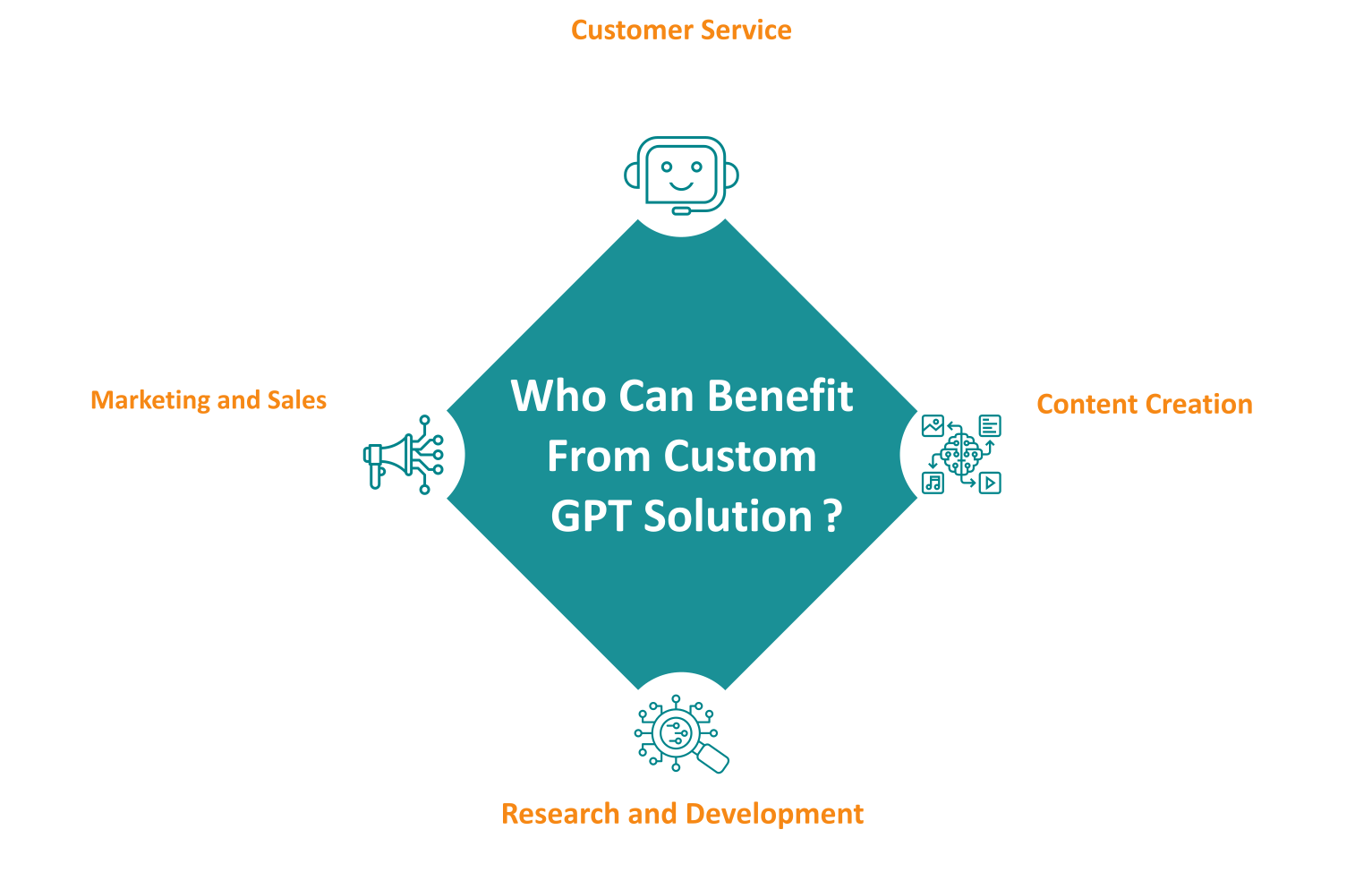
Identify business objectives and relevant datasets.Choose the optimal GPT architecture and fine-tune for accuracy.Deploy securely with APIs, apps, or private infrastructure.Monitor usage, performance, and accuracy.Update models with new data and feedback loops.Who Can Benefit from Custom GPT Solutions?
Our Business Model


Technology Stack


Our Clients
We understand that your success is our success, and that's why we are dedicated to providing you with top-quality service and software solutions.

Your GPT. Your Data. Your Competitive Edge.
Empower your teams with GPT models that understand your domain, data, and business goals. Discover how Seaflux can build a GPT tailored for your success.
Connect With Us
Frequently Asked Questions (FAQ): Get the Answers You Need
What types of AI solutions does Seaflux build for enterprises?
Seaflux builds custom AI solutions across six categories: predictive analytics and ML models for forecasting and anomaly detection; generative AI and LLM integrations using OpenAI, Anthropic, Gemini, and Mistral; conversational AI chatbots and voice assistants; computer vision systems for image recognition and quality inspection; NLP for document intelligence and sentiment analysis; and AI agents for end-to-end workflow automation. All solutions are production-grade, cloud-native, and built with responsible AI principles not proof-of-concept demos.
How does Seaflux approach AI implementation for enterprise clients?
Seaflux follows a five-stage process: Discovery and Strategy (defining the AI use case, assessing data readiness, and modelling ROI before writing a line of code); Data Preparation (cleaning, structuring, and engineering features); Model Development and Testing (building, tuning, and validating the model against business KPIs); MLOps and Deployment (automating the pipeline and releasing to production); and Monitoring and Optimisation (tracking model performance and retraining as needed). This means every engagement starts with business outcomes, not technology choices.
Can Seaflux integrate LLMs like ChatGPT or Claude into our existing systems?
Yes, LLM integration is one of our fastest-growing services. Seaflux integrates OpenAI GPT models, Anthropic Claude, Google Gemini, and open-source models via LiteLLM (an API gateway that lets you switch between providers without rewriting your application). We build RAG (Retrieval-Augmented Generation) pipelines to ground LLM responses in your own data, implement prompt engineering for your workflows, and deploy everything with production-grade monitoring and cost controls. Integrations connect to your existing databases, APIs, and enterprise systems.
How do you ensure AI models are accurate, unbiased, and compliant?
Seaflux applies responsible AI frameworks at every project stage. Accuracy is validated through rigorous testing against held-out datasets and real-world edge cases before deployment. Bias detection uses statistical fairness checks across demographic and feature groups. Explainability is built in using techniques like SHAP values and LIME so model decisions can be audited and explained to regulators or stakeholders. For regulated industries like fintech and healthcare, we map AI outputs to specific compliance requirements from the design stage.
What is the difference between a custom AI solution and using an off-the-shelf AI tool?
Off-the-shelf AI tools are fast to deploy but trained on generic data, they can't learn your specific customer behaviour, product catalogue, pricing logic, or operational constraints. Custom AI models are trained on your data, optimised for your KPIs, and integrated into your systems and workflows. Seaflux helps you choose the right approach: we often combine both, using a commercial LLM as a foundation and fine-tuning or augmenting it with your proprietary data to get the speed of an off-the-shelf tool with the accuracy of a custom model.
Which industries has Seaflux built AI solutions for?
Seaflux has delivered AI solutions across fintech (fraud detection, algorithmic trading, credit risk), healthcare (diagnostic AI, patient monitoring, insurance automation), retail and e-commerce (demand forecasting, recommendation engines, supply chain optimisation), logistics (route optimisation, ETA prediction), and real estate (valuation models, document intelligence). Our cross-industry experience means we bring proven patterns from adjacent sectors rather than solving each problem from scratch.
How can AI help improve business operations?
AI helps organizations automate workflows, improve customer experiences, enhance decision-making, reduce operational costs, detect anomalies, and generate business insights from large-scale data.
Which AI technologies and frameworks do you work with?
Our team works with OpenAI, Anthropic, Gemini, LangChain, LlamaIndex, TensorFlow, PyTorch, Hugging Face, vector databases, Kubernetes, and cloud AI platforms.