AI in Finance: Transforming Risk Management and Fraud Detection
Artificial Intelligence (AI) is transforming the financial services industry, changing how institutions operate and engage with customers. By analyzing vast amounts of data quickly and accurately, AI enhances decision-making, improves customer experiences, and reduces risks.
Investment in AI financial services is booming, projected to increase from $35 billion in 2023 to $97 billion by 2027, reflecting a 29% compound annual growth rate. This surge highlights the growing recognition of AI's ability to deliver significant value to financial institutions.
Recent innovations, such as JPMorgan Chase’s advanced AI assistant and Morgan Stanley’s meeting summarization tool, showcase the practical applications of AI in finance. These developments signal a future where intelligent systems will play a crucial role in driving efficiency and growth in the financial sector.

Current State of AI in Financial Services
The adoption of Artificial Intelligence in finance is rapidly growing, enhancing operations and customer experiences. Key AI applications in financial services include:
- Risk Assessment: AI helps banks analyze data for informed lending and effective portfolio management.
- Fraud Detection: AI systems, including fraud detection AI, identify suspicious activities in real time, protecting customers and saving millions.
- Customer Service: AI chatbots provide instant responses, with tools like Morgan Stanley’s meeting summarization improving communication.
Seaflux has covered several of these applications in depth, including AI-powered fraud detection and AI-driven credit scoring for lending platforms.
JPMorgan Chase's LLM Suite also leverages advanced language models to enhance operations and offers AI solutions for financial institutions.
Overall, the rise of AI in financial services demonstrates a strong commitment to using technology for better performance and customer satisfaction.
Projected Growth and Investment
The financial services sector is set to boost its Artificial Intelligence in finance investments from $35 billion in 2023 to $97 billion by 2027, marking a 29% CAGR. This growth not only provides a competitive advantage by streamlining operations and enhancing decision-making but also improves the customer experience through personalized services and faster support.
In summary, the projected rise in AI spending signifies a transformative shift in AI financial services, leading to greater efficiency and stronger customer engagement.
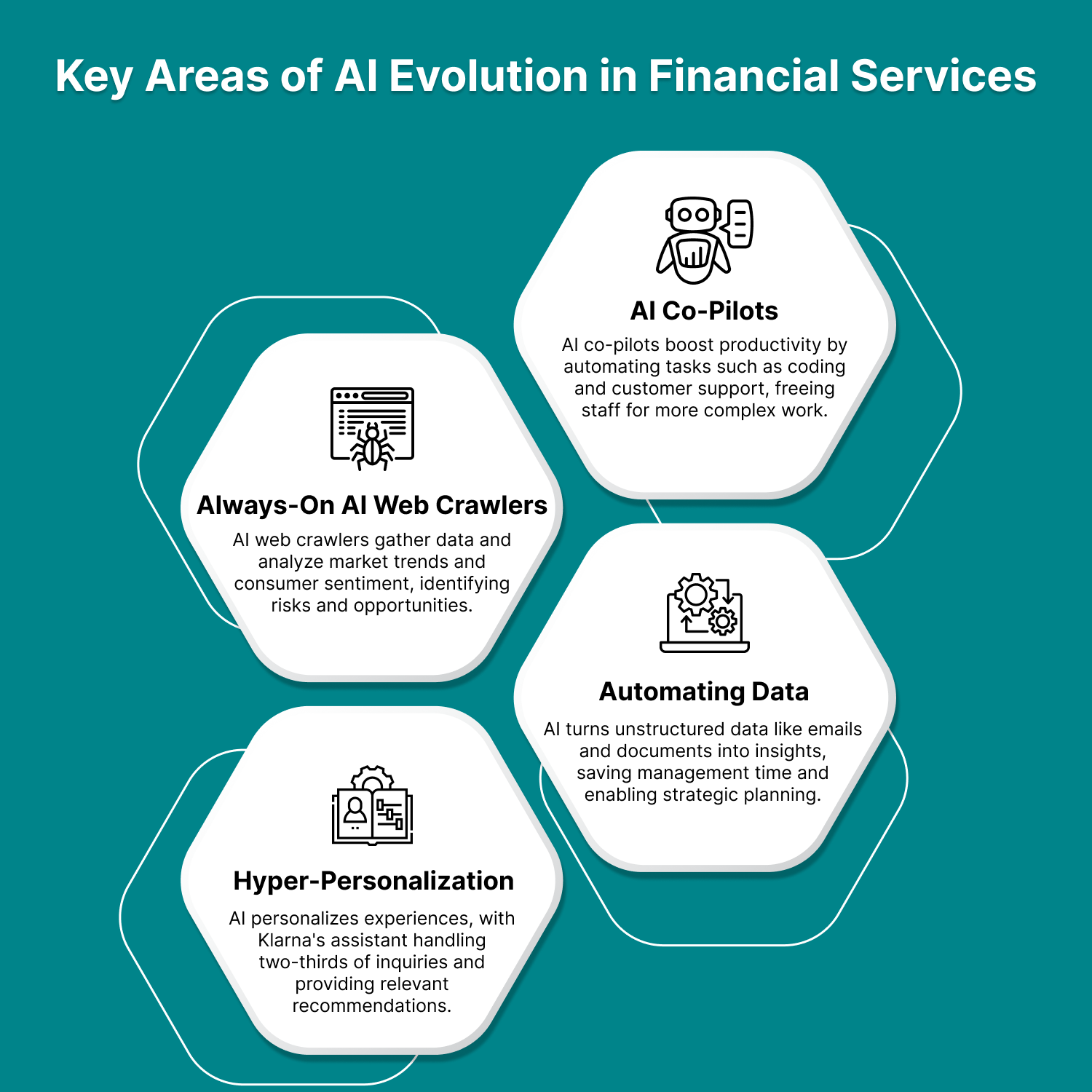
Key Areas of AI Evolution in Financial Services
Future Applications of AI in Risk Management
AI is set to transform risk management in financial services, particularly through synthetic data. This data, generated by AI algorithms, mimics real-world data without compromising sensitive information, enhancing predictive modeling and fraud detection.
One major advantage of synthetic data is its ability to improve predictive models. By offering diverse datasets, it helps institutions test various scenarios and refine their algorithms, leading to more accurate forecasts.
Additionally, synthetic data strengthens fraud detection AI. With a robust dataset, AI can identify patterns and anomalies indicating fraudulent activity, allowing for quicker responses to potential threats and safeguarding customer trust.
As AI adoption in banking grows, integrating synthetic data into risk management will become essential for enhancing accuracy and efficiency in the financial services industry.
For a broader look at how AI is reshaping the fintech industry beyond risk management, see our guide on AI in fintech use cases.
The Role of Fintechs in Democratizing AI
Fintech companies are at the forefront of using AI to innovate and transform financial services, enhancing efficiency and improving customer experiences.
For example, Klarna uses AI to create personalized shopping experiences, with its assistant handling two-thirds of customer interactions, boosting satisfaction and reducing response times. Deriskly offers AI-driven compliance solutions, helping institutions navigate complex regulations efficiently.
Fintechs also make AI accessible to smaller institutions that lack resources to develop their own capabilities. By providing scalable solutions like AI-powered chatbots and data analytics platforms, they enable smaller players to compete with larger banks. This democratization of AI allows institutions of all sizes to leverage technology, driving innovation in the financial sector.
As fintechs continue to evolve, their influence will ensure that AI benefits a broader range of institutions and customers.
For more insights into how fintech solutions are transforming the landscape, visit Seaflux's Fintech Solutions page.
How Seaflux Helps Financial Institutions Build AI-Powered Risk Management
- AI & Machine Learning Development: Custom fraud detection and credit risk models built for your institution's specific data and regulatory environment. Learn more
- Data Engineering Services: Robust data pipelines that feed accurate, real-time data into your AI risk models. Learn more
- Cloud Computing Services: Secure, compliant cloud infrastructure for financial institutions running AI at scale. Learn more
End Note
AI is poised to revolutionize the financial services industry, enhancing efficiency, improving customer experiences, and strengthening risk management. As institutions adopt AI financial services technologies, they can streamline operations, personalize services, and extract valuable insights from data.
These advancements present exciting implications for the future of banking, reshaping how we interact with financial products. It’s crucial for both consumers and industry professionals to stay informed about these changes, as they will significantly influence financial decisions.
Stay updated on the latest AI trends to make informed choices in an evolving financial landscape.
Frequently Asked Questions (FAQ): Get the Answers You Need
How is AI used in financial risk management?
AI improves risk management through real-time fraud detection, predictive credit risk scoring, and synthetic data generation for stress-testing models, allowing institutions to identify and respond to risk faster than traditional methods.
What is synthetic data and why does it matter for risk management?
Synthetic data is AI-generated data that mimics real-world patterns without exposing sensitive customer information. It helps institutions test risk models against a wider range of scenarios without compromising data privacy.
Can smaller financial institutions afford to implement AI for risk management?
Yes. Fintech providers now offer scalable, AI-powered risk and fraud detection tools that smaller institutions can adopt without building AI capabilities in-house, leveling the playing field with larger banks.
How much are financial institutions investing in AI?
Global AI investment in financial services is projected to grow from $35 billion in 2023 to $97 billion by 2027, a 29% compound annual growth rate.
What are the biggest risks of using AI in financial risk management?
Key challenges include data quality issues, model transparency (ensuring AI decisions can be explained to regulators), and evolving compliance requirements around AI use in regulated industries.

Krunal Bhimani
Business Development Executive