How to Build a Multi-Tenant SaaS Platform the Right Way (2026 Guide)
You don’t feel the weight of multi-tenancy on day one.
You feel it later when your product starts behaving differently for different customers.
One client wants data residency. Another needs custom workflows. A third demands strict audit trails. Suddenly, what looked like a clean system becomes a patchwork of exceptions.
At that point, architecture stops being invisible. It becomes the constraint. And multi-tenancy, especially in a multi-tenant architecture, is usually where that constraint shows up first, often revealing gaps in multi-tenant architecture best practices.
Start with Reality not Theory
Every SaaS founder imagines scale. Few design for the mess that comes with it.
Tenants do not grow uniformly. Usage patterns diverge. Enterprise clients stretch your system in ways early users never did. So the question is not how to support multiple tenants. It is how to support them without breaking everything else.
That’s the transformation behind Multi-tenant SaaS architecture and a thoughtful multi-tenant database design, and a scalable multi-tenant system design.
The Trade-off you make before Writing Code
Before picking a multi-tenant database model or cloud provider, there is a more uncomfortable question tied closely to your multi-tenant database design.
Do you want control or efficiency or simplicity? Because you rarely get all three.
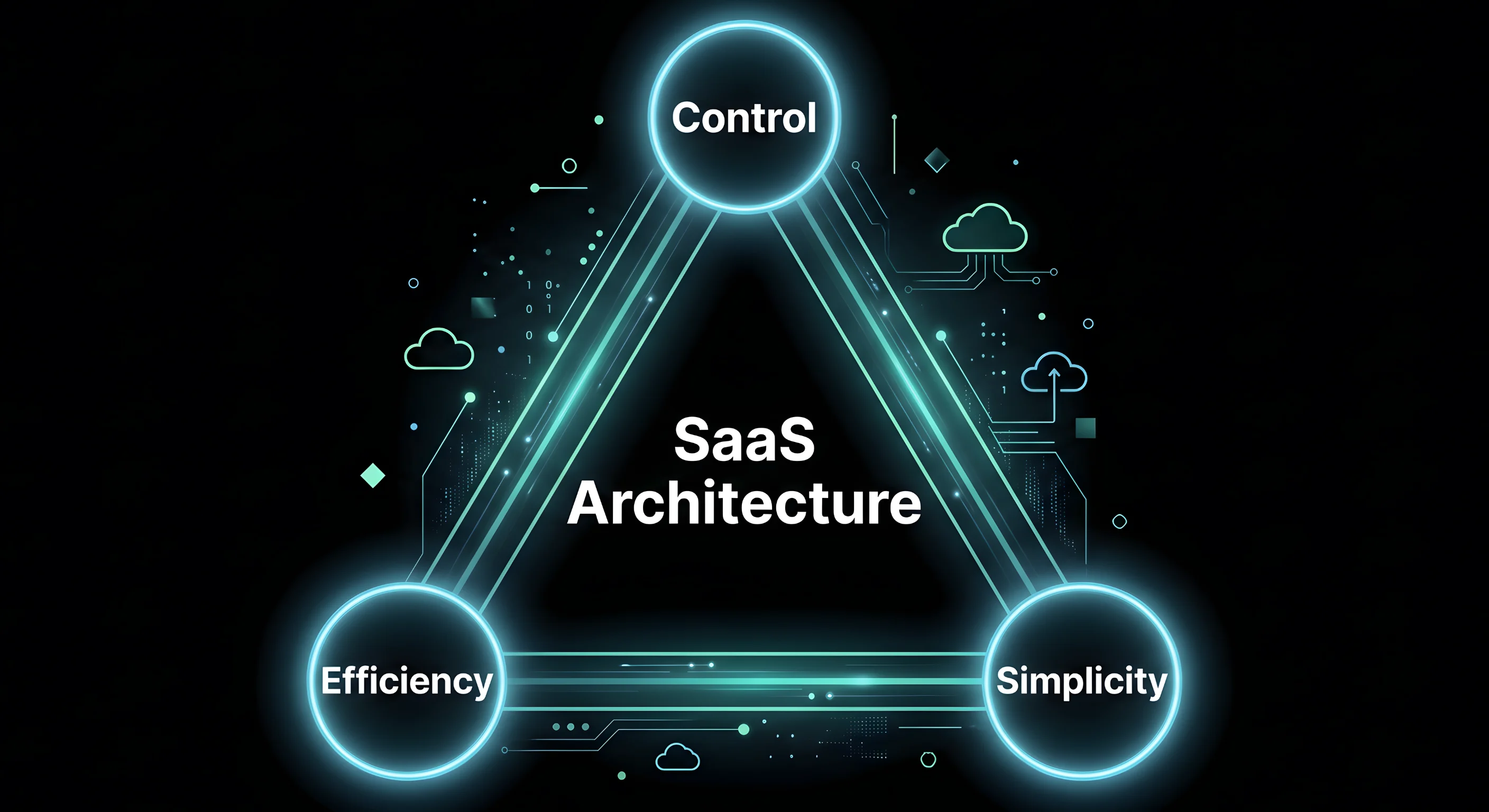
Maximum control → higher cost and complexity
Maximum efficiency → tighter constraints and stricter discipline
Maximum simplicity → limited flexibility later
Most teams do not consciously choose. They default to what’s easiest to ship. That decision quietly compounds, often becoming visible only when scale introduces edge cases, performance pressure and unexpected architectural limitations in a multi-tenant SaaS architecture.
Where Systems actually Diverge
Multi-tenancy becomes real the moment you decide how tenants exist inside your system and not conceptually, but physically within your multi-tenant architecture.
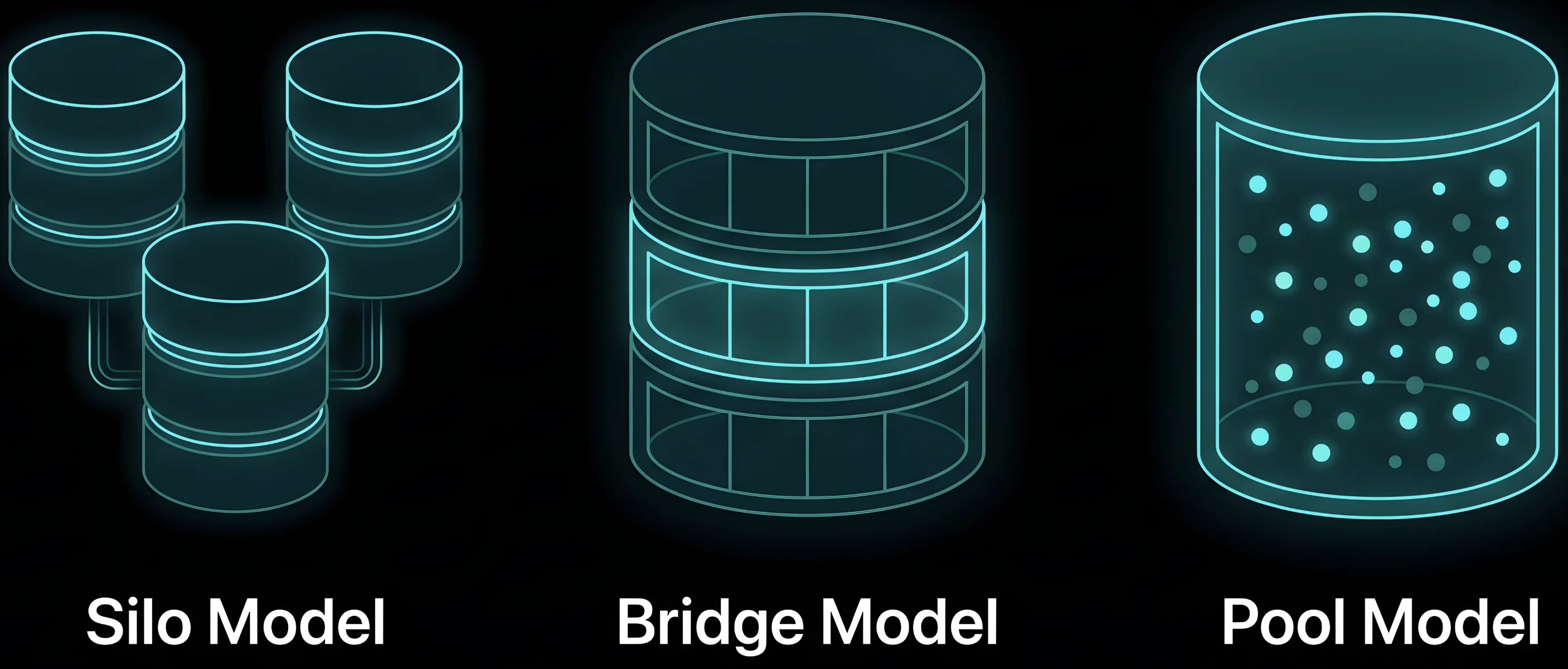
Silo model
Each tenant lives in its own database.
This works well when isolation and compliance matter and closely resembles the single-tenant side of multi-tenant vs single-tenant architecture. It is easy to reason about, easy to secure and easy to explain to enterprise clients.
But scale changes the equation. Every schema update, every migration, every backup multiplies. What starts as clarity turns into operational weight.
- Strongest data isolation by design
- Simplified compliance and audit requirements
- High operational overhead as tenants grow
Bridge model
A shared database with separate schemas.
This gives you a middle ground. Some isolation without full duplication. It allows tenant-level separation while keeping infrastructure relatively controlled within a multi-tenant SaaS architecture.
Over time, though, schema management becomes a layer of complexity on its own. Versioning and migrations require coordination and cross-tenant operations become less straightforward, highlighting the need for strong multi-tenant architecture best practices.
- Balanced approach between isolation and efficiency
- Easier infrastructure management compared to silo model
- Schema evolution becomes increasingly complex at scale
Pool model
All tenants share the same database and schema, separated logically.
This is where efficiency peaks in a multi-tenant architecture. Infrastructure is leaner and scaling becomes more predictable. But the burden shifts to discipline. Every query must enforce isolation. Every service must be tenant-aware. There’s no margin for mistakes in a shared multi-tenant SaaS platform.
- Maximum resource efficiency and cost optimization
- Simplified scaling and infrastructure footprint
- Requires strict enforcement of tenant-level security rules
Designing for Change not Permanence
The mistake is not choosing the wrong model. It is assuming you will never need to change it.
Teams that succeed in building scalable SaaS do not treat architecture as fixed. They design for movement within their multi-tenant SaaS architecture. They start with what makes sense early but create abstraction layers that allow evolution later. Because growth does not just increase usage. It introduces new constraints.
These constraints often come from real-world usage patterns and not initial assumptions made during system design.
Isolation as a System Behavior
Tenant isolation is often treated as a database concern. In reality, it is a system-wide behavior that complements your multi-tenant database design.
A request should carry tenant context from the moment it enters the system until the final response is delivered. That includes authentication, API handling, background jobs, caching and even logs across the entire multi-tenant SaaS platform.

Strong systems do not rely on assumptions here. They enforce boundaries structurally by making sure that no layer operates without tenant awareness, which is a core part of effective multi-tenant system design and is often reinforced with row level isolation at the data layer. This also ensures debugging clarity and predictable behavior under load. Plus, it even reduces the risk of accidental cross-tenant data leakage in distributed environments.
Cloud changes Expectations
Modern cloud-native SaaS infrastructure removes many limitations. But replaces them with expectations around automation within a multi-tenant SaaS architecture.
Provisioning tenants manually does not scale. It creates delays and operational dependencies.
In a mature system, tenant onboarding happens automatically. Access is configured, resources are allocated and system-level controls are applied without manual intervention. That is not an enhancement. It is the baseline for systems that need to grow without friction.
Cost is decided Early
Cloud cost is often treated as something to optimise later. But in fact, cost is a direct outcome of architectural decisions made early, especially when choosing between multi-tenant vs single-tenant architecture.
A poorly designed system increases cost with every new tenant. A well-structured one improves efficiency as it scales.
This is what defines sustainable SaaS platform development 2026, not just scaling usage, but doing it without linear cost growth.
The Problem of Uneven Usage
In shared environments, not all tenants behave the same. Some generate more traffic. Some run heavier workloads. Some create sudden spikes.
When the system does not account for this, performance becomes inconsistent. Not broken, but unpredictable.
Preventing this requires built-in controls like resource limits, workload balancing and prioritisation mechanisms. These are not optimisations. They are safeguards that support strong SaaS tenant isolation strategies.
Where Microservices genuinely Help
Microservices are often seen as the default path to scalability. They do help but only when used intentionally, especially in the context of multi-tenant microservices.
They allow parts of the system to scale independently and reduce the impact of failures. But they also introduce communication overhead and operational complexity.
The real value comes from isolating what needs to scale differently. Everything else can remain simpler.
Security cannot be Retrofitted
Security decisions do not age well when delayed.
In multi-tenant systems, the risk is exposure. But along with that it is exposure across tenants. And that’s significantly more damaging.
Strong systems enforce tenant boundaries at every layer. Access is controlled, APIs are scoped and actions are traceable.
More importantly, they are designed with the assumption that mistakes can happen and limit the blast radius when they do.
Building beyond Current Use Cases
Many systems are designed around initial users. But SaaS products evolve in predictable ways.
Pricing becomes layered. Features become tiered. Enterprise clients introduce new constraints. Regional requirements begin to matter.
If the architecture does not support this evolution, growth turns into friction. This is where Product Engineering matters within a multi-tenant architecture. Not just building what works now, but anticipating what will be required later.
What matters at Scale
What matters is… not the stack. Not the tools.
What matters is whether the system can grow without resistance, especially when built using multi-tenant microservices.
Can you onboard new tenants without slowing down operations
Can you ensure isolation without increasing complexity
Can you scale usage without degrading performance
Can you adapt to new requirements without rewriting the system
If the answer to these stays consistent, the architecture is doing its job.
The Bottom Line
Multi-tenancy is not something you add later. It is something that quietly defines how far your product can go.
Most systems do not break because they cannot handle scale. They break because they were not designed to handle variation.
And in SaaS, variation is inevitable.
This is where thoughtful product engineering and scalable infrastructure design, often powered by multi-tenant microservices, quietly separate systems that grow… from systems that stall.
Build it Right from the Start
As a cloud computing services provider, we help teams build scalable systems with the right foundation. From custom software development services to SaaS development services, we focus on creating reliable and future-ready products.
If you're looking for a saas application development company or need custom cloud solutions, we can help you design systems that scale without friction.

Murtuza Rampurwala
Director of Sales and Marketing