
A surprising number of startups are making the same infrastructure mistake in Kubernetes in 2026 discussions.
Before validating their product… before acquiring real users… even before their first scale problem appears… they build an extremely complex cloud stack. Kubernetes clusters. Multi-region failover. Service meshes. Autoscaling policies.
It looks strong when written down.
The team spends more hours on infrastructure. Instead of focusing on building the product.
This raises an important question. This question is asked by many CTOs and founders.
Is Kubernetes the right choice in 2026? Or has cloud infrastructure evolved beyond it?
It is not a question with a simple “yes” or “no.” Kubernetes is still an important part of enterprise cloud and modern container orchestration ecosystems. The challenge is in deciding that when and where it should be applied.
Startups and mid-size companies are planning their cloud upgrades. Early infrastructure choices determine speed‑to‑market. And strongly influence long-term Cloud modernization ROI as well as scalability over time.
Let’s break down the real role Kubernetes plays in modern cloud architecture today and understand when to use Kubernetes as organizations grow.
Kubernetes has supported cloud-native systems for close to ten years and has become a key component of modern cloud-native infrastructure.
Organizations struggled with the shift. Shift from from monoliths to microservices. Kubernetes helped solve that challenge.
Companies needed a way to:
A unified container orchestration layer was introduced by Kubernetes. It could manage thousands of containers across distributed systems. It helped organizations build systems that grow with demand.
For large enterprises and technology platforms, Kubernetes enabled:
Even in Kubernetes in 2026, it continues to run many of the biggest digital platforms in the world.
Large‑enterprise practices often prove effective. But they do not always fit early‑stage or mid‑scale firms.
Kubernetes gives teams a lot of flexibility. But it also makes operations more complex.
For startups still validating their product, that complexity often becomes a distraction. Many founders exploring Kubernetes for startup infrastructure realize that adopting it too early can slow down development instead of accelerating it.
Running Kubernetes effectively requires expertise in:
Managed Kubernetes does not remove all responsibilities. Teams must still ensure cluster health, workload optimization and performance troubleshooting inside their cloud-native infrastructure environments.
For early-stage companies, this can create unnecessary overhead.
Teams should be building products and growing customers. But they often get stuck managing infrastructure.
That’s why founders are questioning Kubernetes for early startups. They do not want to bring it in too soon. Especially when managed cloud services for startups and early cloud modernization services can help teams launch. If you're just getting started with containerization, a lighter approach like Docker for startups may be a smarter first step before committing to full Kubernetes orchestration.
Cloud infrastructure has changed a lot in some years.
Modern platforms deliver serverless and managed PaaS options. They simplify operations by reducing complexity.
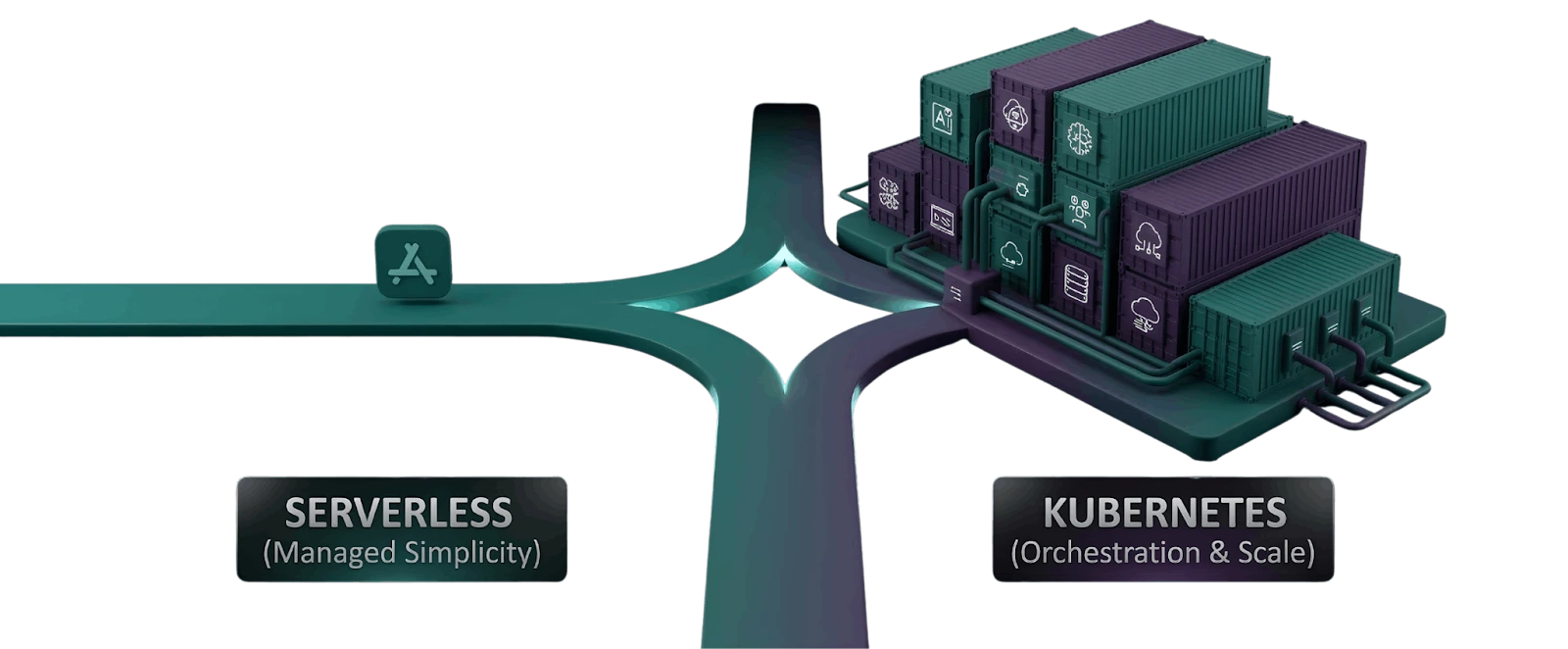
This leads to a common comparison in modern Kubernetes vs Serverless 2026 discussions.
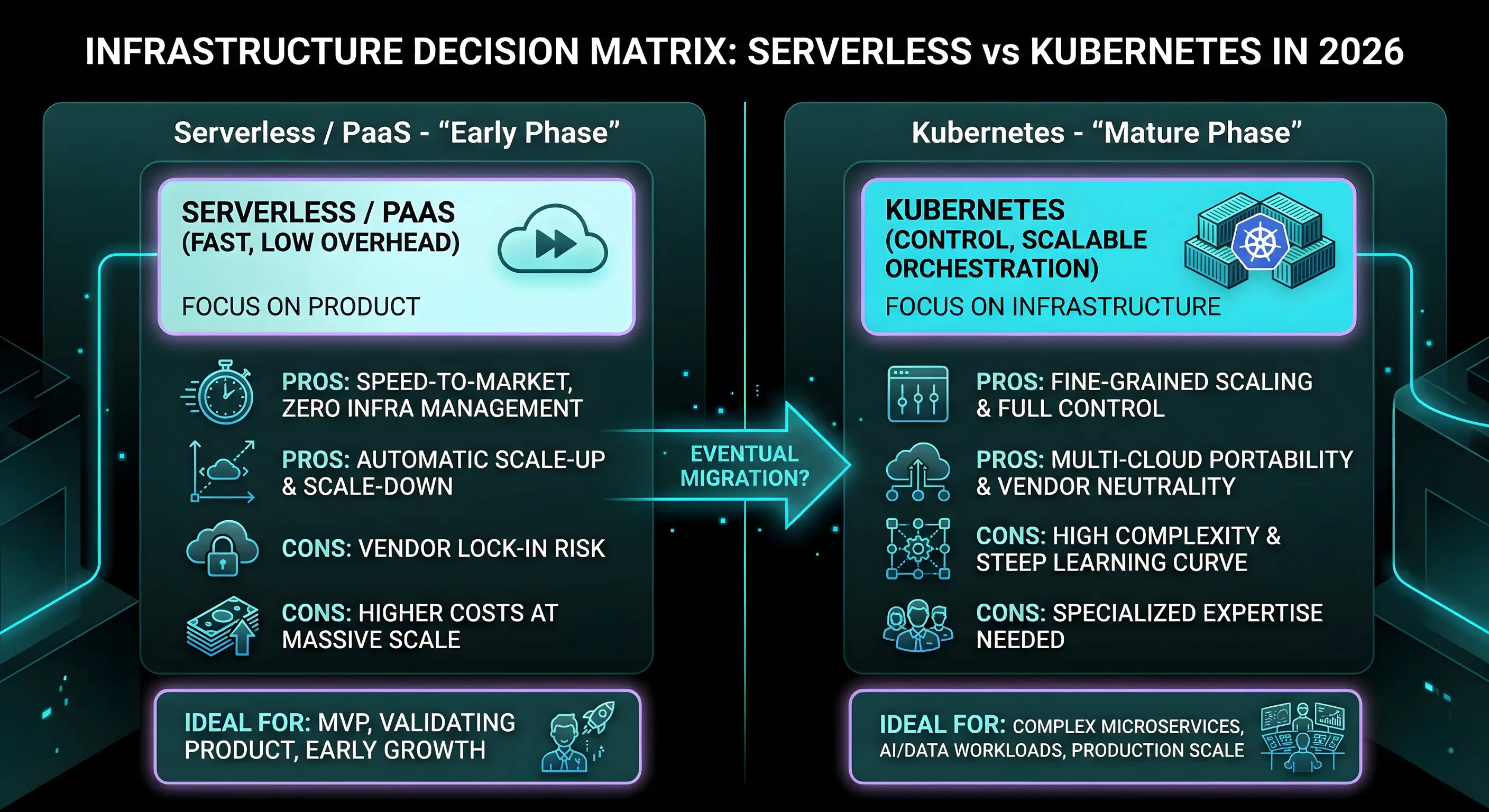
Serverless and managed platform services provide several advantages for early-stage products.
They offer:
Startups testing new ideas often use this approach. It helps them move faster in development.
Engineers get to focus on the product. Without worrying about the infrastructure.
However, serverless platforms also introduce potential trade-offs:
For companies that eventually grow into complex platforms, these limitations can become significant in the broader kubernetes vs serverless infrastructure decision. It's also worth exploring vertical cloud solutions as an alternative path, purpose-built cloud platforms that deliver compliance and industry-specific capabilities without requiring you to configure everything from scratch.
Kubernetes is on the other side of the spectrum.
It needs more know-how. Yet gives you more flexibility in infrastructure management and container orchestration.
Organizations gain:
Kubernetes becomes particularly valuable when running:
For companies planning long-term platform scale, Kubernetes remains one of the most powerful infrastructure foundations available. Many organizations adopt it with support from experienced Kubernetes consulting services to ensure the architecture is implemented correctly.
The key question is timing.
Kubernetes becomes extremely valuable once organizations reach a certain scale or architectural complexity. This stage is often where businesses clearly understand when to use Kubernetes to support growing systems and increasing infrastructure demands.
For many mid-scale enterprises, the platform solves problems that simpler infrastructure cannot handle efficiently.
Kubernetes is typically the right choice when:
Businesses building data platforms or AI‑powered apps usually lean on Kubernetes to run them.
It helps platforms handle heavy compute jobs. And still keeps them reliable and scalable while supporting a scalable cloud architecture.
This is particularly important for organizations investing in cloud-native infrastructure and maturing their DevOps for startup practices as they scale.
Cloud modernization is changing enterprise IT. Kubernetes is becoming a core infrastructure layer.
Older systems were built on virtual machines. Today, they can be redesigned into containerized platforms.
Companies can update their architecture with this approach. While avoiding a full rewrite of existing systems.
Containerization combined with orchestration enables organizations to achieve:
A lot of mid-size companies bring in Kubernetes as part of their cloud journey. It helps them shift into modern infrastructure at their own pace. And keeps operations steady along the way, often guided by specialized kubernetes consulting services.
Kubernetes is still ahead in 2026. Especially when it comes to AI orchestration and Kubernetes for AI workloads.
Artificial intelligence systems require flexible compute orchestration. This includes GPU clusters, batch jobs and scalable inference services.
Kubernetes provides the orchestration layer. It manages these workloads efficiently.
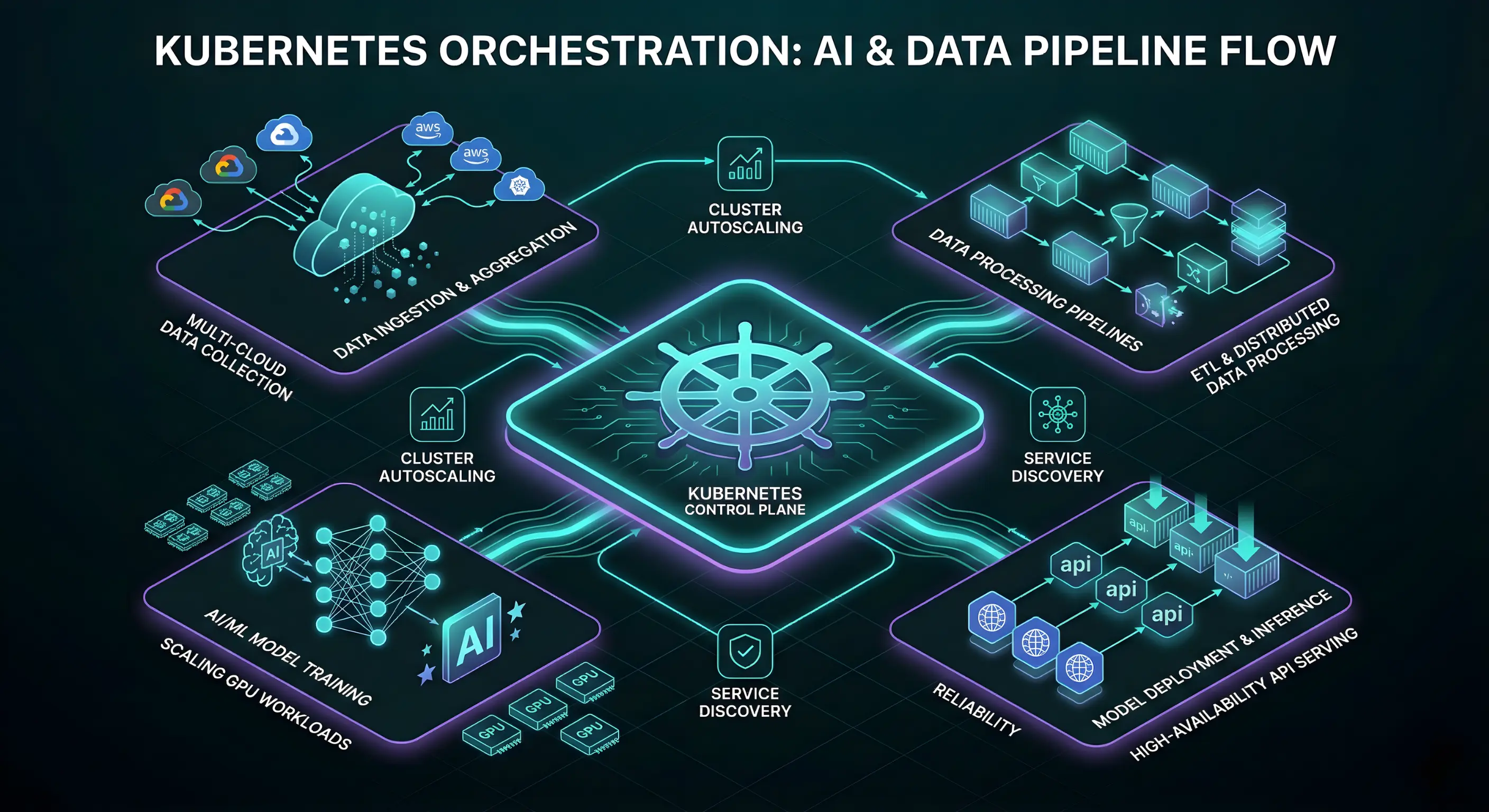
This allows companies building AI-driven platforms to:
AI is reshaping industries everywhere. Kubernetes ensures those workloads scale reliably, which is why many organizations are increasingly investing in Kubernetes for AI workloads.
One of the biggest infrastructure mistakes organizations make is choosing technology based on trends rather than actual business needs.
Startups often adopt Kubernetes too early.
Many big companies postpone cloud upgrades.
The right architecture depends on several factors:
That’s why businesses bring in cloud experts. They help in shaping the right infrastructure and cloud-native infrastructure strategy.
Good architects know where to start. Sometimes it is with serverless platforms. Other times it is straight into Kubernetes for big systems. In many cases, teams also plan a Kubernetes migration strategy early with guidance from Kubernetes implementation services providers.
Early decisions shape long‑term efficiency. It saves you headaches and money down the road.
Scaling today is not only about servers. It requires thoughtful system design that balances speed, cost efficiency and long-term scalability.
Organizations working with experienced cloud teams and cloud modernization services benefit from:
The goal is not simply to deploy Kubernetes.
The goal is to build the right platform architecture for the company’s stage of growth.
For many startups, that may mean starting with serverless platforms before eventually evaluating Kubernetes for startup infrastructure as the product and user base begin to scale.
For mid-scale enterprises, Kubernetes may already be the correct foundation.
The difference lies in choosing the architecture intentionally rather than by default.
The answer is yes.
But only when it is for the right reasons.
Kubernetes is a leading infrastructure solution. It helps organizations design scalable systems and SaaS products. It even provides orchestration for AI based applications and increasingly supports Kubernetes for AI workloads across modern platforms.
It is not always the right place to start. Young companies are still figuring out their products.
The smartest organizations today approach infrastructure strategically. They focus on speed to market early, then adopt more advanced orchestration platforms as their system complexity grows.
When implemented at the right stage, Kubernetes becomes an incredibly powerful foundation for modern enterprise cloud architecture and mature DevOps for startup environments, often supported by reliable Kubernetes implementation services.
The real question for CTOs and founders is not whether Kubernetes is good technology.
The real question is that “Is Kubernetes the right architecture for your product today or is it something your platform should grow into tomorrow?”
Deciding when to transition to Kubernetes requires a strategic partner who understands the balance between speed and scalability. As a premier cloud computing services provider, Seaflux helps organizations navigate these complex architectural decisions. Whether you are looking for a custom software development company to build your next-born-in-the-cloud application or need expert DevOps services to optimize your existing pipelines, our team is here to help. We specialize in designing custom cloud solutions that align with your specific growth stage, ensuring your infrastructure is an asset to your innovation, not a bottleneck.

Business Development Manager