
Most enterprises do not realize that they have a data problem… until their AI starts giving the wrong answers.
Dashboards do not match. Teams argue over numbers. Reports take days instead of minutes. And suddenly, the issue is not analytics anymore but it is architecture, especially within a modern data architecture landscape.
Should your data stay centralized? Or should it be owned by the teams that create it?
That’s where the Data Mesh vs Data Lakehouse 2026 conversation begins.
Most data ecosystems were not designed. They grew, rather than being built as a scalable modern data architecture.
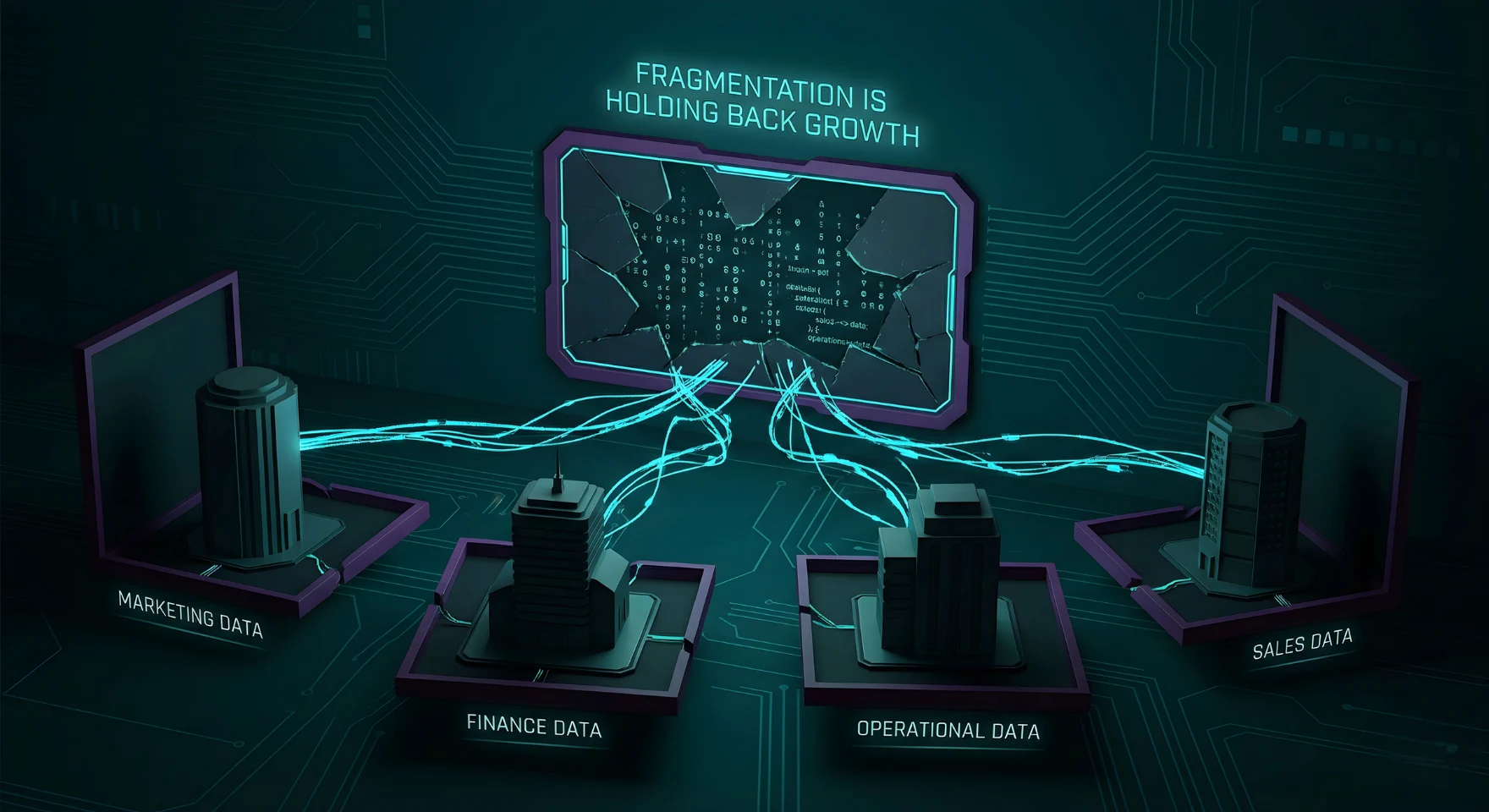
Different teams adopted different tools at different times. Over time, this created disconnected systems where data lives in silos across departments. Marketing dashboards do not align with finance reports. Product analytics does not match operational data.
This fragmentation impacts more than reporting. It affects:
Organizations today are not just looking to fix dashboards. They want to modernize their entire data foundation using cloud data engineering practices. So analytics, automation and growth can grow stronger, which is why understanding data mesh vs data lakehouse early becomes essential.
This is where choosing the right architecture becomes critical.
A Data Lakehouse is a centralized data architecture. This data lakehouse architecture brings together lake flexibility and warehouse control.
It lets enterprises store diverse data formats in one system. Along with ensuring performance, reliability and governance for analytics and reporting, supported by structured data governance models.
In practical terms, it simplifies the modern data stack by unifying:
The biggest advantage of a Lakehouse lies in its ability to create a single and governed data layer within a data lakehouse architecture.
Organizations benefit from:
Data Lakehouse benefits make it highly effective. Especially for companies focused on business intelligence. It helps teams reach insights faster with the support of scalable data engineering solutions.
For many organizations early in their data maturity journey, a Lakehouse becomes the foundation for data democratization and a broader data democratization strategy. It is by enabling business users to access trusted data without relying heavily on engineering teams.
While Lakehouse centralizes data, Data Mesh introduces a fundamentally different approach.
Data Mesh architecture is a decentralized approach where data ownership is distributed across business domains. Each domain treats its data as a product, responsible for its quality, accessibility and governance.
This model is built on decentralized data management by shifting responsibility from a central data team to domain-specific teams, making it ideal for a scalable data architecture at enterprise scale.
Data Mesh suits organizations working at scale. It helps avoid bottlenecks caused by central teams while unlocking key data mesh benefits across the enterprise.
It enables:
Big enterprises with siloed teams need agility. Centralized systems often struggle to keep up, which is a key consideration in the data mesh vs data lakehouse decision.
At a high level, the difference comes down to how data is owned, managed and consumed within a modern data architecture.
Data Lakehouse
A centralized architecture combining the flexibility of data lakes with the management features of data warehouses. It is ideal for unified analytics, reporting and business intelligence use cases, delivering strong data lakehouse benefits for growing enterprises.
Data Mesh
Data is managed as a product within domains. This decentralized model suits large enterprises with complex teams. It is by enabling scale without central slowdowns, supported by distributed data engineering solutions.
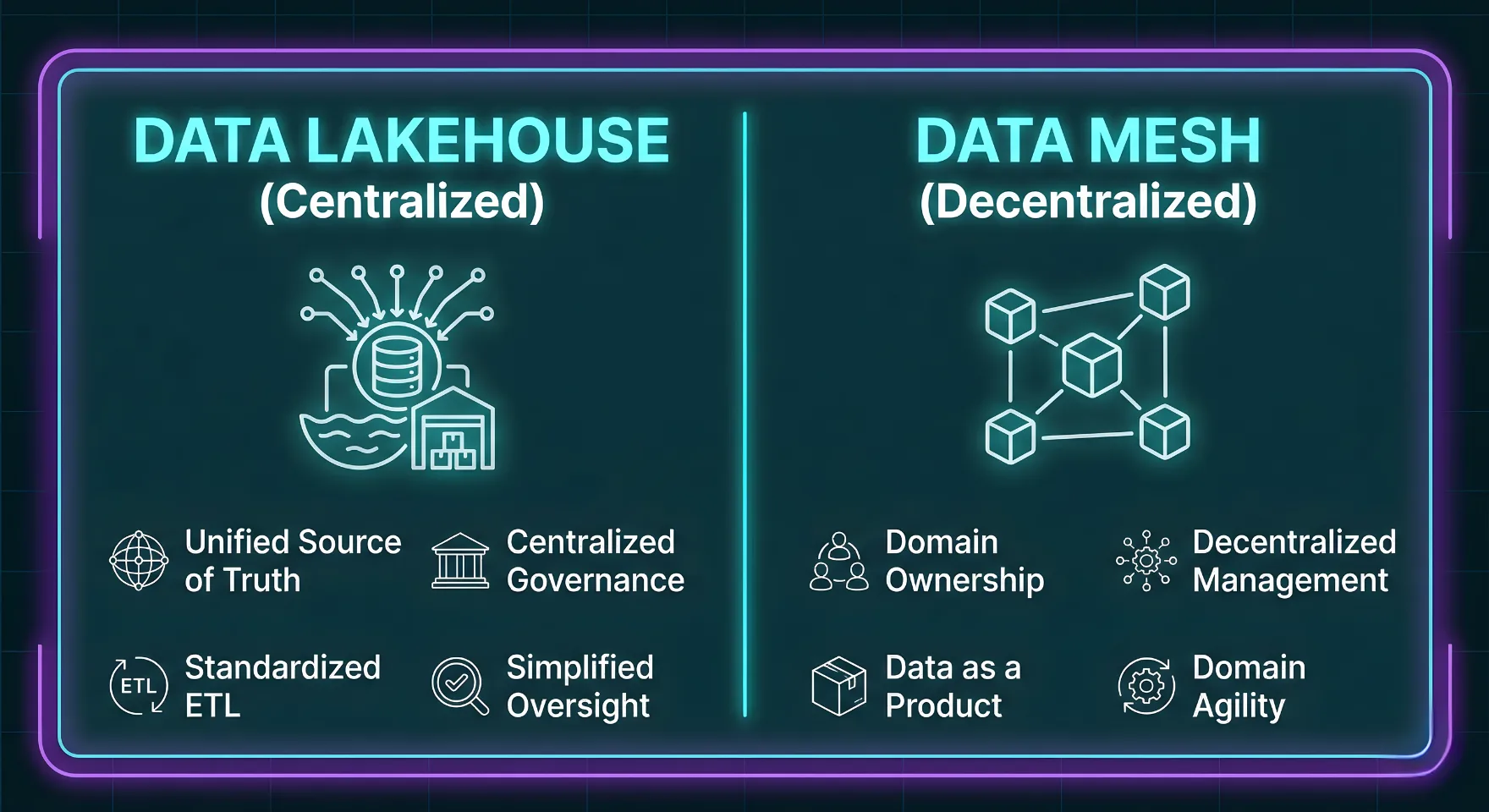
This is not about better or worse. It is about alignment with your organization and future vision, and how well each approach fits into your enterprise data architecture strategy.
Speed is one of the biggest competitive advantages today.
A Data Lakehouse accelerates time-to-insight by providing a centralized platform where analysts and business users can access consistent data quickly.
Data Mesh, or a well-designed data mesh architecture, on the other hand, reduces dependency on central teams by allowing domains to generate insights independently.
Each approach improve speed but in different ways, which is an important factor in data lakehouse vs data mesh evaluations.
Governance that are strong is important. Especially in regulated industries. It cannot be compromised. Lakehouse architectures simplify governance. They do this through centralized control over:
Data Mesh can support governance as well, but it requires standardized policies across domains to maintain consistency, often enforced using cloud data engineering tools and frameworks.
For organizations evaluating data governance models, this becomes a key decision factor in the data lakehouse vs data mesh debate.
Businesses want data open to every team. And not kept only with data specialists.
A Lakehouse opens data to everyone. It does this through shared access layers and BI tools powered by a data lakehouse architecture.
Data Mesh goes a step ahead by embedding data ownership within domains. They make sure that teams not only access data but also understand and manage it effectively.
A real-world example of what happens when data silos are finally broken down can be seen in Seaflux's Finance Automation case study, where automated data ingestion pipelines and unified dashboards led to a 50% reduction in operational costs and a 31% improvement in efficiency for a major European brewing enterprise.
AI initiatives are driving data architecture decisions more than ever before.
To build scalable AI systems, organizations need:
A Lakehouse provides a strong base. It is for training AI models using unified datasets, further demonstrating data lakehouse benefits in AI readiness.
Data Mesh creates domain-specific data products through a data mesh architecture approach. These are especially useful for specialized AI cases. This is what defines AI ready data infrastructure.
Organizations investing in AI Agents Development Services often benefit from combining both approaches to support both centralized training and domain-level intelligence.
In reality, most organizations are not choosing one architecture over the other.
They are combining both.
A common pattern in 2026 looks like:
This hybrid approach allows enterprises to:
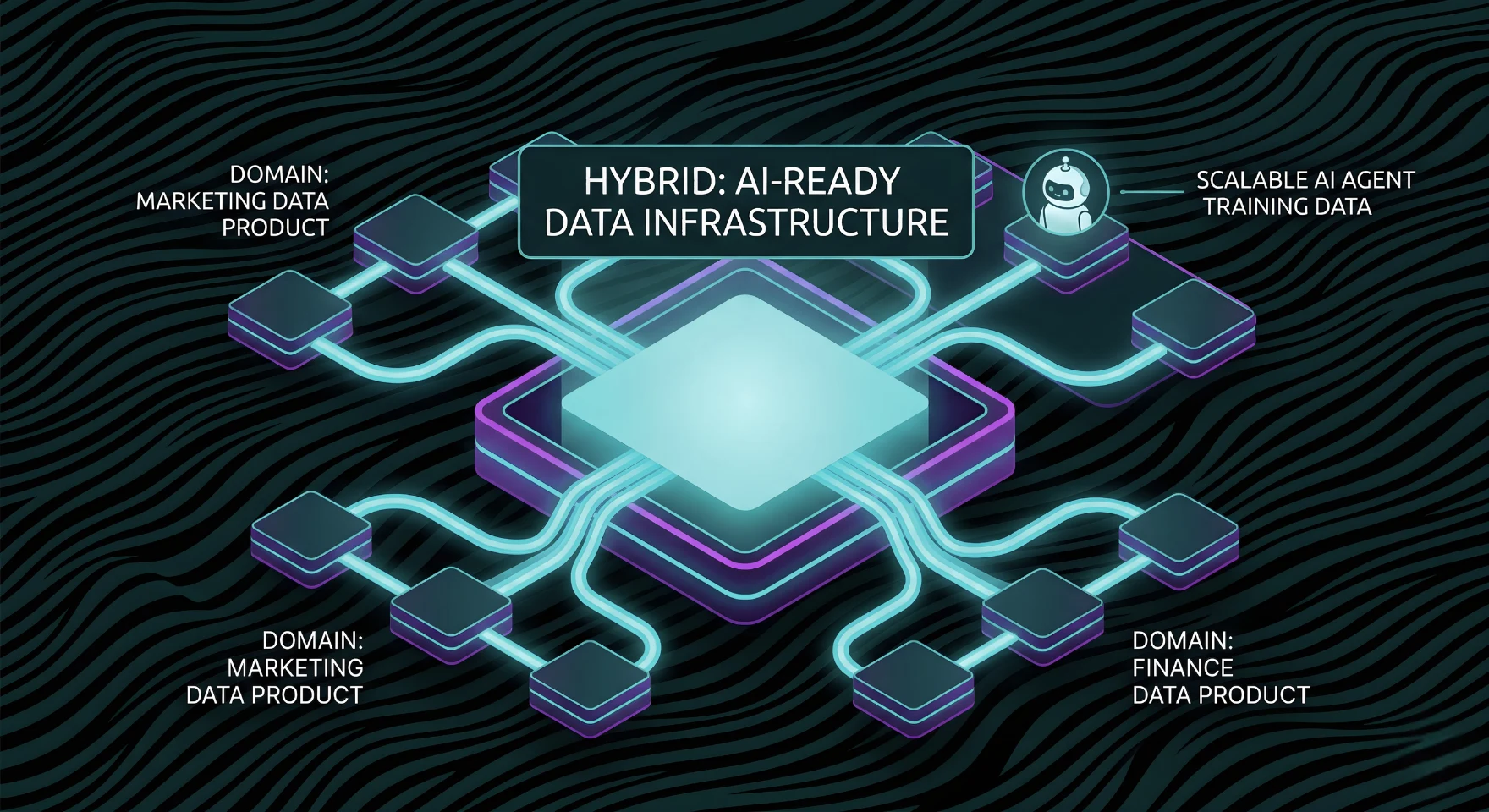
It shows how enterprise data architecture is changing. Now it is flexible, layered and built for business while capturing the best data mesh benefits.
Choosing the wrong architecture is a technical mistake. Along with that it is a business risk.
Incorrect decisions often lead to:
Many organizations underestimate how costly migrations can be. Fixing architecture later is significantly more complex than designing it right from the beginning, especially when evaluating data lakehouse vs data mesh.
That’s why forward-looking companies focus on building scalable foundations early and not just for today, but for future growth.
Building a scalable data system takes more than picking tools. It means aligning the design with business goals, data flows and long‑term needs.
Organizations that partner with experienced teams benefit from:
Capabilities like:
Custom Software Developmentplay a critical role in ensuring the architecture supports both current operations and future innovation, including implementing a robust data lakehouse architecture where needed.
The goal is not just to build a system. It is to build the right system from day one.
If your organization:
A Data Lakehouse is often the right starting point, especially when supported by strong data governance models.
If your organization:
Data Mesh may be the better long-term strategy due to its strong data mesh benefits.
For most enterprises, the solution is hybrid model. A model that grows with the business.
Data architecture is not just for engineers anymore. It is a business decision with real impact on growth and innovation.
This conversation of Data Mesh vs Data Lakehouse is not about trend. It is about enabling:
The real question is not which architecture is better.
It is this:
Is your current data architecture helping your teams move faster, unlock insights and scale AI… or is it quietly becoming the bottleneck holding you back?
Building the right architecture is only half the work, execution is what drives results. A trusted data engineering services company like Seaflux helps turn strategy into scalable, high-performing systems.
With expertise in cloud data engineering and tailored data engineering solutions, they optimize data pipelines, storage, and processing for reliability and growth. Their data analytics and visualization services further enable faster insights and better decision-making.
Whether you are modernizing or scaling, the right partner ensures your data strategy delivers real business impact.

Business Development Executive