How to Build a Real Estate Portal Like Zillow or Rightmove That Actually Scales
The first 5,000 listings feel easy.
The next 50,000 expose everything.
Search starts slowing down. Duplicate listings appear across regions. Maps lag during traffic spikes. Brokers complain about delayed updates. Infrastructure costs suddenly rise faster than user growth.
Most founders assume building a real estate platform, handling real estate portal development, or creating a Zillow clone is mainly a frontend challenge. But it is not.
The real challenge begins underneath the interface. Inside the data pipelines, search infrastructure, image delivery systems and cloud architecture holding everything together.
That’s why large-scale platforms like Zillow or Rightmove are not simply “listing websites.” They are highly optimized data ecosystems designed to process millions of constantly changing records with extremely low latency.
Modern proptech software development and real estate SaaS platform architecture are less about displaying listings and more about managing massive amounts of geospatial, image-heavy, real-time data. That also without compromising performance. And the biggest scalability mistakes usually happen very early.
Real estate data behaves differently from normal platforms
Most applications deal with relatively stable datasets. Property platforms and real estate marketplace platforms do not.
Every listing carries multiple layers of constantly changing information. Pricing, geolocation, images, availability, agent details, amenities, regional tags, ownership history, nearby infrastructure and more.
Now imagine processing that continuously across hundreds of thousands of properties while users search, zoom maps, filter neighborhoods, use map-based real estate search, and refresh inventory in real time. This is why weak database architecture becomes a serious operational problem very quickly in large-scale real estate portal development.
Poor schema design creates:
- Slow search response
- Inconsistent listings
- Delayed updates
- Infrastructure overload during traffic spikes
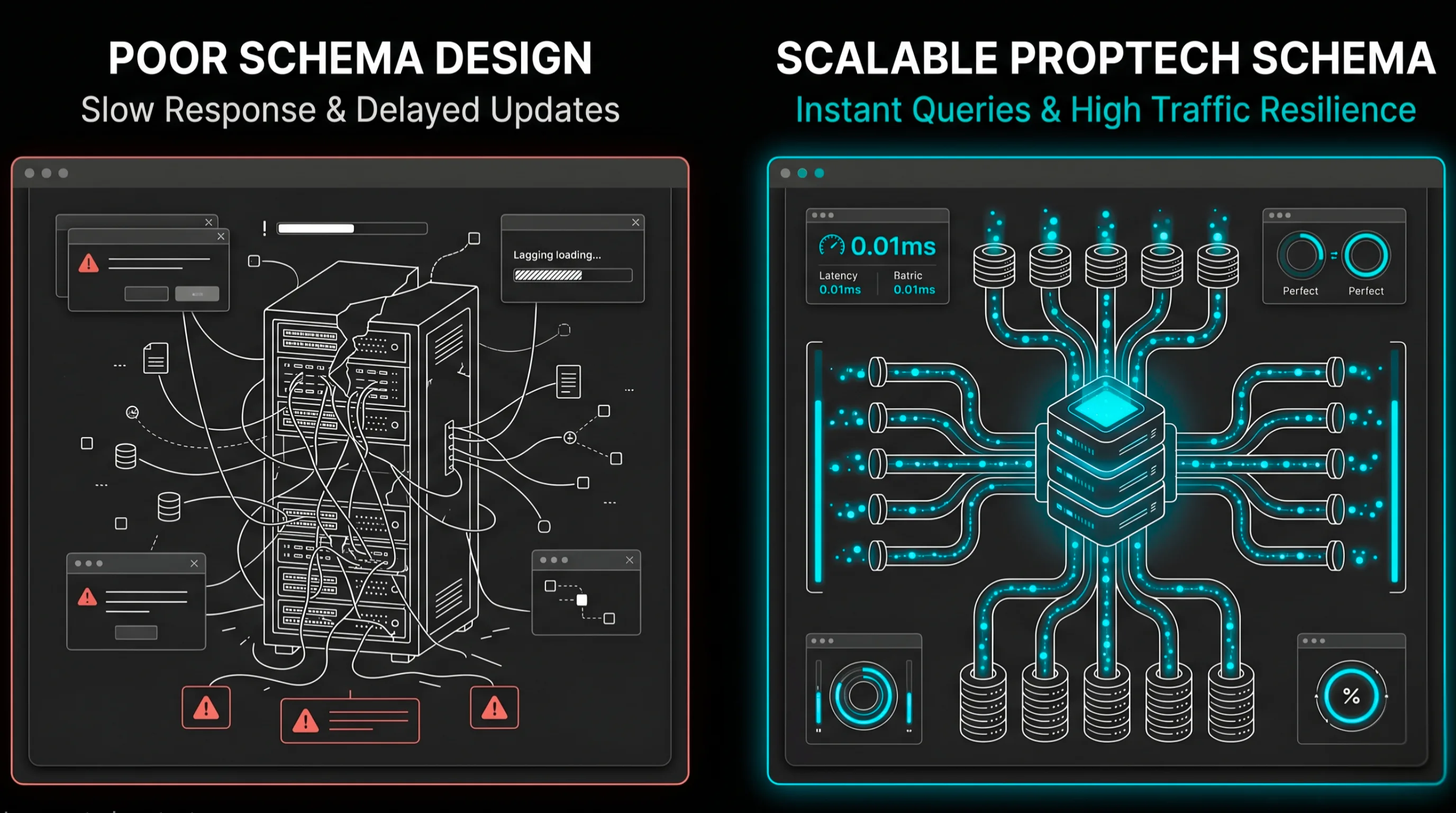
And unlike smaller platforms, real estate portals and real estate marketplace platforms cannot afford inconsistency. Users leave quickly when listings appear outdated or inaccurate. That’s why backend structure and scalable real estate database design matter far more than most founders initially expect.
MLS integration becomes the real operational challenge
One of the least understood areas in MLS IDX integration cost planning is operational maintenance.
The moment teams decide to build a portal like Zillow, develop a custom real estate app, or launch a Rightmove clone, they run into the complexity of data aggregation. Property information rarely comes from one clean source.
Instead, listings arrive through:
- MLS feeds
- Brokerage systems
- Third-party APIs
- Manual uploads
- Regional property networks
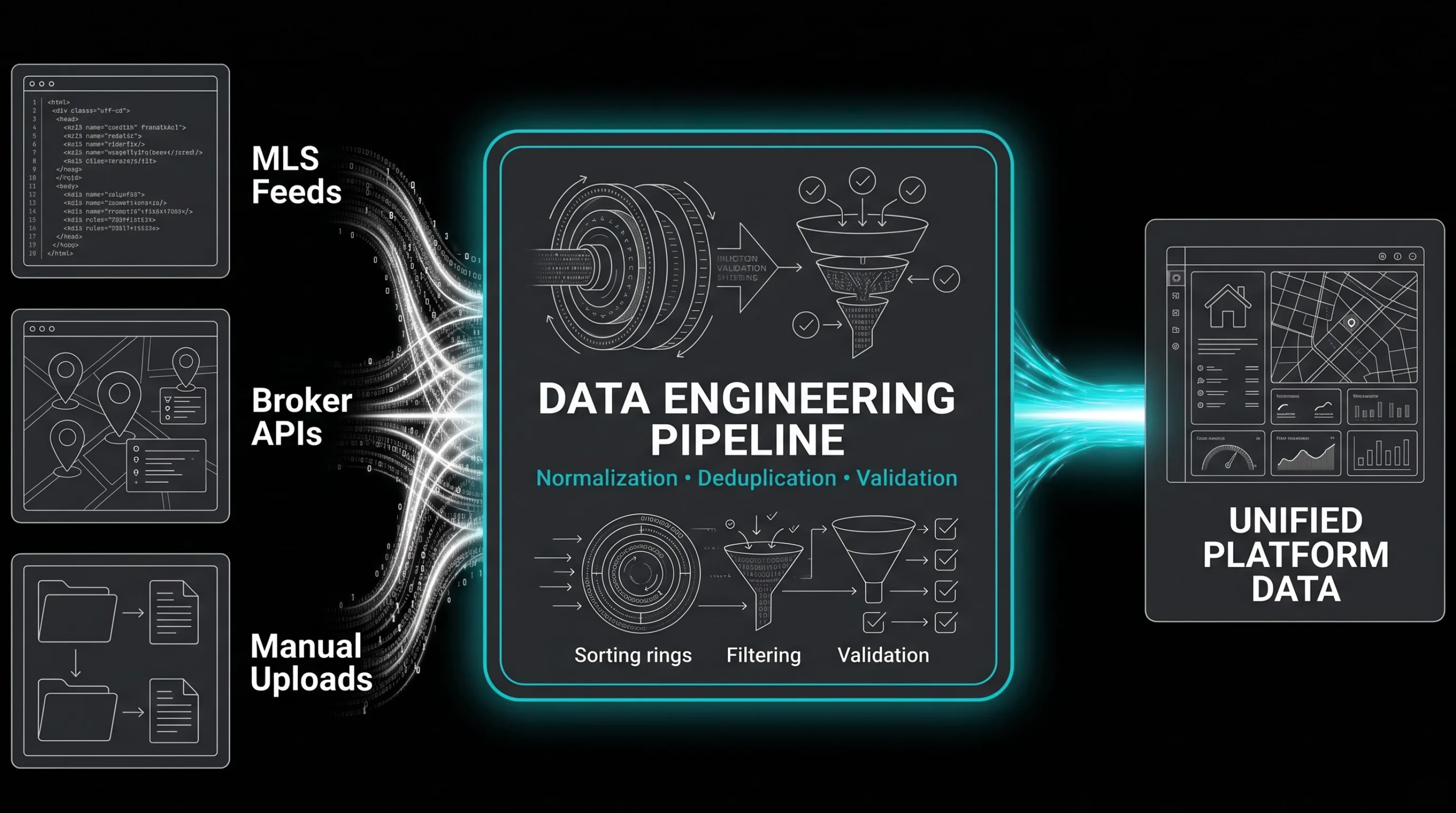
Every source behaves differently.
Some update instantly. Some lag for hours. Others structure data inconsistently or duplicate records across multiple regions. This is where strong data engineering becomes critical in proptech software development and large-scale MLS IDX integration workflows.
Scalable MLS systems require constant feed normalization, deduplication logic, validation pipelines and synchronization workflows to maintain listing accuracy continuously. Without that infrastructure, platforms become operationally unreliable long before traffic becomes large. And once user trust drops, recovery becomes difficult.
Search performance decides whether users stay
Users rarely remember the design of a property portal. They remember whether search felt fast.
Modern real estate portal architecture and custom real estate app infrastructure revolve heavily around geospatial performance because users now expect instant map rendering, neighborhood filtering, radius-based search, commute-aware recommendations and nearby property discovery in milliseconds.
This requires specialized infrastructure.
Most scalable platforms rely on combinations like:
- PostgreSQL with PostGIS for geospatial handling
- Elasticsearch or OpenSearch for indexing
- Redis for caching
- Cloud-native search pipelines to reduce query pressure
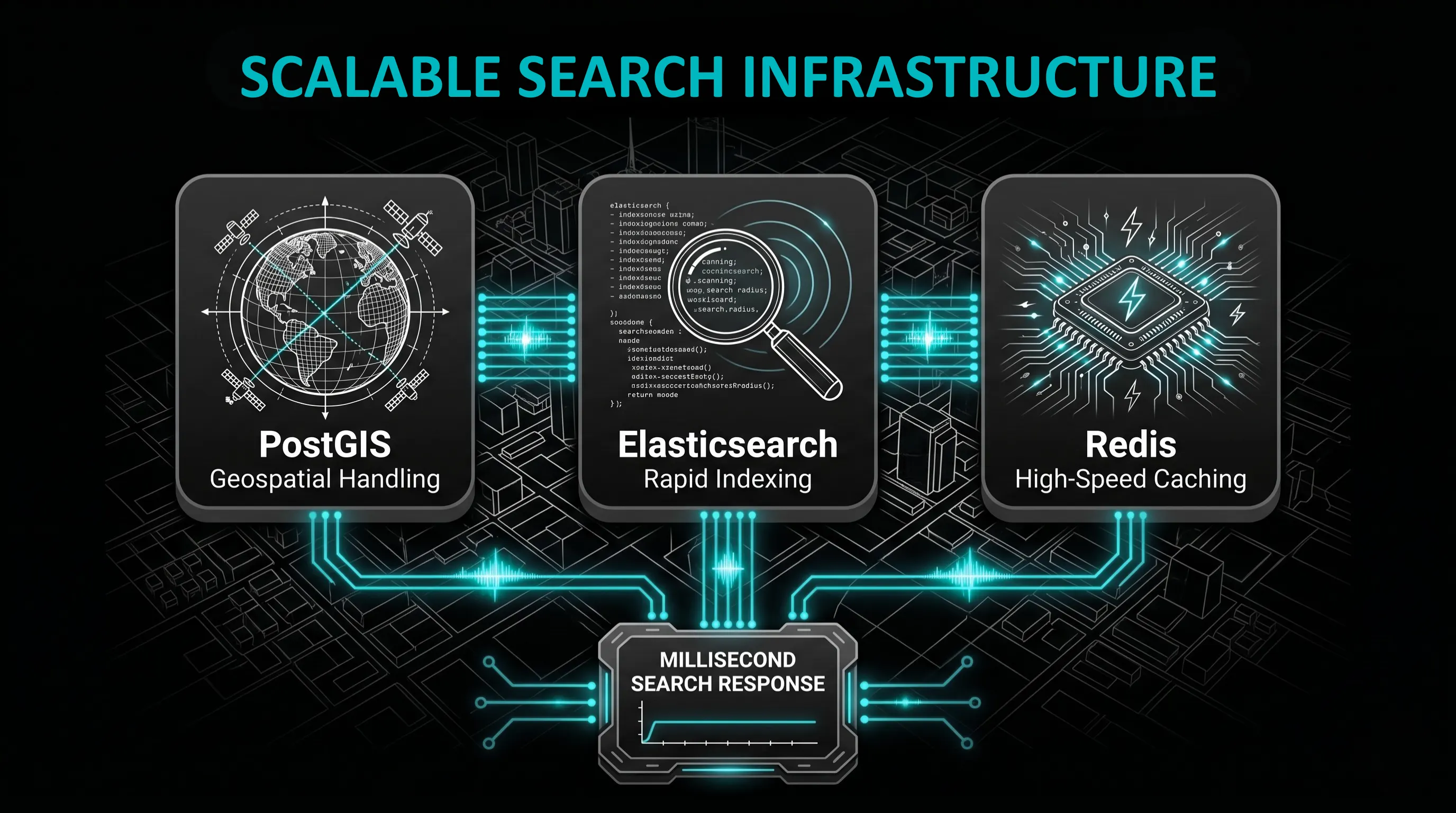
The challenge is not simply finding listings. The challenge is retrieving the right listings instantly while millions of location-based queries happen simultaneously. That’s where architectural quality separates scalable platforms. They separate from visually polished but technically fragile products.
Mapping APIs should support the system not run the system
One common mistake in custom real estate app development, online property marketplace development, or Zillow clone development is depending too heavily on Google Maps or Mapbox for core operational logic.
These tools are excellent for visualization and frontend interaction. But relying on them for heavy operational querying becomes expensive very quickly.
Strong platforms separate:
- Visual rendering
- Geospatial indexing
- Recommendation systems
- Backend querying
Into independent layers. This improves both scalability and cost control. More importantly, it prevents infrastructure costs from spiraling as search activity grows. It is because once user traffic increases, mapping requests scale aggressively. And without efficient architecture underneath, operational costs grow faster than platform revenue.
Image infrastructure quietly becomes one of the biggest costs
Real estate users expect image-rich experiences by default.
Property listings now include high-resolution galleries and drone visuals. Plus, walkthrough videos, floor plans and virtual tours. Compressed thumbnails are also needed for faster mobile delivery. All of this puts heavy pressure on storage and bandwidth at scale.
This is why strong cloud infrastructure for real estate platforms and large-scale online property marketplace systems usually depends on:
- AWS S3 or Azure Blob storage
- CDN delivery layers
- Intelligent image optimization pipelines
- Regional caching systems
Without proper image architecture, page speed suffers, mobile experience degrades and infrastructure costs rise rapidly. And in property platforms, page speed directly affects lead generation performance. A delay of even a few seconds can significantly reduce user engagement.
White-label solutions solve launch speed not scalability
Many founders choose white-label platforms initially because they reduce launch timelines for launching a quick Zillow clone. For early validation, this can work. But scalability exposes limitations very quickly.
Most white-label systems restrict:
- Search customization
- Backend flexibility
- Integration control
- Infrastructure optimization
The bigger problem is long-term rigidity.
As traffic grows, businesses often realize they cannot evolve the platform properly without expensive migration later. This is why many serious property businesses eventually move toward custom infrastructure anyway.
The difference is that rebuilding later costs significantly more than planning scalability properly from the beginning.
Poor database planning destroys growth quietly
One of the biggest long-term risks in scalable geospatial search systems, property tech platform architecture, and real estate marketplace app architecture is weak database planning. This rarely causes immediate failure. Instead, the platform slowly becomes heavier over time.
Search indexing slows down. Listing updates delay. Query costs increase. Infrastructure becomes harder to optimize. And eventually, scaling requires expensive restructuring projects.
The issue is that most early-stage platforms optimize for launch speed rather than operational sustainability. But once property data volume increases significantly, those shortcuts become extremely expensive to reverse.
That’s why database design should never be treated as a secondary technical decision in proptech software development.
In proptech, it directly impacts:
- Future scalability
- Infrastructure cost
- User retention
- Search reliability
Cloud-native architecture changes scaling economics completely
Traditional monolithic infrastructure struggles under unpredictable property traffic. Real estate platforms and real estate marketplace apps experience highly uneven demand patterns.
A viral listing, regional market spike, or sudden inventory trend can generate huge search surges instantly.
Cloud-native systems handle this far more effectively through:
- Autoscaling compute
- Distributed caching
- Load balancing
- Isolated services
- Dynamic resource allocation
This improves both operational stability and infrastructure efficiency.
More importantly, cloud-native design allows businesses to scale selectively instead of overbuilding infrastructure upfront.
That’s critical for controlling operational cost while maintaining performance.
The real cost is not building the platform
Most founders ask that “How much does it cost to build a portal like Zillow or a Rightmove clone?”
But they should ask that “How much will it cost to scale and maintain efficiently?”
This is because operational infrastructure becomes the largest long-term investment in proptech software development.
Cost layers include:
- MLS synchronization
- Search indexing
- Image delivery
- Cloud compute
- Bandwidth usage
- Analytics pipelines
- API dependencies
This is why strong architecture matters far more than excessive feature development early on.
A platform with fewer features but strong infrastructure scales much more effectively than a feature-heavy platform built on weak backend systems.
Seaflux role in transformation
At Seaflux, real estate platforms are built as scalable operational ecosystems rather than simple listing marketplaces. As a custom software development company, Seaflux focuses on creating high-performance infrastructure for modern property businesses.
Through real estate software development, cloud architecture, and data engineering, Seaflux delivers custom real estate solutions designed for scalability and operational efficiency.
By integrating custom AI solutions, platforms are built to support:
- Real-time listing synchronization
- Low-latency search performance
- Cloud-native scalability
- Optimized image delivery
- Large-scale geospatial operations
As a trusted cloud computing services provider, Seaflux helps property platforms handle growing traffic, real-time data movement, and complex search operations without compromising performance.
The focus remains on long-term scalability because in real estate technology, growth exposes backend decisions before frontend limitations.
If you are planning to build or scale a modern real estate platform, schedule a call with us to discuss scalable infrastructure, AI-driven workflows, and custom platform development strategies.
Conclusion
Most property platforms and real estate marketplace apps fail because they scale badly. The systems that survive long term are not necessarily the ones with the flashiest interfaces. They are the ones whose infrastructure was designed properly before growth pressure arrived. And in proptech, rebuilding architecture after scale is always more expensive than building it correctly the first time.
Do not build a real estate platform or approach real estate portal development in a way that slows down the moment growth arrives. Build infrastructure that can handle massive listing volume, real-time search behavior and constant data movement without sacrificing speed, reliability, or operational efficiency.
Because in modern proptech, scalability is not an upgrade later. It is the foundation everything depends on.

Krunal Bhimani
Business Development Executive