BNPL Platform Development: How to Build Buy Now Pay Later Software
Most Buy Now Pay Later products do not fail during checkout.
They fail 90 days later.
The transaction looked successful. The approval flow felt smooth. The merchant conversion rate improved. Investors liked the growth chart.
Then repayment delays started increasing. Fraud patterns became harder to detect. Chargeback handling slowed down. Regulatory reporting became chaotic. Recovery workflows stayed manual while transaction volume scaled aggressively.
That’s the hidden reality of BNPL infrastructure.
The checkout experience is only the visible layer.
The real system lives underneath, inside the credit engine, event pipelines, repayment orchestration, fraud controls, payment orchestration platform architecture and BNPL architecture operational reporting systems holding the platform together.
And this is exactly why modern BNPL platform development and fintech software development have become far more complex than adding installment options to a payment gateway.
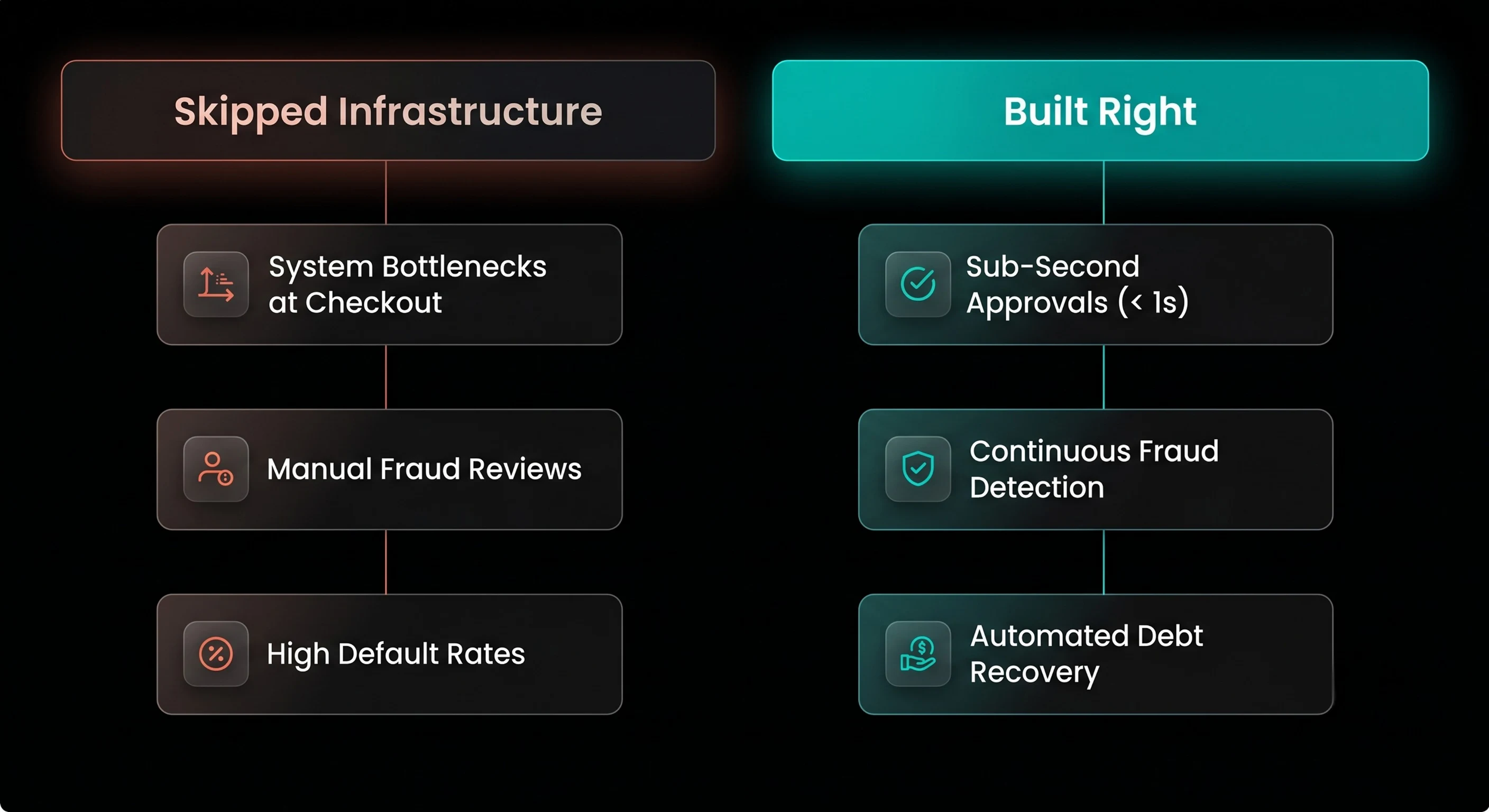
The companies surviving long-term are not simply optimizing approval speed. They are building systems capable of making real-time credit decisioning safely at enormous scale without collapsing operationally later.
BNPL systems behave more like lending infrastructure than payment products
A lot of founders underestimate this early.
The frontend experience feels lightweight.
Select installments, verify identity, approve transaction.
But operationally, a BNPL infrastructure platform is simultaneously handling:
- Credit underwriting
- Fraud detection
- Payment orchestration
- Regulatory tracking
- Repayment monitoring
- Merchant settlement
- Risk exposure management
All inside a few seconds during checkout.
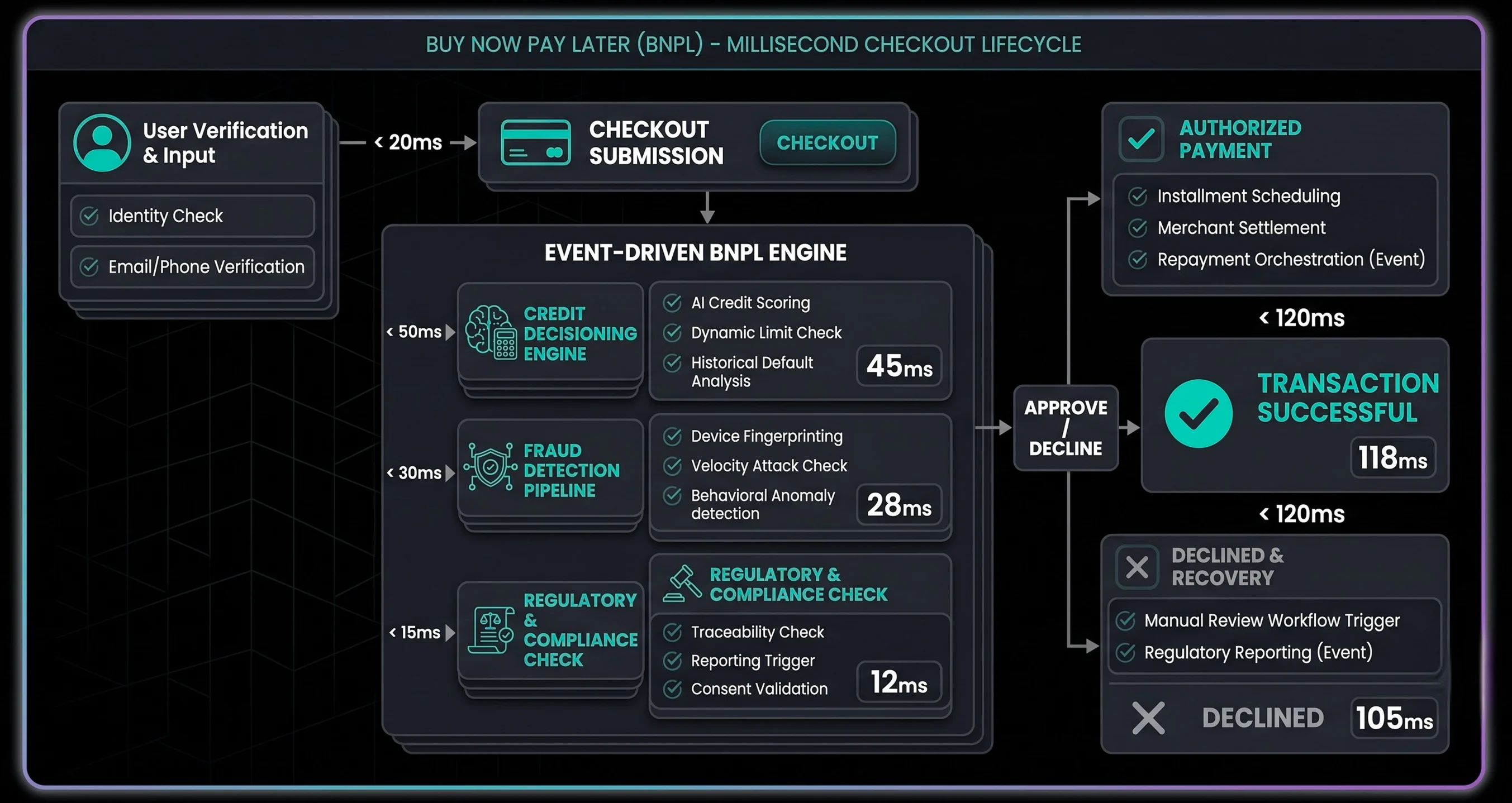
That is why strong buy now pay later architecture and BNPL app development strategies prioritize event-driven infrastructure from the beginning. Because traditional synchronous systems struggle badly once transaction concurrency rises.
Modern BNPL systems need:
- Real-time decision pipelines
- Asynchronous risk processing
- Dynamic limit management
- Real-time credit decisioning
- AI credit scoring
- Continuous fraud evaluation
Without slowing checkout performance.
The approval engine becomes the product
Most users never think about the infrastructure behind a BNPL decision.
They only experience approved or declined.
Which means the approval engine quietly becomes the most important part of the entire business. And in competitive checkout environments, decision speed matters massively.
A slow approval flow damages merchant conversion immediately. This is the reason behind why modern credit risk engine systems increasingly rely on event-stream processing and AI-driven scoring models instead of static underwriting rules for real-time credit decisioning.
The platform continuously evaluates transaction behavior, repayment history, merchant category, device intelligence, behavioral signals, income estimation, fintech fraud detection signals and fraud probability simultaneously.
And it needs to do this in milliseconds. Not minutes.
Why? Because checkout abandonment increases aggressively once friction enters the approval flow
Event-driven systems are becoming mandatory for scale
Traditional monolithic fintech systems struggle badly under BNPL concurrency pressure.
The reason is simple.
Too many operations happen simultaneously:
- User verification
- Credit evaluation
- Fraud analysis
- Merchant validation
- Payment authorization
- Installment scheduling
Trying to handle this sequentially creates bottlenecks immediately.
This is why modern automated lending systems and fintech software development teams increasingly use event-driven BNPL infrastructure powered through Kafka, RabbitMQ, AWS EventBridge or similar asynchronous infrastructure layers.
The advantage is operational elasticity.
Instead of blocking transactions while every process completes sequentially, services communicate through distributed events independently.
That creates:
- Faster approvals
- Better scalability
- Improved fault tolerance
- Cleaner system isolation
And most importantly, operational resilience during transaction spikes.
Merchant integration quality directly affects growth
A surprising number of BNPL platforms underestimate merchant integration complexity.
The easiest product to integrate usually wins merchant adoption fastest.
This is why strong scalable checkout integration design matters so much operationally.
Merchants expect:
- Lightweight SDKs
- Fast deployment
- Minimal frontend disruption
- Flexible API support
- Stable transaction behavior
The onboarding experience must feel simple technically. Even if the infrastructure underneath is extremely sophisticated.
Mature BNPL ecosystems and automated lending platform providers now provide:
- Mobile SDKs
- Web checkout components
- Embedded financing widgets
- Fintech payment gateway compatibility
- API-first merchant integrations
Because reducing merchant engineering effort directly improves platform expansion speed.
Checkout speed and risk management are constantly fighting each other
This is one of the hardest operational balances in BNPL infrastructure.
Frictionless approval improves conversion. Weak risk controls increase default exposure. Strong BNPL infrastructure systems solve this through adaptive decisioning and advanced BNPL risk management strategies rather than rigid verification workflows. Low-risk transactions move through minimal friction pathways.
High-risk behavior dynamically triggers:
- Additional verification
- Identity escalation
- Manual review workflows
- Spending restrictions
This is where AI-driven underwriting and AI-driven credit scoring become extremely valuable.
Instead of static approval logic, systems continuously adapt risk models using:
- Repayment behavior
- Device intelligence
- Merchant patterns
- Behavioral anomalies
- Historical default signals
This creates far more flexible operational risk management compared to traditional fixed-rule systems.
Fraud detection must operate before repayment cycles expose problems
One major mistake many early BNPL products make is relying too heavily on repayment history before strengthening fraud infrastructure. And that creates delayed visibility.
Modern fintech payment gateway ecosystems and automated lending platform systems increasingly integrate fraud analysis directly into transaction orchestration itself.
The system continuously evaluates:
- Device fingerprinting
- Velocity attacks
- Identity inconsistencies
- Synthetic identity behavior
- Checkout anomalies
This is done before approvals finalize.
This matters because fraud exposure compounds aggressively under high transaction concurrency. And once transaction volume scales, manual fraud review becomes operationally impossible.
Debt recovery automation is getting faster than founders expect
Most BNPL products focus heavily on acquisition and checkout optimization early. Very few prioritize collections architecture seriously enough. That is what becomes dangerous later. Because repayment recovery workflows become exponentially harder once scale increases.
Strong BNPL infrastructure systems automate:
- Payment reminders
- Retry logic
- Delinquency escalation
- Settlement coordination
- Repayment restructuring
- Recovery prioritization
Modern BNPL architecture automates recovery workflows without depending heavily on manual operations teams.
This is one of the biggest operational differences between scalable lending platforms and short-lived fintech products. The systems surviving long-term usually built repayment orchestration early. Not after default rates started becoming painful.
Regulatory reporting becomes infrastructure not compliance paperwork
A lot of fintech founders still underestimate reporting complexity in lending systems.
As transaction volume grows, regulators increasingly expect:
- Transaction traceability
- Risk exposure visibility
- Audit reconstruction
- User consent tracking
- Repayment transparency
Manually generating these reports becomes unsustainable quickly.
This is why mature regtech for startups infrastructure increasingly embeds reporting directly into event pipelines and operational data architecture itself. Every approval, repayment, fraud event and risk decision becomes part of an auditable operational stream automatically.
That dramatically reduces operational reporting chaos later. And more importantly, it prevents painful data restructuring once regulators request deeper visibility.
Modular architecture prevents future infrastructure paralysis
One of the biggest long-term risks in BNPL systems is tightly coupled infrastructure.
When credit scoring, payment processing, fraud detection and repayment systems become deeply dependent on each other operationally, future scaling becomes extremely painful. Strong BNPL platform development and BNPL app development prioritize modularity aggressively.
This allows:
- Credit engines to evolve independently
- Fraud systems to improve separately
- Merchant APIs to scale independently
- Regulatory logic to adapt regionally
This becomes extremely important once products expand internationally or introduce new financing products later.
Seaflux’s Role
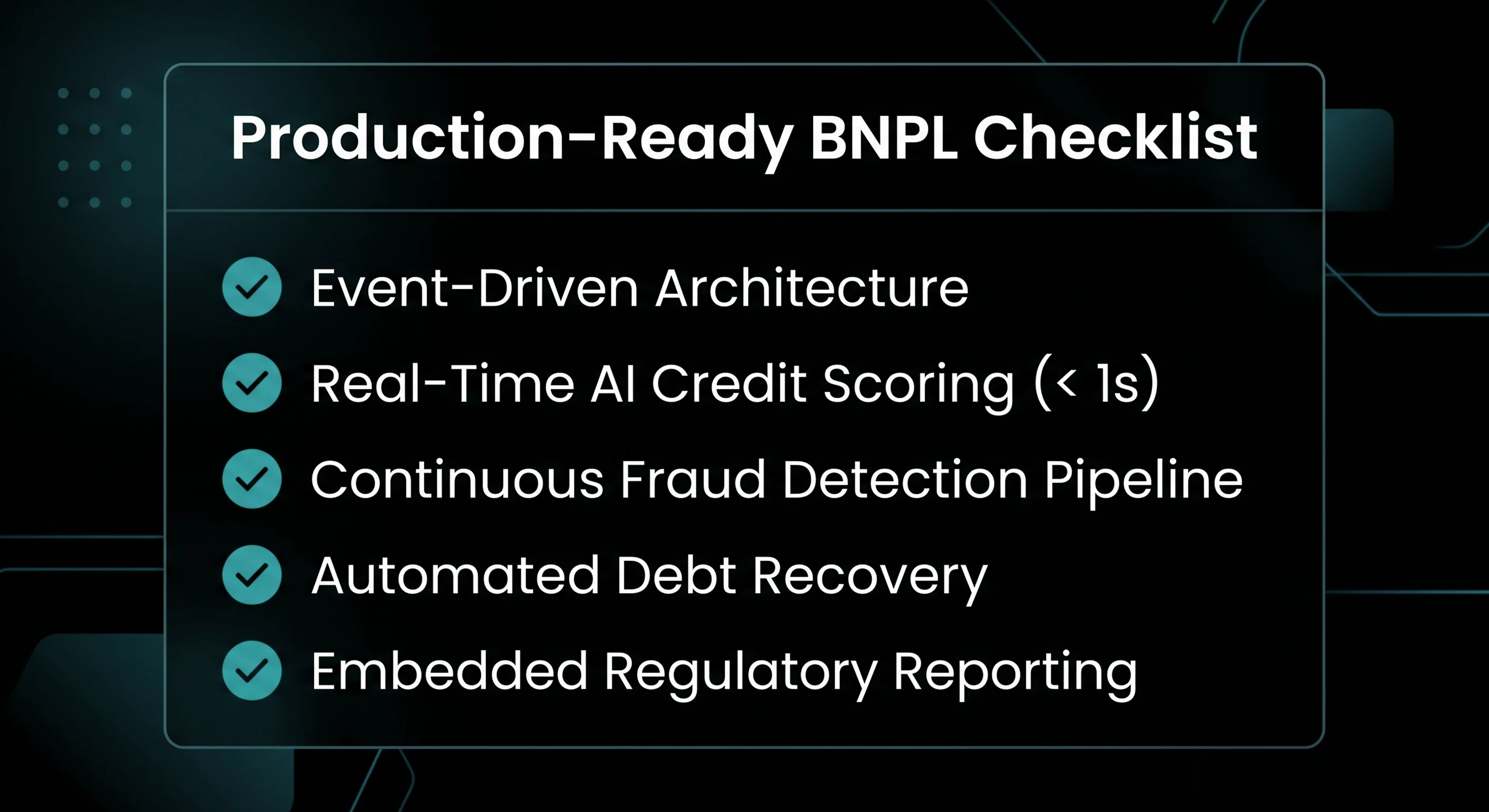
At Seaflux, BNPL infrastructure is built as scalable lending architecture, not just lightweight checkout tooling. As a fintech software development company, the focus is on creating systems that can handle real-time lending complexity at scale.
Through fintech software development, buy now pay later software development, lending platform development, custom fintech solutions and AI development services, platforms are designed to support:
- Real-time credit decisioning
- AI-driven credit scoring
- Event-driven transaction orchestration
- Modular merchant integrations
- Adaptive fintech fraud detection
- Automated repayment workflows
- Scalable regulatory reporting
Our custom software development services and BNPL app development approach help businesses balance checkout speed with operational resilience as transaction volume grows.
Because the hardest part of BNPL systems is not approving transactions quickly. It is managing the operational complexity that follows at scale.
If your BNPL platform suddenly processed 50x more transactions next quarter, would your infrastructure still make sub-second risk decisions confidently?

Krunal Bhimani
Business Development Executive