 Logistic
 USA
USA 20 Weeks
How We Built a Product Carbon Footprint Platform for a 300-Supplier Manufacturer
Case study: how an AI-powered digital twin platform automated Scope 3 emissions tracking and product carbon footprint reporting for a global manufacturer.
Overview
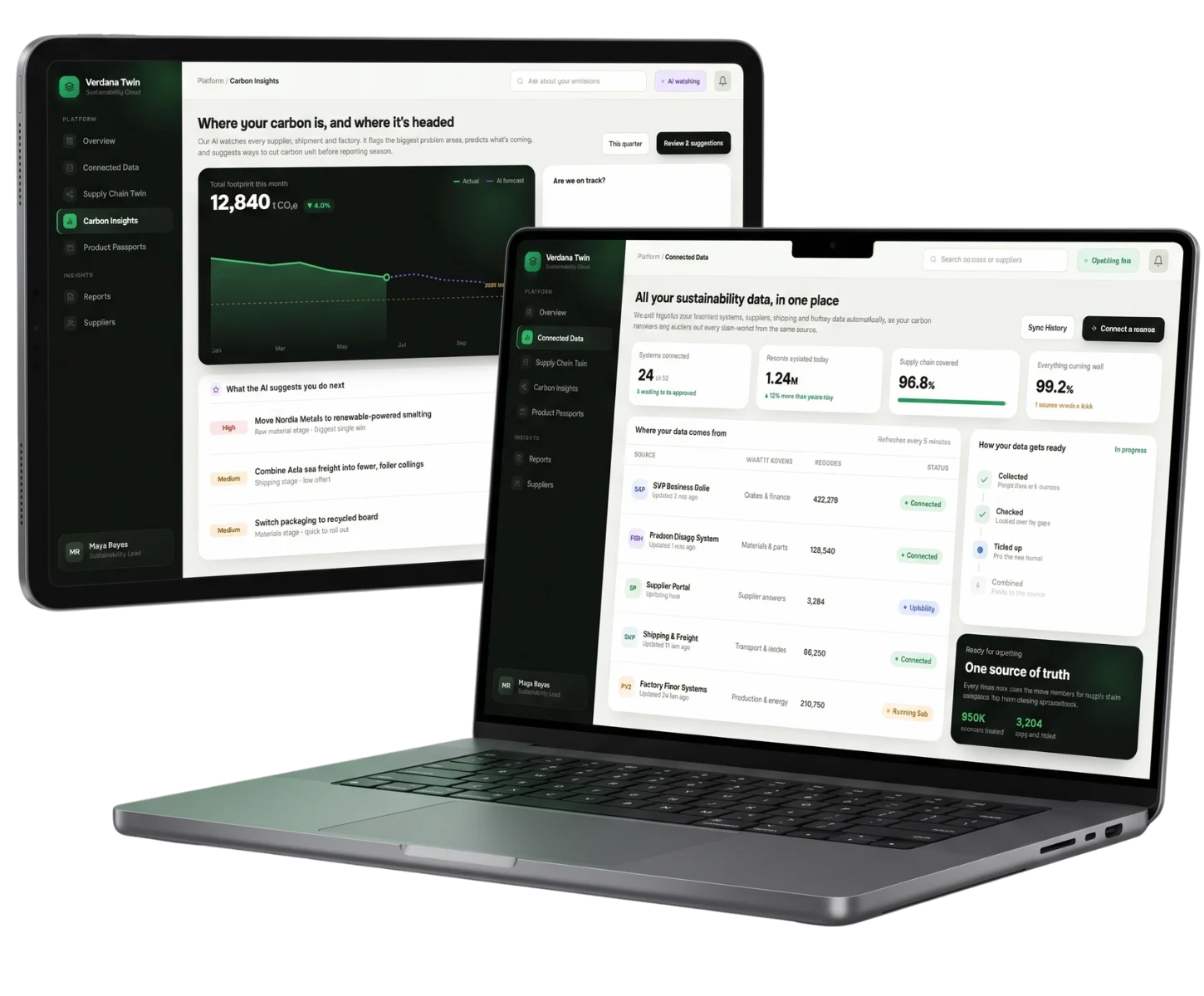
A global manufacturing enterprise with suppliers spread across multiple continents struggled to measure Scope 3 emissions across thousands of products and suppliers. Sustainability teams relied on spreadsheets, disconnected ERP systems, and manual supplier questionnaires that made carbon reporting slow, inconsistent, and difficult to audit. Rather than building another static reporting dashboard, we developed an AI-powered supply chain digital twin platform that continuously models suppliers, materials, manufacturing operations, and logistics as connected digital assets. The platform automatically calculates Product Carbon Footprints (PCF), identifies carbon hotspots using AI, and provides end-to-end lifecycle traceability across the entire supply chain, functioning as both a carbon accounting software layer and an ESG reporting software system for the business.
The Challenge
Client Overview
The client is a multinational manufacturer operating across hundreds of suppliers, manufacturing facilities, and logistics partners worldwide. With increasing ESG regulations and customer demand for sustainable products, they needed accurate product-level emissions data while maintaining visibility across their entire supply chain. Although they had invested in ERP, PLM, and supplier management systems, sustainability information remained fragmented across departments and external partners, and existing tools lacked lifecycle traceability, AI-driven insights, and real-time supplier collaboration.
Key Pain Points
- Supplier sustainability data was collected manually through spreadsheets and emails
- Product Carbon Footprint calculations required weeks of manual consolidation
- No unified view of suppliers, products, logistics, and manufacturing emissions
- Limited visibility into emission hotspots across the supply chain
- Difficult to comply with evolving ESG and sustainability regulations, including emerging Digital Product Passport (DPP) requirements
- Leadership lacked real-time dashboards to monitor sustainability performance
Our Solution
Unified Sustainability Data Platform
Supply Chain Digital Twin Engine
AI Carbon Intelligence Engine
Product Carbon Footprint & Digital Product Passport
Executive Sustainability Analytics
Platform Capabilities
Built to provide real-time sustainability intelligence, lifecycle traceability, and enterprise-scale supplier collaboration.

Supply Chain Digital Twin
Creates connected digital representations of suppliers, products, manufacturing assets, and logistics operations for complete lifecycle visibility.

Product Carbon Footprint Engine
Automatically calculates product-level emissions across sourcing, production, transportation, warehousing, and delivery, functioning as a dedicated product carbon footprint (PCF) software module.

AI Sustainability Intelligence
Detects emission hotspots, predicts supplier risks, forecasts sustainability trends, and recommends carbon reduction opportunities using an AI-powered carbon accounting platform.

Supplier Collaboration Portal
Allows suppliers to securely submit emissions data, certifications, and sustainability information through standardized workflows.

Digital Product Passport
Generates digital product records containing lifecycle history, carbon footprint, material composition, and compliance documentation, supporting digital product passport (DPP) software requirements.

ESG Reporting Automation
Automates sustainability reporting with audit-ready datasets and executive dashboards for regulatory compliance, reducing dependence on manual ESG reporting software workflows.

Real-Time Executive Dashboards
Provides live monitoring of emissions, supplier performance, carbon trends, and enterprise sustainability KPIs.

Enterprise Integration Framework
Connects ERP, PLM, MES, logistics systems, IoT devices, and supplier platforms through secure APIs and automated data pipelines.
Built with Modern Tech
We leverage cutting-edge technologies to build scalable, secure, and high-performance applications that grow with your business.
 ReactJS
 TypeScript
 Node.js
 Python
 AWS S3
 AWS S3
 PostgreSQL
 Amazon Athena
Measurable Results
Real outcomes that transformed our client's operations and delivered significant ROI.

Faster Product Carbon Footprint Calculations
Reduced weeks of manual data consolidation into automated calculations completed within hours.

Reduction in Manual Supplier Data Collection
Automated supplier collaboration significantly reduced spreadsheet-driven reporting.

Supply Chain Lifecycle Visibility
Created digital twins for suppliers, materials, logistics, and products, providing complete lifecycle traceability.

Executive Sustainability Insights
Leadership gained continuous visibility into emissions, supplier performance, compliance, and carbon reduction opportunities through live dashboards.
Project Delivery Approach
A proven methodology that ensures quality delivery, on time and on budget.
Discovery & Sustainability Assessment
Mapped supplier ecosystems, enterprise systems, reporting workflows, and regulatory requirements to identify opportunities for digital twin implementation.

Platform Architecture & Data Model
Designed the cloud-native sustainability software platform, digital twin data model, and enterprise integration architecture.

Data Integration & Digital Twin Development
Integrated enterprise systems and supplier data while creating digital twins for products, suppliers, materials, and manufacturing assets.

AI Model Development
Built predictive analytics models for carbon forecasting, supplier risk analysis, and sustainability optimization within the AI-powered carbon accounting platform.

Dashboard & Reporting
Delivered executive dashboards, Product Carbon Footprint reporting, Digital Product Passports, and self-service sustainability analytics.

Production Rollout & Hypercare
Completed production deployment, user training, and post-go-live monitoring to ensure platform adoption and operational success.
