

"Should we move to the cloud?"
Stop asking that. Seriously. That ship sailed years ago.
It is 2026. The market doesn't care about "adoption" anymore. The first big wave of migration is done. It’s over. Now, the game is different. It is about precision. It is about Vertical Cloud.
But what does that actually mean for the folks running regulated industries like healthcare and fintech? Let’s cut through the noise and talk about what this shift signals for the future of cloud computing.
You need to look at the bones of the infrastructure.
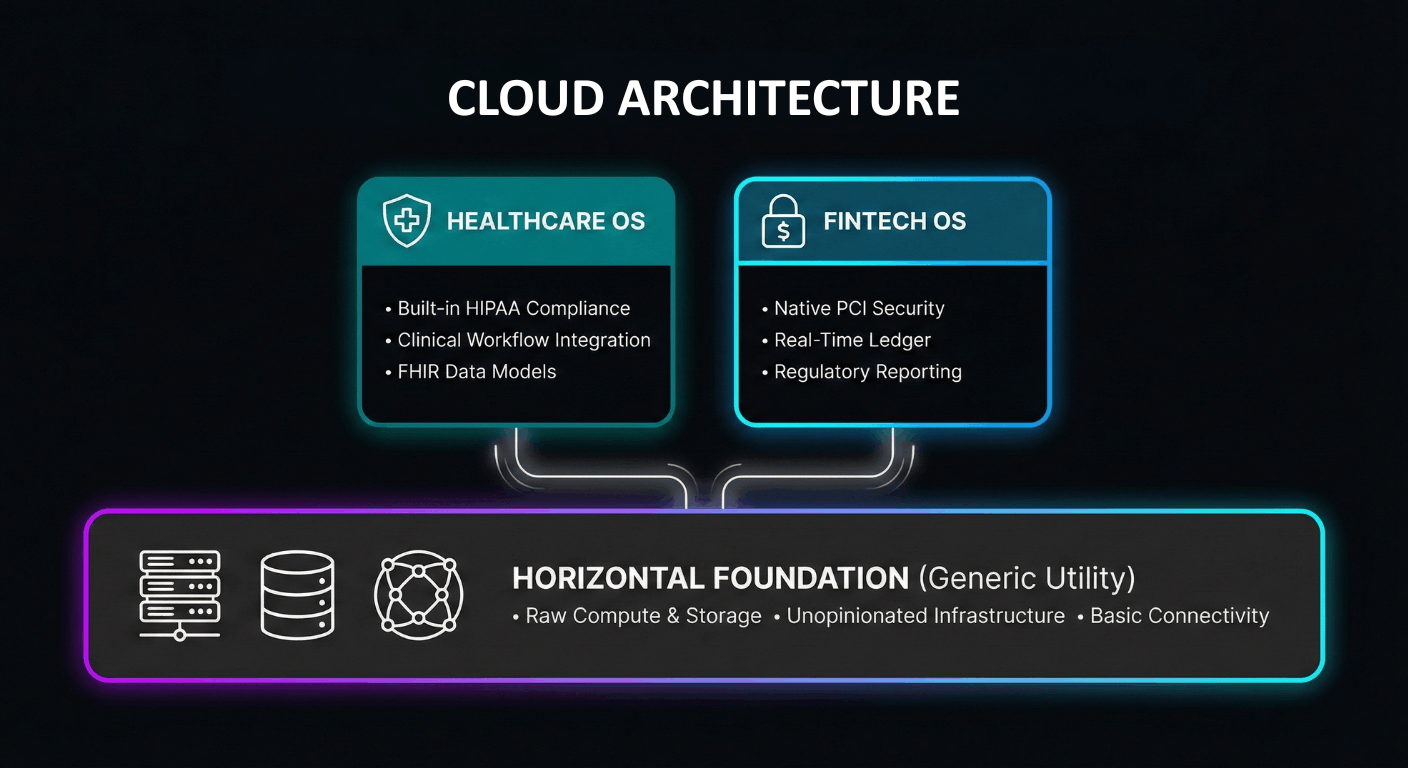
Horizontal Cloud is the bedrock. It is the solid ground. Think AWS or Azure. They give you raw compute, storage, and networking. They are utilities. They run everything from a kid’s Minecraft server to a Fortune 500 database.
Vertical (Industry) Cloud is the house you build on that bedrock. It is specific. It sits on top of the foundation, but it comes pre-loaded. It has the data models, the workflows, and the strict security rules that your specific industry actually needs. This is also the foundation on which modern vertical SaaS products and custom cloud solutions are built.
In 2026, nobody is throwing away the horizontal cloud. It is still the engine. But smart teams are layering vertical solutions on top so they can stop building the same boring compliance tools over and over.
Horizontal clouds are beasts. They are infinite. They give you the blocks to build anything.
But they are also agnostic. They don't know what "HIPAA" is until you teach them.
For years, dev teams burned months of time just configuring these general servers to meet basic rules. It was slow. It was expensive. Vertical Cloud flips the script. You don't start with a blank slate. You start with a platform that already speaks your language and increasingly, one that supports vertical AI use cases out of the box.
This lets companies ship products without the constant fear of breaking a compliance rule. Here is the reality.
In the medical world, data privacy is the whole ballgame.
From HIPAA in the U.S. to GDPR in Europe, the rules are heavy. Meeting them used to mean months of custom engineering work. Vertical clouds designed for Healthcare Software Development change the math. They embed these rules right into the code. You don't add them later. They are baked in.
This approach is now central to modern cloud solutions for healthcare, where compliance, interoperability, scalability, and seamless legacy system integration must exist from day one.
Then you have FHIR (Fast Healthcare Interoperability Resources). Connecting systems used to be a nightmare. Now? The platform handles it. This makes exchanging patient data reliable. It lets doctors try new things, like remote monitoring apps, without getting tangled in red tape.

Benefits include:
Cut the time IT teams spend on "plumbing," and they can focus on what matters: the patients.
Financial services have a weird problem. You need to be 100% secure, but you also need to be fast.
Regulations like PCI-DSS and SOX create a mess of complexity that kills speed. Vertical cloud solutions for Fintech and modern cloud banking solutions solve this by putting the governance models right in the native architecture, making fintech regulatory compliance a built-in capability rather than an afterthought.
These platforms come with tools for secure transactions and fraud detection right out of the box. We saw this firsthand when building systems like our AI-Powered Crypto Trading Platform. By using specialized architecture, banks and startups can worry less about the auditors and more about the user experience.
Fintech advantages include:
The result? You launch faster. You stay safe.
Here is the truth: A vertical cloud is a powerful tool, but it doesn't run itself.
As companies jump on this trend, they realize they need a pilot. You need a partner who knows the cloud architecture and the industry rules, especially when building or scaling a vertical SaaS platform or deploying a HIPAA-compliant cloud environment, or implementing industry cloud solutions. That is where domain-specialized teams come in.
Partners like Seaflux Technologies bridge that gap. We don't just dump technology on you. We align it with your goals. Whether it is Cloud Modernization or specific integrations, the right partner ensures the software actually works.
Key roles of specialized partners include:
In 2026, the cloud isn’t just about moving data. It is about optimizing it for your specific reality.
Vertical cloud is the enabler. It gives you the compliance and capabilities you need without the headache. The horizontal cloud is still the foundation, but the vertical layer adds the brains.
For companies and partners, hopping on this trend means building strategies that aren't just "capable," they are built to win.
At Seaflux Technologies, we focus entirely on creating secure, compliant, and scalable cloud systems for regulated sectors as a trusted healthcare software development company and provider of fintech app development services.
Compliance shouldn't be a bottleneck. Let’s create a cloud strategy that actually moves your business forward.
👉 Book a Strategy Session with Our Architects Here

Business Development Executive