How Much Does Logistics Software Development Cost in 2026
You don’t overspend on logistics software in one decision.
You lose money gradually through integrations that don’t scale. APIs that bill per request and dashboards that lag add to it. AI features that never deliver ROI make it worse.
By the time it shows up on your balance sheet that it is already too late.
Most CTOs don’t actually need “software.” But instead of that they need clarity where the money goes and what actually drives cost. They also need to understand which decisions lock them into expensive systems later.
This guide breaks that down without hiding behind estimates and also helps you understand supply chain software development cost in real-world scenarios.
What you’re really paying for
When someone quotes you a number for logistics software, they are usually compressing multiple layers into one line item.
In reality, your cost is spread across four distinct areas:
- Core product build
- Infrastructure and cloud
- Third-party dependencies
- Ongoing data and AI operations
Ignoring any one of these leads to budget overruns later and increases total logistics software cost over time, including your logistics app development cost.
In 2026, logistics software development cost 2026 is less about coding effort and more about how intelligently you design these layers from day one.
The base layer that decides everything
Your fleet management software architecture is where cost efficiency is either created or destroyed.
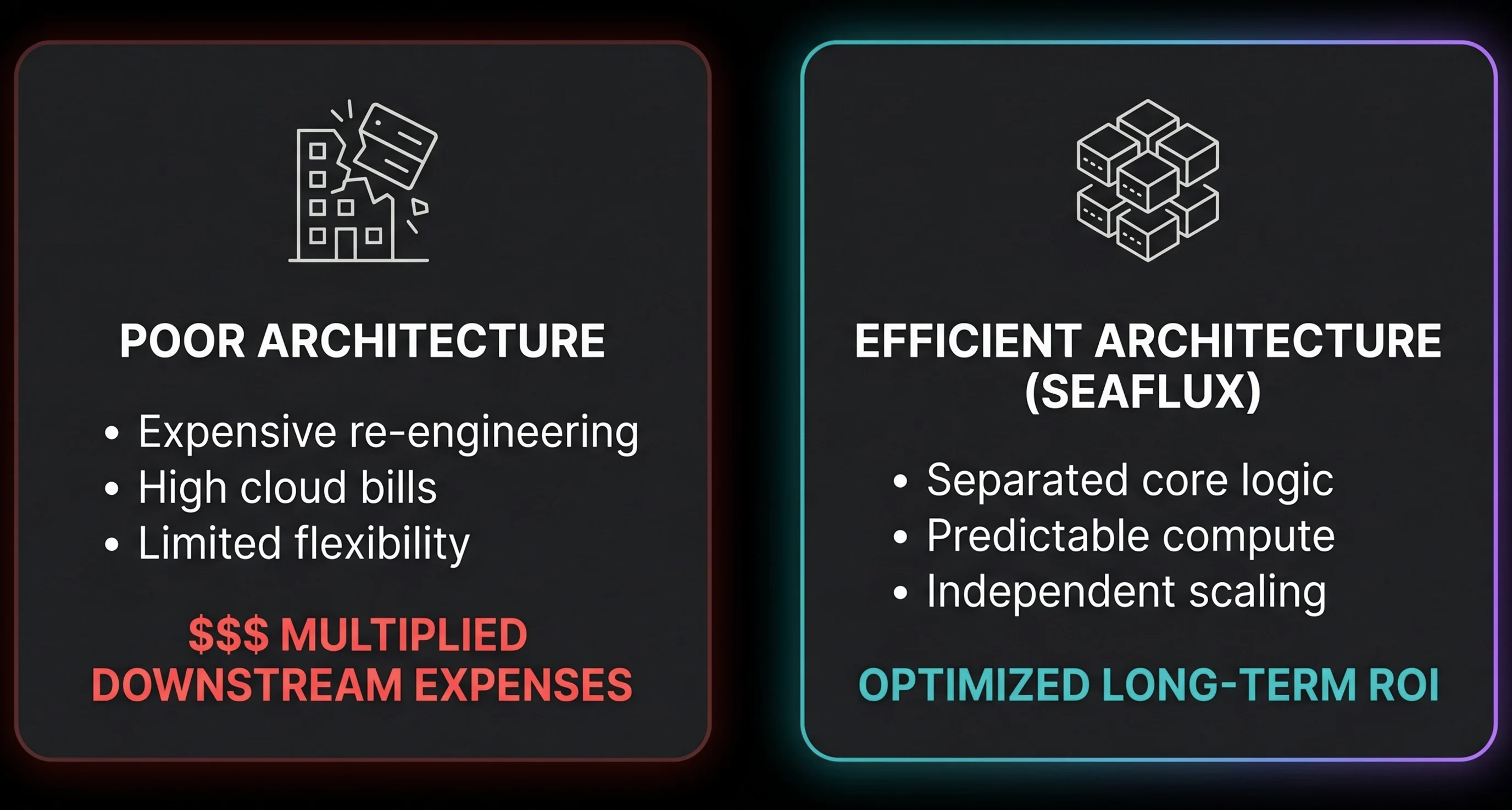
A poorly designed architecture forces you into:
- Expensive re-engineering later
- Higher cloud bills due to inefficient processing
- Limited flexibility when scaling features
On the other hand, a proper system does three things:
- Separates core logic from integrations
- Keeps compute usage predictable
- Allows modules to scale independently
Realistic investment range:
An MVP setup for smaller scale projects usually costs $30,000 to $80,000 approx.
A scalable system that is cloud-based can range from about $80,000 to $200,000 or might be more.
These align with real-world 2026 build baselines where even MVP systems now start above ~$30K due to integrations and infra complexity. This is a key factor in overall logistics software development cost.
This is not where you cut costs. Every shortcut here multiplies expenses downstream.
TMS is where most budgets start
A Transport Management System is usually the first major component. But the cost varies massively. And that depends on how deep you go, which directly impacts your overall transport management system cost.
TMS development cost ranges:
- A basic TMS comes with tracking and dispatch. It costs from $50,000 to $120,000 approx.
- A mid level TMS that comes with multi route planning and analytics range from $120,000 to $250,000.
- An advanced AI-enabled TMS can cost approx. in between $250,000 to $500,000 or maybe more.
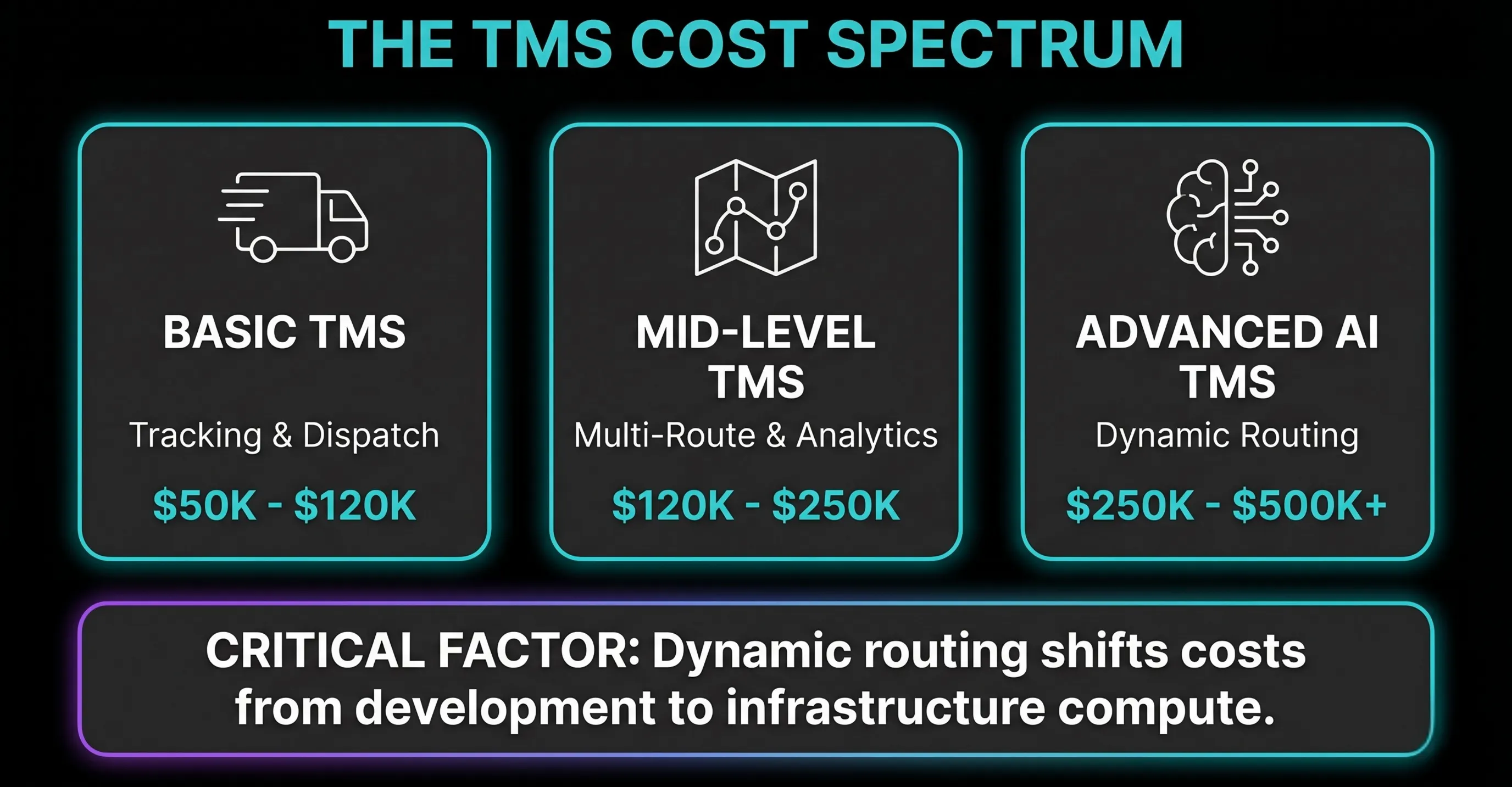
Enterprise-level implementations alone can hit $100K–$500K. And that depends on integrations and scale. The keyword here is TMS development cost and what most vendors won’t tell you is that routing logic is cheap. And real-time optimization is not.
The moment you introduce dynamic routing, cost shifts from development to infrastructure and compute, increasing overall logistics software cost significantly.
WMS quietly adds complexity
Warehouse systems are often underestimated.
A basic WMS usually costs around $40,000 to $100,000. And if someone goes for a more advanced setup with multiple warehouses and automation, it can go from $100,000 to $250,000 or even higher.
Mid-scale logistics platforms that combine warehouse + dispatch typically fall between $150K–$300K overall.
The real cost driver here is synchronization. Every delay between warehouse and fleet creates inefficiency. That’s why custom builds outperform SaaS here. You control how tightly your systems communicate.
AI is where budgets either explode or pay back
Most companies approach AI backwards. They invest in models first, then fix data later. That’s why their logistics AI automation ROI never shows up.
Initial AI setup:
- $80,000 – $250,000+ (models, pipelines, integration)
Ongoing AI operations:
- $8,000 – $40,000/month (compute, retraining, monitoring)
AI-enabled platforms typically push total system cost above $250K+ due to infrastructure and training requirements, increasing overall logistics software development cost.
Use cases include:
- Predictive ETAs
- Demand forecasting
- Route optimization
- Predictive maintenance
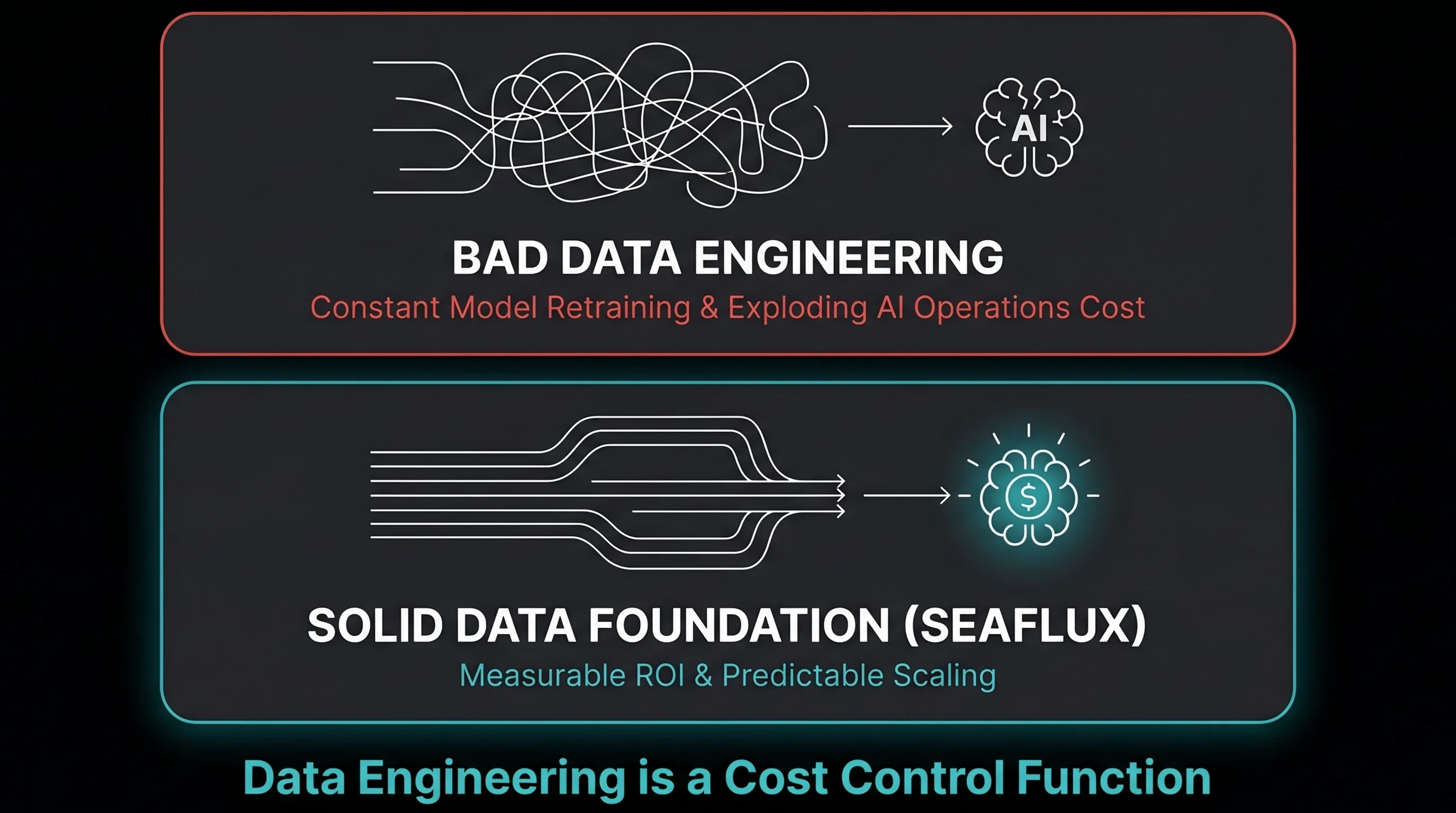
The part that matters is… Bad data engineering early on can double or triple your AI cost later. If your data pipelines are inconsistent, your models will constantly need retraining and correction. That’s not an AI problem. That’s a foundation problem.
The hidden cost nobody budgets for
This is where most financial planning fails.
Your system will depend on third-party services:
- Maps and routing APIs
- Payment gateways
- Notifications and communication
- External datasets
API cost reality:
- Early stage costs $1,000 to $5,000/month
- Scaling stage charges $5,000 to $30,000+/month
These costs scale with usage, not features. So even if your software stays the same, your expenses grow with business volume. This is critical in managing custom supply chain software pricing over time and controlling logistics software cost.
Cloud is not cheap if you design it wrong
Cloud pricing looks simple, until… your usage scales. Your costs come from compute, storage and data transfer.
Cloud cost reality:
- MVP stage: $2,000 to $10,000/month
- Growth stage: $10,000 to $50,000+/month
The difference comes down to architecture.
Inefficient systems:
- Process more data than needed
- Store redundant datasets
- Trigger unnecessary compute cycles
Efficient systems:
- Process only what’s required
- Optimize workloads
- Scale predictably
Cloud-native design is no longer optional. It is cost control.
Build vs buy is not a feature comparison
Most discussions around build vs. buy logistics software are framed incorrectly. It is not about features. It is about control and long-term cost, including how transport management system cost evolves over time.
SaaS platforms:
- Lower upfront cost
- Subscription-based ($50–$500/user/month typical)
- Limited customization
- Rising cost with scale
Custom software:
- Higher upfront investment
- Full workflow control
- Lower cost at scale
- Better integration
Over 3-5 years, SaaS often becomes more expensive. Especially for growing operations, increasing total logistics management software cost.
The real cost breakdown in numbers
For a mid-scale logistics platform in 2026:
- Architecture and backend systems usually cost approx. $80,000 to $200,000.
- The TMS module can range from $120,000 to $300,000.
- A WMS module falls between $80,000 and $200,000.
- AI capabilities may cost anywhere from $100,000 to $250,000.
- Integrations and APIs can add another $30,000 to $100,000.
Total initial build:
- The cost is between $300,000 and $700,000. It might be more. And it is based on validated estimates, forming the core of your total logistics platform development cost.
Ongoing monthly cost:
- The costs range from $20,000 to $100,000. This depends on the scale.
Where smart teams save money
Cost optimization does not come from cutting features. It comes from making the right decisions early.
Smart teams:
- Build core logic in-house
- Use APIs selectively
- Invest in data engineering early
- Design modular systems
This reduces:
- Rebuild costs
- AI inefficiencies
- Cloud waste
All of which directly lowers long-term logistics management software cost and overall fleet management software cost.
Why bad data decisions are the most expensive mistake
Most teams underestimate this.
If your data layer is inconsistent:
- AI models fail more often
- Reporting becomes unreliable
- Systems require constant fixes
Fixing data later is significantly more expensive than designing it right early. This is why data engineering is not a support function. It is a cost control function that directly affects logistics management software cost.
What this means for your next decision
If you are evaluating logistics software today, the question is not, “How much will this cost to build?” The real question is that, “How much will this cost to operate and scale over the next 3 years?” Because that’s where most budgets fail and where true logistics platform development cost becomes visible.
Where Seaflux fits in
At Seaflux, the focus is on delivering custom logistics software that scales without financial surprises. As a custom software development company, Seaflux builds solutions tailored to your workflows, giving you better control, flexibility and long-term cost efficiency.
For a deeper look at bringing fragmented logistics systems together, see our guide on logistics platform consolidation and unified intelligence in 2026.
With custom AI solutions and reliable cloud computing development services, every system is designed for measurable ROI, performance and predictable scaling as your operations grow.
Seaflux provides end-to-end custom logistics solutions that connect fleet, warehouse and supply chain operations into one system. As a supply chain solutions provider, the goal is to reduce inefficiencies, control costs, and optimize overall supply chain software development cost.
Schedule a meeting with us to discuss your logistics software strategy.
Final word
You can always add features later. You cannot undo bad architecture cheaply.
Make the right decisions early and your system becomes an asset. Get it wrong and it becomes a cost center you keep feeding.
Stop guessing your software budget.
Build a system where costs stay predictable, margins stay protected and every scale decision works in your favour. Not against you.
Frequently Asked Questions (FAQ): Get the Answers You Need
How much does logistics software development cost in 2026?
A mid-scale logistics platform typically costs between $300,000 and $700,000 for the initial build, covering architecture, TMS, WMS, AI capabilities, and integrations. Ongoing monthly costs usually range from $20,000 to $100,000 depending on scale.
What is the difference between TMS and WMS cost?
A basic Transport Management System (TMS) starts around $50,000, while a basic Warehouse Management System (WMS) starts slightly lower at around $40,000. Costs for both scale significantly with automation, multi-location support, and AI-enabled features, reaching $250,000 or more at the advanced tier.
Is custom logistics software cheaper than SaaS in the long run?
Often, yes. SaaS platforms have lower upfront costs but typically charge $50 to $500 per user per month, which adds up significantly over 3 to 5 years. Custom software has a higher initial investment but tends to cost less at scale and offers full workflow control.
What drives up AI costs in logistics platforms the most?
Poor data engineering is the biggest hidden cost driver. If data pipelines are inconsistent, AI models require constant retraining and correction, which can double or triple AI-related costs over time.
How much do third-party APIs cost for a logistics platform?
Early-stage platforms typically spend $1,000 to $5,000 per month on APIs like maps, routing, and payments. At scale, this can grow to $5,000 to $30,000 or more per month, since API costs scale with usage rather than features.

Hardik Dangodara
Business Development Manager