
Your next competitive advantage won’t be a product. It’ll be a conversation.
Not a chatbot that answers FAQs.
Not a scripted assistant that breaks after two queries.
But an enterprise-grade AI system powered by custom LLMs that understands your data. It adapts to your workflows and acts like a dependable teammate.
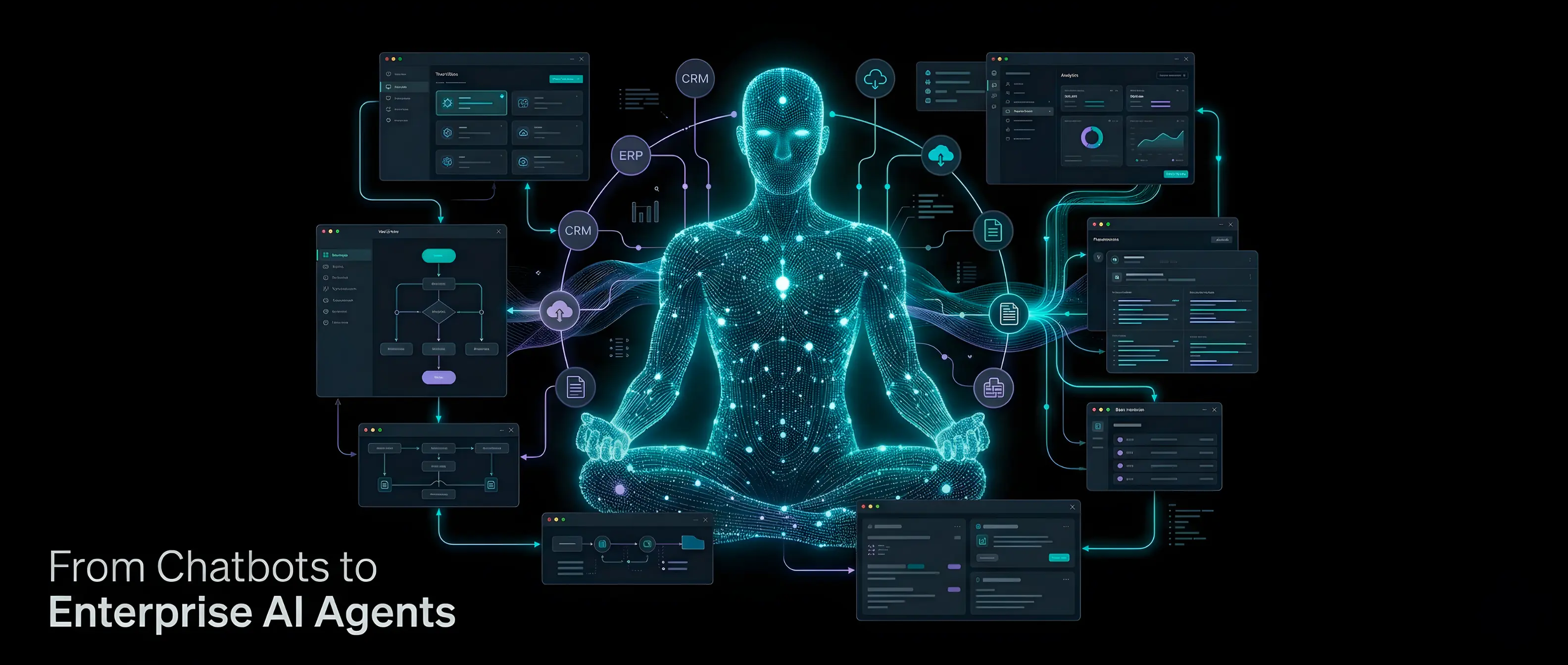
Here’s how leading companies will shape chatbot systems by 2026.
This is not about hype. It is about architecture, control and ROI, and ultimately improving AI chatbot ROI.
Most businesses still think in terms of “chatbot = interface.” That mindset is already outdated.
In 2026, the real value lies in Enterprise AI Agents. It is the systems that do not just respond, but execute tasks across your organization, enabling workflow automation with AI:
The difference is that a chatbot talks and an enterprise AI agent works.
And the only way this works at scale is with the right foundation: Custom LLMs + RAG implementation + secure deployment.
Generic AI tools look impressive in demos. They fail in production.
Here’s where they break:
For CTOs, this is not a feature gap. It is a risk surface that limits the effectiveness of any enterprise AI chatbot.
Which is why enterprises are shifting toward Custom LLM development backed by controlled infrastructure.
If you are evaluating how to build AI chatbot in 2026, here’s the architecture that’s emerging as the standard for maximizing AI chatbot ROI.
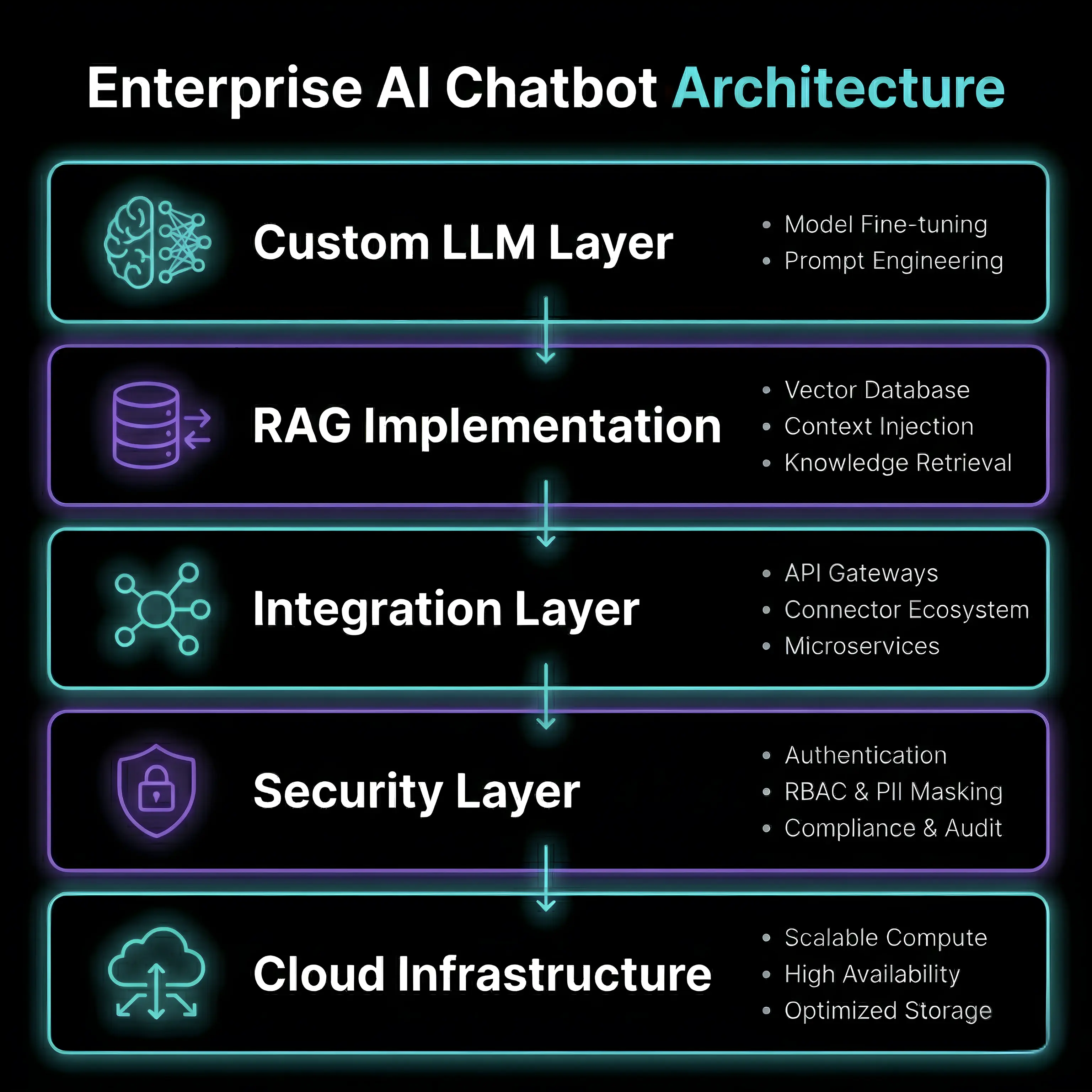
At the center sits your language model strategy.
Custom LLMs tailor intelligence to your business by enabling secure, accurate and optimized responses. Those are aligned with enterprise data, workflows and policies.
This does not always mean training from start. It means:
A well-implemented Custom LLM becomes your company’s knowledge engine aligned with your tone, processes and policies.
Without context, even the best models hallucinate.
That’s where RAG implementation becomes non-negotiable.
RAG links systems with real-time enterprise data. This improves accuracy and grounds responses in trusted knowledge for your enterprise AI chatbot.
Instead of relying only on pre-trained knowledge, RAG systems:
Think of it as giving your AI system a live connection to your company’s brain.
Key components of strong RAG architecture:
For enterprises, this is where accuracy meets scalability.
Enterprise chatbots without integration remain proof‑of‑concept demos.
Through deep integrations, chatbots become enterprise AI agents. They automate workflows and improve operational performance as part of a scalable AI chatbot architecture.
Your system must connect with:
This is where AI Agents Development Services become critical by building systems that do not just answer questions, but trigger actions that enhance AI for operational efficiency.
Example:
Instead of “What’s the status of invoice #4821?”
Your AI agent:
That’s operational impact.
For CTOs and engineering leaders, secure AI deployment is not a feature. It is the baseline.
Enterprise AI demands built-in security, ensuring data privacy, compliance, controlled access and complete visibility across all interactions and system operations of your enterprise AI chatbot.
Here’s what must be built in from day one:
Compliance requirements are GDPR, HIPAA and SOC2. They demand visibility and control at every step.
Anything less falls short of enterprise standards.
AI systems are resource-intensive. Your infrastructure needs to match.
Strong cloud infrastructure make systems scalable and efficient. They handle growth and real-time demands with ease. And they keep costs optimized while maintaining reliability for your enterprise AI chatbot.
This is where Cloud Computing Services come into play:
The goal is predictable scalability. Because your AI would not stay small for long.
AI initiatives often stumble not from technical limits. But from a lack of clear business objectives.
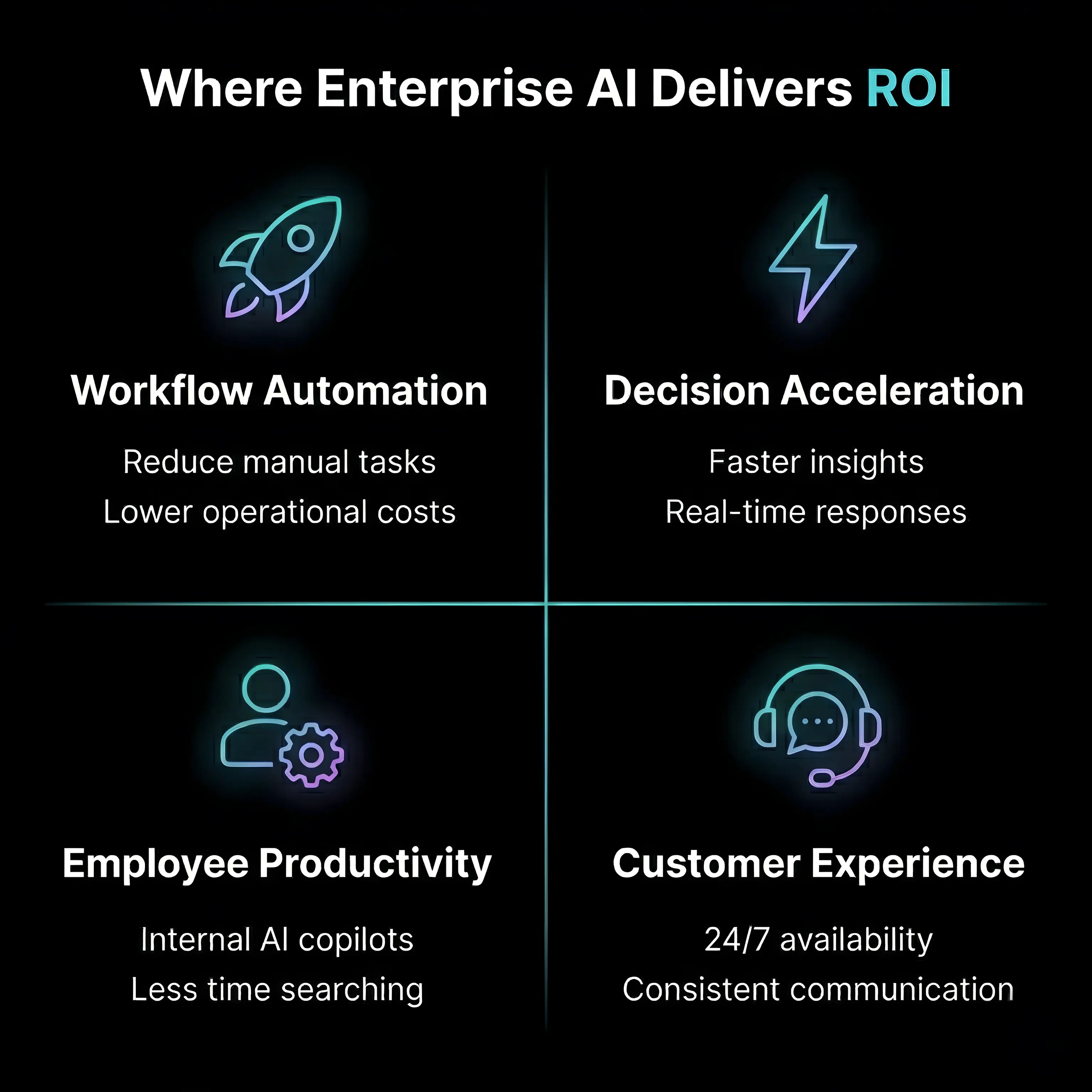
If you are evaluating enterprise AI agents, measure impact across:
The ROI of AI Chatbot architecture is not theoretical anymore. It is measurable and increasingly expected.
The biggest mistake enterprises make is overbuilding too early.
Your stack should evolve based on use case maturity when developing AI agent solutions.
A practical approach:
And most importantly build with extensibility in mind. Because your AI capabilities will expand faster than your roadmap predicts.
The role of CTOs and VPs of Engineering is shifting.
You are no longer just managing systems.
You are designing intelligence layers for your organization.
This means:
This is where Custom Software Development aligned with AI becomes critical and not generic builds, but tailored systems that fit your organization’s DNA.
The most successful enterprise AI systems won’t feel like AI.
They’ll be:
Your teams won’t “use a chatbot.”
They’ll simply get work done faster, smarter and with fewer bottlenecks.
If you are still asking whether to invest in AI, you are already behind.
The refined question should be that how well is your AI aligned with your business? Because in 2026, the winners would not be the ones who adopted AI first.
The winners will be those who built it right. Systems that are secure, scalable and fully integrated through powerful AI agent solutions.
The gap between AI experiments and real operations is growing. Organizations must act quickly to close it.
Ready to move from pilots to production? It begins with the right architecture and knowing how to build AI chatbot systems that deliver operational impact.
Seaflux supports enterprises in creating secure and scalable agents. Each is customized to business workflows instead of generic models.
Now is the time to build what your competitors will struggle to catch up with!
At Seaflux, we build scalable, production-ready systems as a trusted AI solutions provider, offering end-to-end AI development services. From AI chatbot development services to AI agents development, we help businesses automate workflows and improve efficiency.
Our AI agent development services, combined with custom LLM development and custom software development services, ensure secure, scalable solutions tailored to your business needs.
Schedule a meeting with us to discuss how we can build the right AI solution for your business.

Business Development Executive