AI in Logistics: 10 Use Cases Transforming Supply Chains 2026
POV: A warehouse manager notices something strange.
The same shipment delay keeps happening every Thursday evening. It is not a major disruption. It is just enough to slow dispatch, push delivery windows and create overnight backlog pressure.
The routing software says everything is functioning normally.
The warehouse dashboard shows no issue.
The fleet team blames traffic.
Three months later, the company realizes the problem was not traffic at all.
Their loading pattern, staffing schedule and route sequencing were colliding at the exact same time every week. And no one could see the pattern because their systems were only reporting activity, not interpreting it.
That’s the difference AI in logistics is creating inside supply chain operations.
Not futuristic robots. Not flashy automation demos. Just systems that finally understand operational behavior fast enough to improve it.
The biggest change in AI in supply chain management 2026 is not visibility anymore. Most companies already have dashboards. The change is decision quality.
AI is helping logistics operations predict pressure before it builds, reduce waste before it spreads and solve inefficiencies before teams even notice them manually through advanced AI supply chain management solutions.
Here are 10 real-world AI in logistics use cases already transforming supply chain operations right now.
When fleets stop waiting to fail
Most maintenance systems still operate like calendars. Vehicles are serviced after fixed intervals whether they need it or not. The problem is that breakdowns rarely follow schedules.
AI-driven predictive maintenance changes that completely. Instead of relying on static service cycles, systems continuously analyze operational signals. Those are engine behavior, fuel patterns, braking irregularities and component stress.
What makes this valuable is not the technology itself but it is the operational continuity it protects.
One unplanned fleet failure can trigger:
- Missed delivery windows
- Driver rescheduling
- Route disruption
- Customer escalation
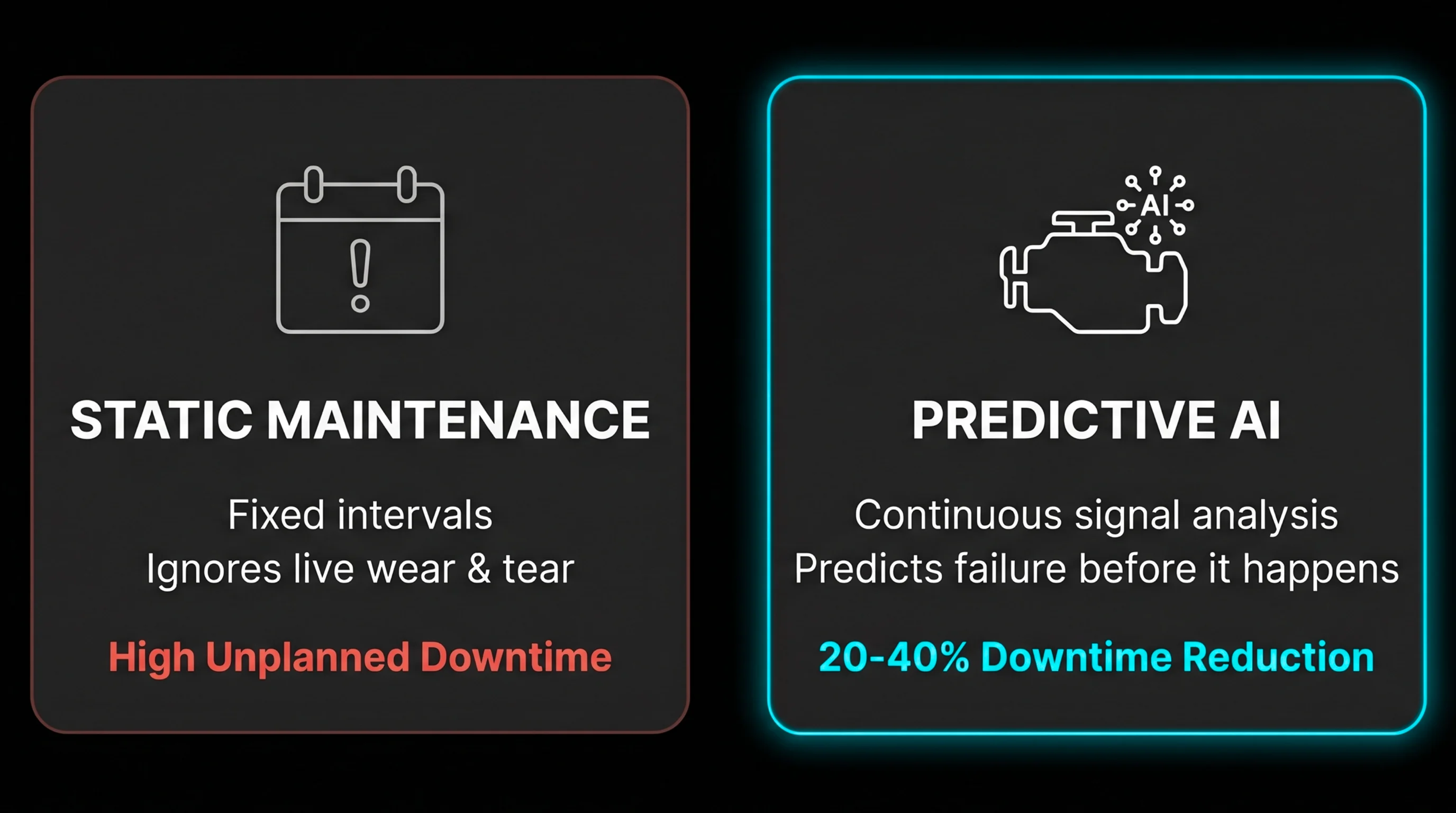
Companies deploying predictive maintenance systems in AI in logistics and supply chain are already reporting downtime reductions between 20-40%. Especially in large commercial fleets where even small disruptions scale aggressively.
Why routing decisions are becoming minute-by-minute
Traditional route planning assumes conditions stay stable long enough for execution. They don’t.
Traffic shifts. Delivery priorities change. Vehicles get delayed during loading. Weather changes road behavior in real time. Static routing systems cannot adapt quickly enough. This is where AI route optimization ROI becomes immediately measurable. AI systems continuously rebalance routes based on live operational conditions instead of fixed dispatch assumptions.
For logistics operators, the gains are practical:
- Lower fuel consumption
- Fewer partial delivery runs
- Better vehicle utilization
- Reduced idle time
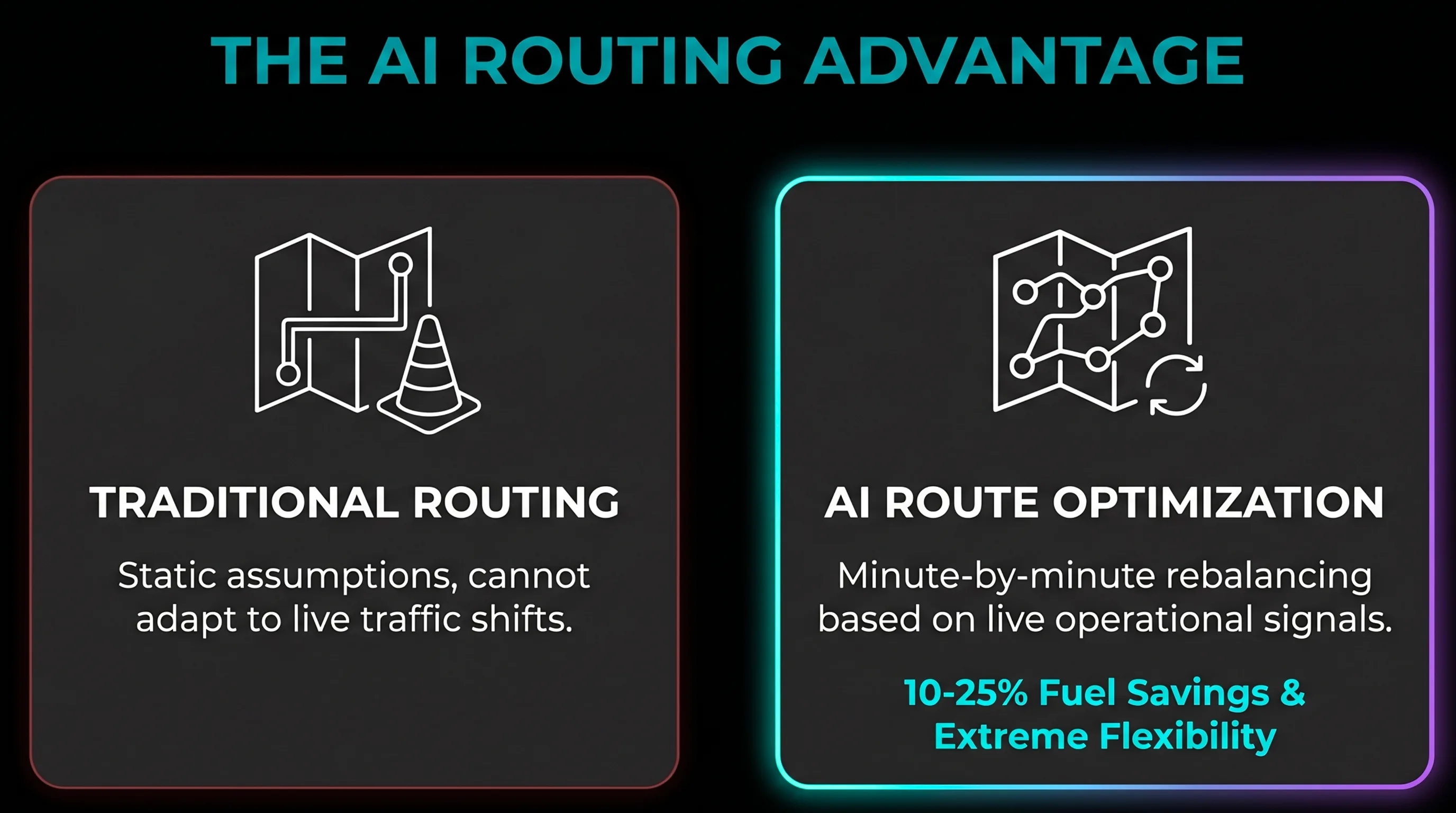
The biggest advantage is not speed. It is flexibility under pressure. Companies using AI-driven routing and logistics automation are seeing fuel savings between 10-25% depending on fleet scale and delivery density.
Inventory forecasting is no longer guesswork
One of the most expensive mistakes in supply chains is reacting too late to demand movement. Overstocking traps working capital. Understocking damages customer trust. Most forecasting systems still rely too heavily on historical averages. AI changes forecasting from static analysis into continuous interpretation.
Modern predictive analytics in logistics systems process live demand signals, seasonal shifts, supplier behavior, regional buying patterns and operational volatility simultaneously. The result is not perfect prediction. It is reduced uncertainty.
This evolution in machine learning supply chain systems allows organizations to make faster and more adaptive inventory decisions across complex AI in logistics and supply chain networks.
That matters because inventory mistakes compound across the supply chain:
- Excess storage cost
- Unnecessary procurement
- Delayed replenishment
- Dead stock accumulation
Companies are improving forecasting accuracy through AI and logistics automation. Those are already reducing excess inventory exposure by 15-35%.
Warehouses are becoming adaptive environments
The most advanced warehouse operations today do not simply automate movement. They adapt movement. This is where automated warehouse robotics in AI in logistics is evolving beyond repetitive machine workflows.
AI systems now dynamically redirect warehouse activity depending on:
- Order urgency
- Congestion zones
- Picking efficiency
- Loading schedules
Warehouses essentially become responsive operational environments instead of fixed process systems. The biggest operational impact usually appears in fulfillment speed and labor dependency reduction.
Large fulfillment centers implementing adaptive robotic workflows, warehouse automation AI, and logistics automation are reporting picking efficiency improvements of 30-50%. Especially during high-volume demand spikes.
Inventory systems are finally learning behavior
Traditional inventory systems track products. AI-driven inventory systems track behavior. That distinction matters.
Modern machine learning inventory management platforms continuously analyze inventory movement and demand patterns. This includes supplier reliability, regional demand fluctuations, seasonal shifts and return trends. The system then repositions inventory dynamically based on those insights.
Instead of relying on fixed reorder rules, systems adapt inventory decisions continuously. This creates operational advantages that are difficult to achieve manually:
- Better warehouse space usage
- Lower holding cost
- Reduced dead inventory
- Faster stock turnover
This becomes a major profitability lever for multi-location operations using AI in logistics and supply chain technologies.
Delivery predictions are becoming operational tools
Customers no longer expect perfection. They expect accuracy. The problem with most ETA systems is that they react too slowly to changing conditions. AI-driven delivery prediction systems constantly reinterpret operational variables like:
- Route behavior
- Driver patterns
- Traffic volatility
- Warehouse loading delays
- Regional congestion patterns
This improves much more than customer communication.
Internally, better ETA intelligence powered by predictive analytics in logistics improves dispatch coordination, reduces support escalations and helps operations teams make better decisions earlier.
And that’s why predictive delivery systems are increasingly becoming operational planning tools rather than customer-facing features.
Fraud detection is moving into real time
Supply chain leakage rarely happens dramatically. It usually hides inside normal-looking operational data.
Duplicate invoices. Fuel inconsistencies. Shipment anomalies. Unusual route behavior.
AI systems are now identifying abnormal operational patterns before financial loss expands. Instead of waiting for monthly audits, systems continuously monitor behavioral irregularities across transactions, fleet activity and inventory movement using advanced AI supply chain management solutions.
For enterprise operators, this creates a major advantage. That advantage is smaller operational leaks stop becoming large financial problems.
Digital twins are becoming executive decision engines
One of the most interesting developments in the digital twin supply chain space is operational simulation.
Companies are now building virtual operational replicas of their logistics environments to test disruptions before they happen in reality.
Leadership teams can simulate:
- Port delays
- Demand spikes
- Supplier failures
- Fleet shortages
- Warehouse bottlenecks
This changes planning entirely.
Instead of reacting after disruption, organizations evaluate risk scenarios in advance and adjust operations proactively using AI in supply chain management.
For global supply chains operating under constant uncertainty, this is becoming a major resilience advantage.
Load planning > manual coordination
Half-utilized fleet capacity quietly drains profit.
AI-driven load optimization systems now evaluate shipment dimensions, delivery sequencing, vehicle constraints and routing logic simultaneously to maximize transport efficiency.
The impact is operationally simple but financially significant:
- Fewer unnecessary trips
- Higher vehicle fill rates
- Lower fuel spend
- Better route density
Even small utilization improvements create major savings when applied across large transportation networks daily.
Exception management is getting automated
Most logistics teams still spend huge amounts of time managing operational exceptions manually.
A delayed shipment triggers emails. A route issue requires calls. Inventory mismatches escalate across departments. AI systems are increasingly absorbing this coordination pressure automatically.
Instead of waiting for teams to detect issues, systems identify disruptions instantly, prioritize severity, and trigger corrective workflows immediately.
That changes operations dramatically. Teams stop spending entire days reacting to problems and start focusing on optimization instead with the help of AI-powered logistics solutions.
None of this works on fragmented data
This is the part many companies try to skip. AI systems are only as effective as the infrastructure feeding them. Disconnected systems create:
- Reporting inconsistencies
- Delayed synchronization
- Inaccurate forecasting
- Weak automation performance
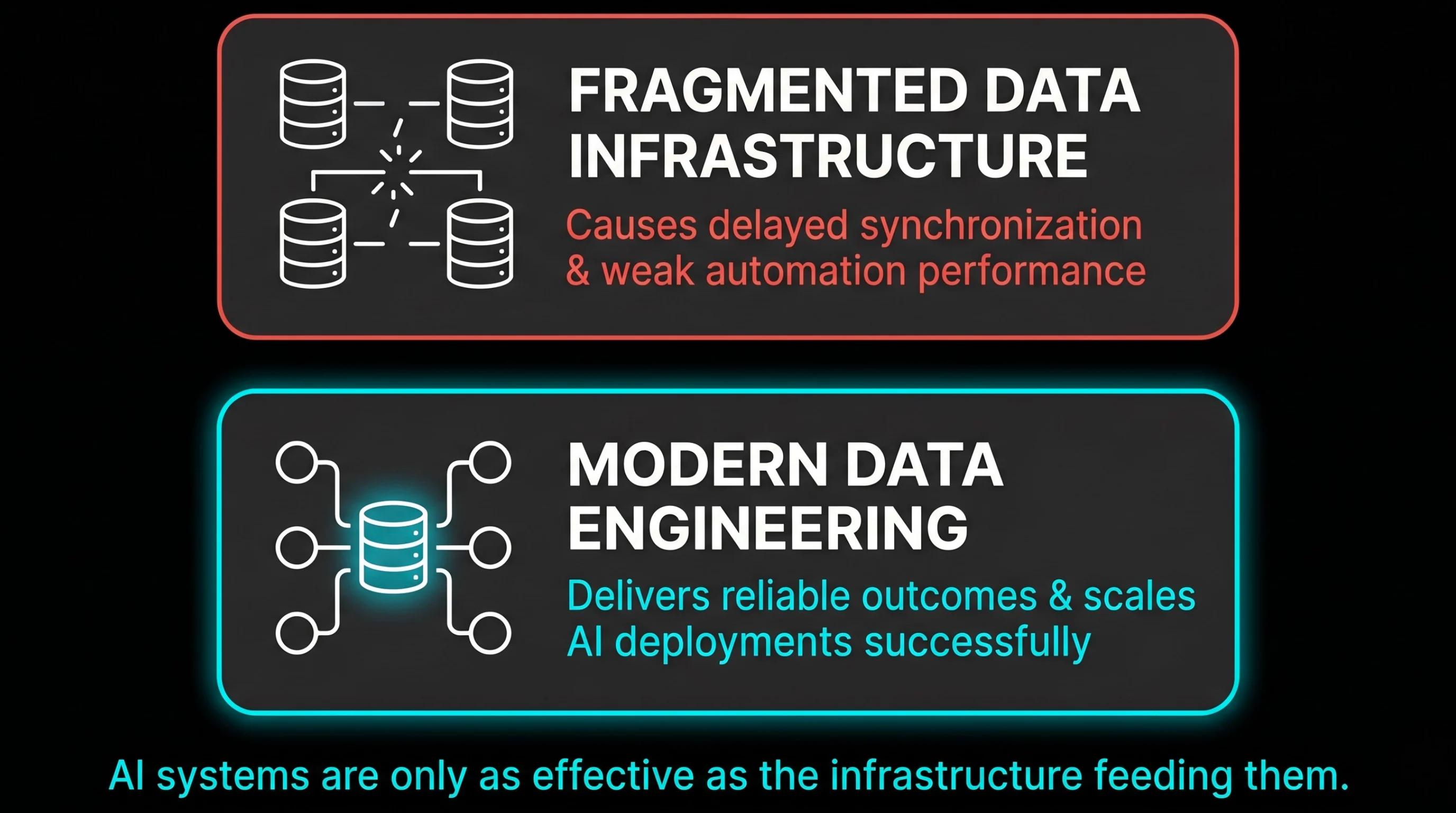
Strong data engineering is no longer optional in modern logistics environments. Without clean operational infrastructure, even advanced AI in supply chain management deployments struggle to deliver reliable outcomes. This is why organizations investing in AI successfully are usually modernizing their data environments first.
What actually separates successful deployments
The companies generating measurable results from AI are not chasing trends aggressively. They are fixing operational friction carefully.
They focus on:
- High-cost inefficiencies first
- Strong operational data quality
- Gradual deployment strategies
- Clear performance metrics
This is the reason their AI investments and AI-powered logistics initiatives produce operational gains instead of becoming expensive experiments.
Where Seaflux fits
At Seaflux, AI deployment is approached from an operational perspective first.
The objective is not adding more dashboards or disconnected automation layers. It’s about building practical AI logistics solutions that improve supply chain performance in measurable ways through intelligent automation, operational visibility, and faster decision-making.
As a custom software development company, Seaflux focuses on creating scalable systems designed around real operational challenges instead of generic technology implementation.
The focus is on delivering measurable outcomes such as:
- Lower operational cost
- Better forecasting
- Faster decision-making
- Reduced downtime
- Stronger scalability
Through advanced AI & Machine Learning Services, Data Engineering, custom AI solutions, and custom logistics software development, Seaflux helps businesses modernize logistics infrastructure with flexible and scalable supply chain automation solutions tailored to operational needs.
From predictive analytics to workflow optimization, these supply chain solutions are designed to improve efficiency, reduce operational friction, and support long-term business growth.
Explore transforming operations with custom logistics software development services.
Schedule a meeting with us to explore smarter AI-driven logistics transformation for your business.
Final thought that is worth remembering
Most supply chains collapse because efficiency is often lost gradually through small delays, missed signals and disconnected systems. Reactive decision-making only adds to the problem.
AI matters because it reduces that friction continuously, and these AI in logistics use cases show how operational efficiency is becoming proactive instead of reactive. Definitely not by replacing operations teams. But by helping them operate with better timing, cleaner visibility and faster decisions every single day.
The biggest logistics advantage in 2026 will come from identifying delays before they spread across operations. That visibility helps businesses respond before disruptions grow larger through smarter AI-powered logistics capabilities.
Build systems that predict pressure early, optimize continuously and turn operational complexity into measurable efficiency.

Krunal Bhimani
Business Development Executive