How AI in Logistics Fixes the Decision Gap in Modern Fleet Management
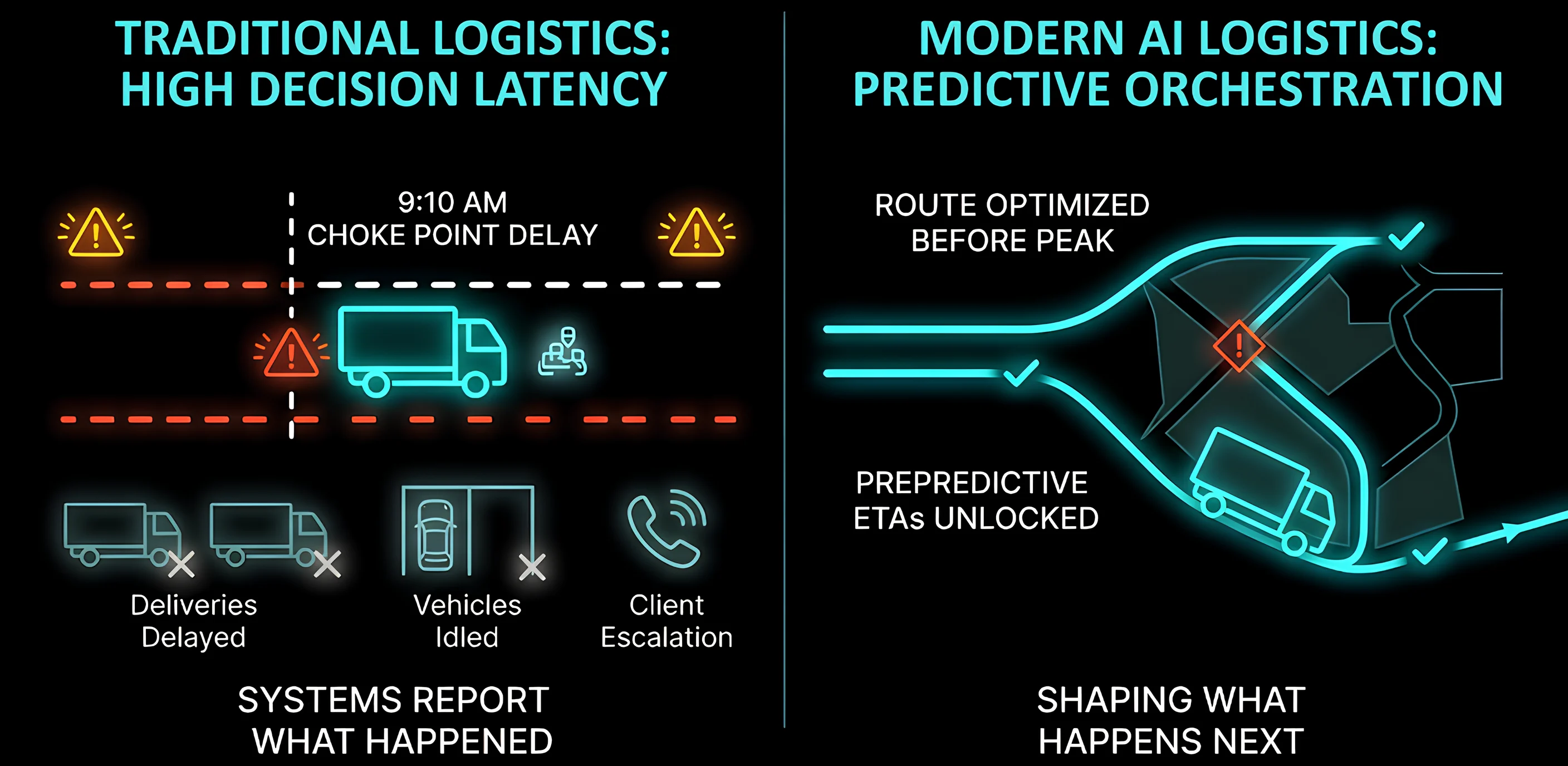
At 7:40 AM, your dashboard says everything is “on track.”
At 9:10 AM, a single delay at a choke point knocks out three deliveries, idles two vehicles and pushes one client into escalation.
Nothing broke. It’s just that your system just didn’t see it coming. That’s the real cost of legacy logistics.
For most fleets, the problem is not visibility anymore. GPS solved that years ago. The problem is decision latency. Systems that report what already happened instead of shaping what happens next. And that gap is where margins disappear.
This is exactly where AI stops being a “nice upgrade” and becomes operational infrastructure, forming the backbone of modern intelligent transportation systems.
Stop tracking & start orchestrating
Traditional fleet systems are built on a simple model. That is collect location data, display it and react when something goes wrong. It is static. Linear. Dependent on human intervention.
AI flips that model.
Instead of asking “Where is my fleet?” the system continuously answers “What should happen next to avoid loss?” using predictive analytics in logistics.
This is the foundation of modern AI logistics architecture and AI fleet management. Systems that don’t just track movement, but also predict, adjust and improve it in real time through dynamic route optimization.
The difference is not subtle:
Static GPS → Periodic updates
AI systems → Continuous decision loops
Manual rerouting → After disruption
Dynamic route optimization → Before disruption compounds
Maintenance checks → Scheduled
Predictive systems → Condition-based, failure-aware
Once this change is in place, logistics stops behaving like a chain and starts operating like a responsive network powered by AI in logistics.
ETAs that actually change outcomes
Most companies think predictive ETAs are about better customer communication. That’s surface-level thinking.
Accurate ETAs matter, but the real value sits deeper. Deeper in how they influence upstream decisions. When your system can predict delays… even before they happen, you unlock three immediate levers. Those are:
- Route correction before congestion peaks
- Load redistribution across nearby vehicles
- Dock scheduling adjustments at the destination
Without predictive intelligence, these decisions happen late. By then, options are already limited and more expensive. With it, you operate inside the window where small changes prevent large losses. That’s where cost savings actually show up, often driven by logistics automation software within an AI-powered supply chain and supported by autonomous fleet management.
Where routing turns into real money
Fuel, driver hours, idle time and missed slots all add up. Most of these losses come down to inefficient routing. Legacy systems treat routing as a one-time calculation. You plan a route, then execute it.
Reality does not work like that.
Traffic shifts. Weather hits. Loading delays cascade. A “perfect route” at dispatch becomes irrelevant within minutes.
This is why dynamic route optimization is not an enhancement. It is the core engine of any modern logistics system and a defining capability of intelligent transportation systems and a smart fleet management system.
AI-driven routing systems recalculate continuously using dynamic route optimization, factoring in:
- Live traffic and congestion patterns
- Delivery window constraints
- Vehicle capacity and load priority
- Driver hours and compliance limits
The result is a constantly evolving one. And the impact is measurable:
- Reduced fuel burn
- Lower idle time
- Higher delivery density per route
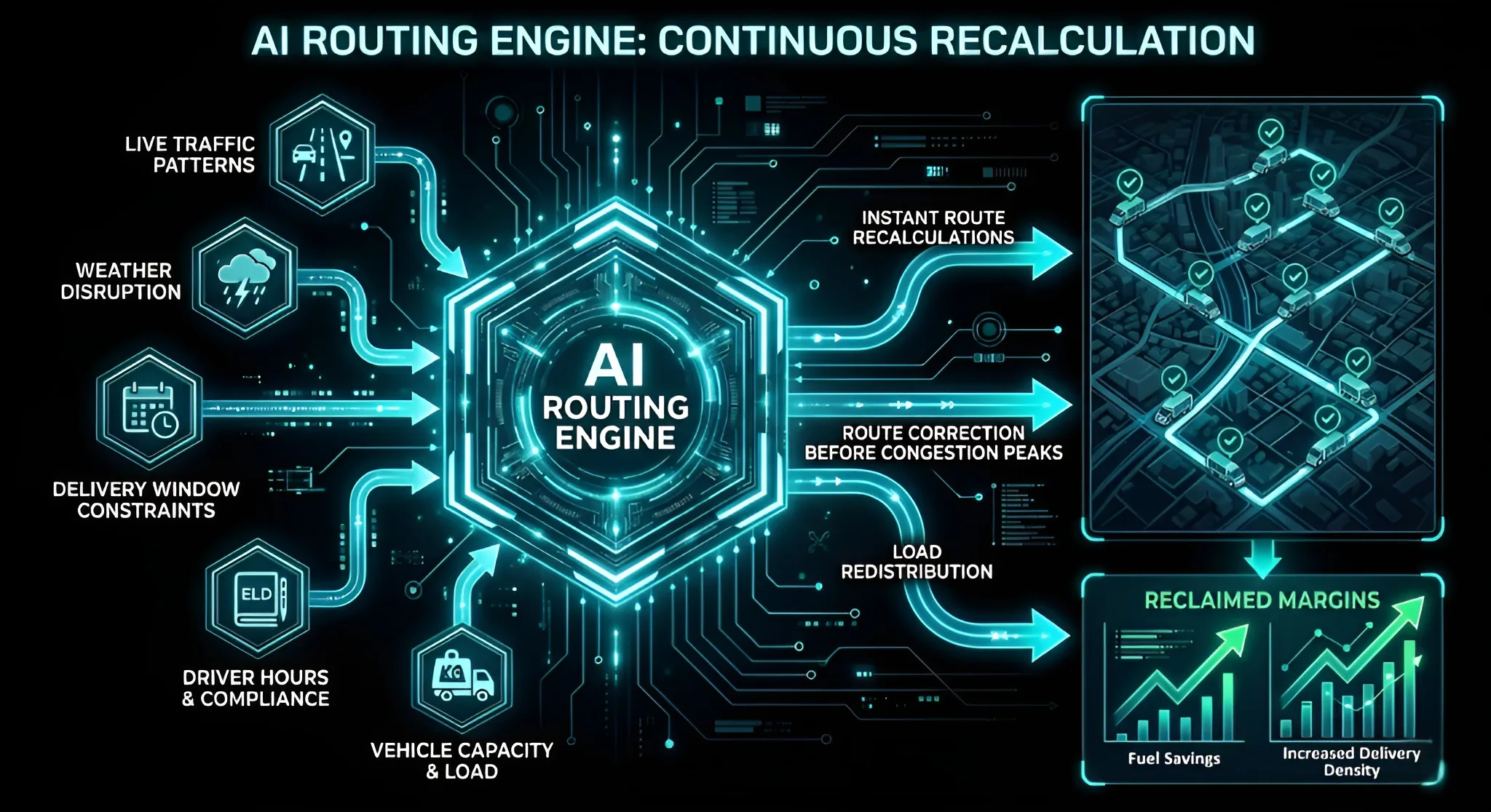
You are not shaving minutes. You are reclaiming margins.
Scaling fleets without scaling chaos
Growth breaks traditional logistics systems.
Add more vehicles and coordination complexity increases exponentially. More dispatchers. More manual overrides. More inconsistencies.
This is exactly where autonomous fleet management becomes critical. The goal is not removing humans. It is removing dependency on manual coordination through AI in logistics.
AI systems handle:
- Vehicle assignment based on real-time constraints
- Load balancing across fleet capacity
- Exception handling without escalation loops
Instead of operators managing vehicles, they manage outcomes. The system absorbs complexity. Teams focus on edge cases and strategic decisions. That’s how fleets scale through autonomous fleet management without multiplying operational overhead.
Killing downtime before it shows up
Unplanned downtime is one of the most expensive blind spots in fleet operations.
A single vehicle breakdown does not just stop one delivery. It disrupts schedules, reallocates loads and increases pressure across the network. Traditional maintenance models rely on fixed schedules or reactive fixes. AI changes that by turning every vehicle into a live data source, continuously feeding signals into the fleet management system. Sensors track performance indicators. These include engine health, temperature patterns and vibration anomalies. The system identifies failure patterns before they surface.
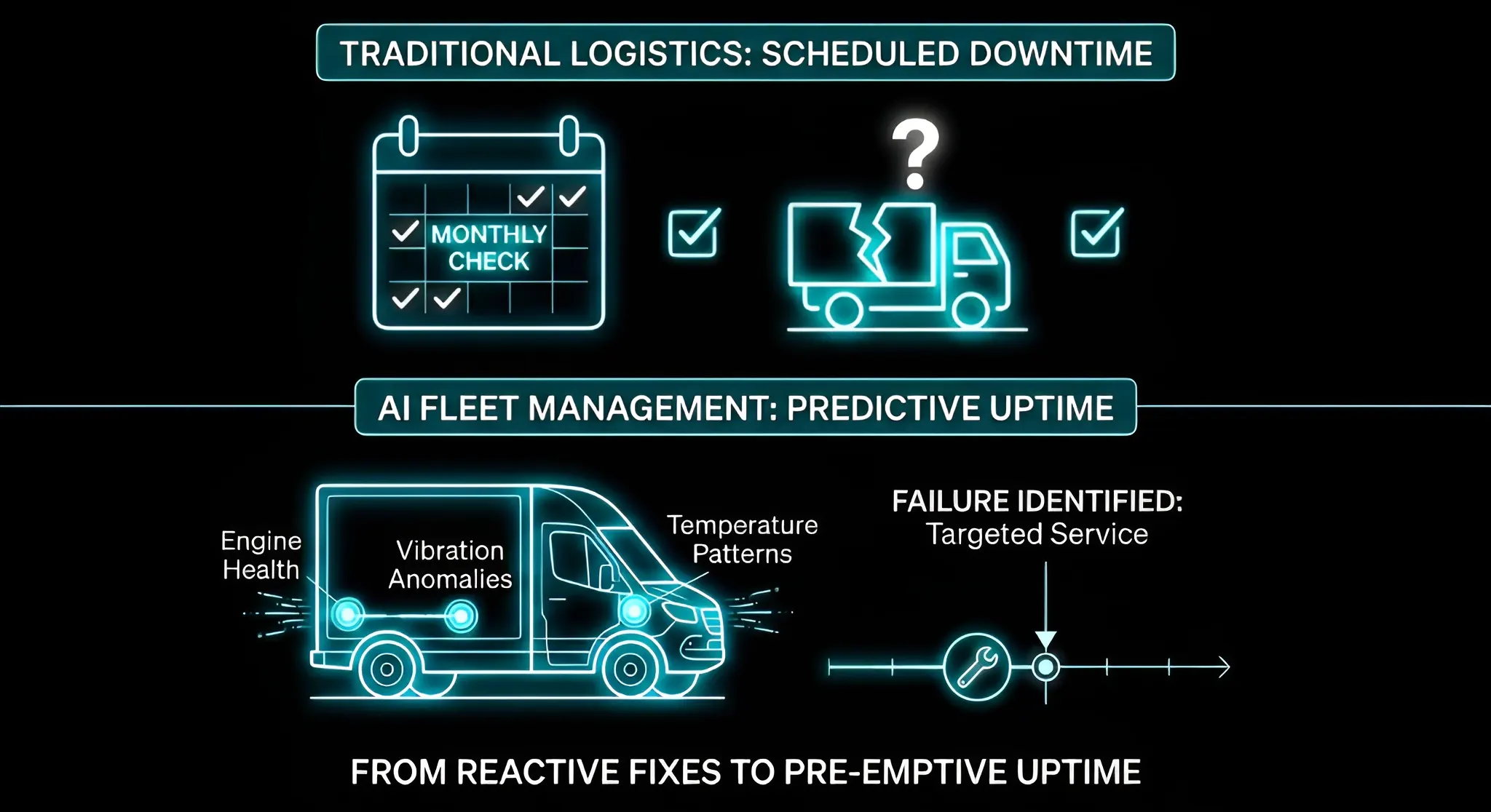
Maintenance becomes:
- Targeted instead of periodic
- Pre-emptive instead of reactive
Vehicles are serviced based on actual need. This leads to higher fleet uptime and fewer cascading disruptions.
When your supply chain starts thinking for itself
Most logistics stacks today are stitched together:
- A tracking system
- A routing tool
- A maintenance log
- A warehouse interface
Each solves a piece of the problem. None talk to each other effectively.
AI systems upgrade individual functions. But along with that they unify them. This is where the concept of a self-optimizing supply chain 2026 becomes real with the support of AI fleet management.
In this model:
- Routing decisions factor in warehouse readiness
- Maintenance schedules influence vehicle allocation
- Delivery delays automatically adjust downstream operations
Everything is connected. Everything feeds into a shared decision engine enhanced by real-time route optimization. The system does not wait for instructions. It continuously adjusts to maintain efficiency. That’s what “self-optimizing” actually means. Definitely not automation, but coordination at scale.
How to upgrade without breaking operations
The biggest resistance to AI adoption is not cost. It is risk.
No COO wants to disrupt live operations with a system overhaul. The answer is not a full replacement. It is a layered deployment of logistics automation software.
Phase 1: Data Structuring
Bring data from GPS, telematics and operational systems together. Feed them into one pipeline. No intelligence yet. Just clean and structured data.
Phase 2: Predictive Layer
Introduce predictive ETAs and anomaly detection. Keep existing workflows intact while adding forward visibility using AI in logistics.
Phase 3: Decision Automation
Enable dynamic route optimization and automated rerouting. Start with limited routes or regions to validate impact.
Phase 4: Fleet Autonomy
Expand into autonomous fleet management and predictive maintenance, moving toward fully autonomous logistics. Gradually reduce manual intervention.
Each phase builds on the previous one. No downtime. No operational shocks. You are not replacing your system. You are evolving it.
Where the ROI actually shows up
AI adoption often gets framed in vague efficiency gains. That’s not how operators think. ROI shows up in specific, trackable metrics:
- Fuel cost reduction from optimized routing
- Increased deliveries per vehicle per day
- Lower maintenance costs due to early detection
- Reduced SLA penalties from improved predictability
But the biggest gain is operational stability within an AI-powered supply chain.
Fewer surprises. Fewer escalations. Fewer firefighting cycles.
That stability compounds over time. It reduces stress on teams, improves client trust and creates a system that can scale without constant intervention. That's where AI-driven logistics actually pays for itself.
Why speed of decisions matters more than data
Centralized systems introduce latency. Data travels, gets processed and returns with instructions.
We all know that in logistics, seconds matter.
AI-driven fleets increasingly rely on edge computing, a critical component of intelligent transportation systems. They process data closer to the source, inside the vehicle or local network.
This enables:
- Instant route recalculations
- Real-time hazard detection
- Faster response to unexpected events
The system does not wait for the cloud. It acts immediately. That’s what turns AI from a reporting tool into a decision engine.
The real risk is staying static
Most logistics leaders think adopting AI is risky. But the reality is the opposite.
Static systems are the ones that rely on fixed routes, manual decisions and delayed reactions. They are already costing you money every day. They just hide it well.
AI does not introduce complexity. It absorbs that complexity instead, enabling fleets to scale without adding operational chaos.
It turns unpredictability into a managed variable. It converts delays into adjustments. It replaces reaction with anticipation. And once that shift happens, logistics stops being a cost center you optimize and becomes a system you control.
Where Seaflux fits in your next move
This transition doesn’t happen with off-the-shelf tools. It requires custom software development services and tailored custom logistics solutions built around your fleet structure and constraints.
That’s where Seaflux operates. It delivers custom AI solutions and AI logistics solutions that integrate into live environments, enabling smarter decisions through fleet optimization software.
This foundational shift also connects directly to broader platform-level thinking, see our guides on logistics platform consolidation and unified intelligence and AI observability in logistics for what comes after fleet-level AI adoption."
The focus stays on higher uptime, lower cost and predictable operations, so you can build a fleet that thinks, adapts and saves money on its own.
Schedule a meeting with us to explore how this can work for your operations.
Frequently Asked Questions (FAQ): Get the Answers You Need
What is decision latency in fleet management?
Decision latency is the delay between when a problem occurs and when a system or team can actually respond to it. Traditional GPS-based fleet systems report what already happened, while AI-powered systems close that gap by predicting and acting before disruption compounds.
How does AI reduce fleet downtime?
AI monitors real-time vehicle data like engine health, temperature, and vibration patterns to detect failure signs before a breakdown happens, shifting maintenance from a fixed schedule to a condition-based, predictive approach.
Is AI-powered fleet management expensive to implement?
Most successful rollouts happen in phases, starting with data structuring, then predictive layers, then decision automation, rather than a full system replacement, which keeps risk and cost manageable.
What is the difference between GPS tracking and AI fleet management?
GPS tracking tells you where a vehicle is right now. AI fleet management goes further, predicting what will happen next and recommending or automating the response, like rerouting before congestion hits.
Can AI fleet management scale with a growing fleet?
Yes, that's one of its core advantages. Instead of adding more dispatchers and manual overrides as a fleet grows, AI systems absorb the added coordination complexity automatically.

Krunal Bhimani
Business Development Executive