Real Cost of AI Chatbot Development in USA (2026 Pricing Guide)
A chatbot quote that looks “reasonable” on paper can quietly become a six-figure system within months.
This will not occur because teams overspend. It will occur because most budgets ignore what actually drives cost in enterprise AI, including realistic expectations around AI chatbot pricing.
By 2026, building conversational systems is no longer just about deploying a bot. It’s about designing an intelligence layer that integrates with business systems, handles sensitive data and operates reliably at scale.
This guide breaks down the real cost of AI chatbot development cost USA. From initial build to long-term ownership, so CTOs and business leaders can plan with clarity around both chatbot investments and broader AI software development cost.
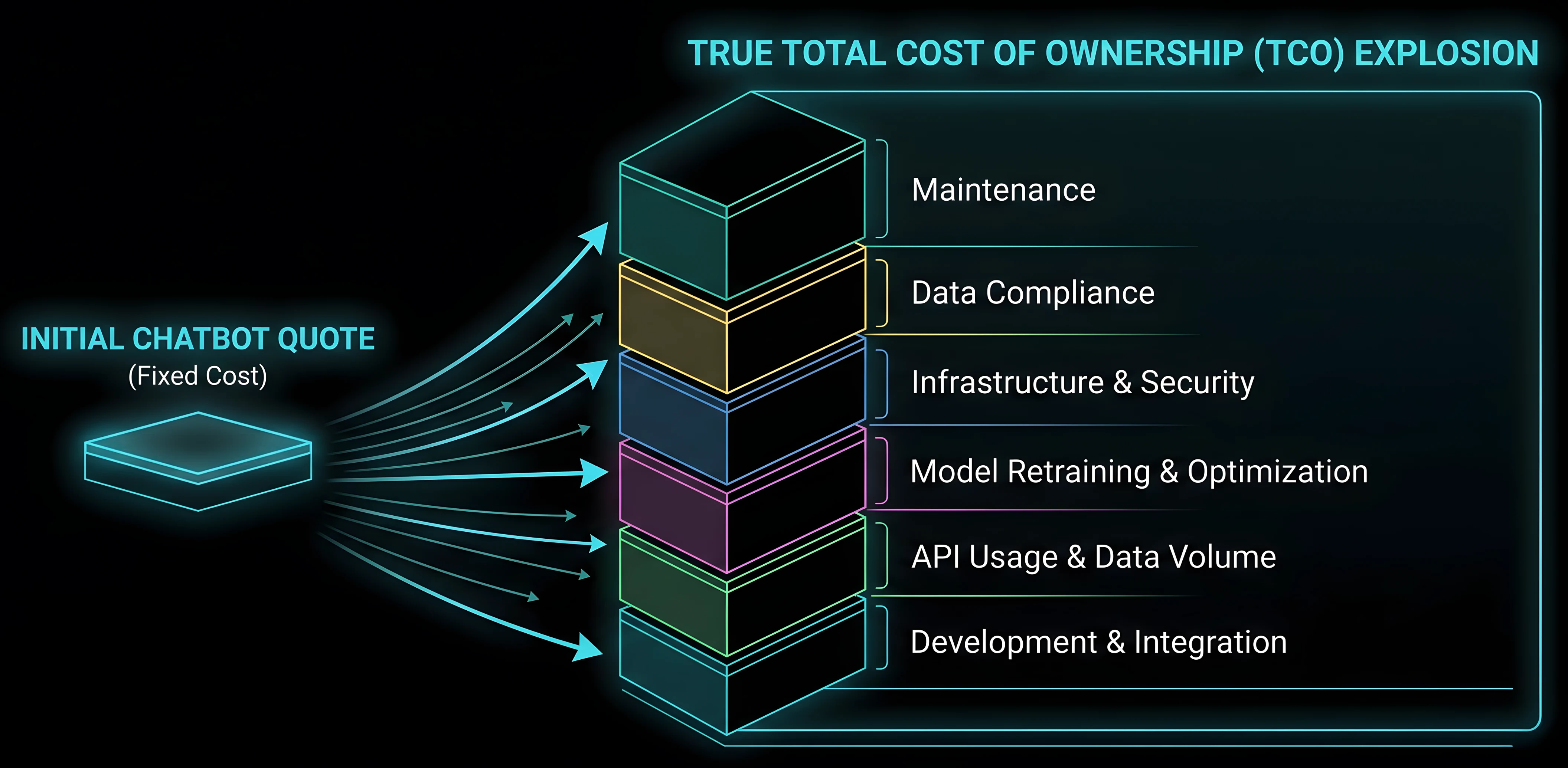
The Misconception of “Chatbot” as a Fixed Cost
The first mistake is treating chatbot development as a one-time expense.
In reality, modern AI systems… especially those powered by Generative AI behave more like infrastructure than software features. Costs are not just tied to development. They grow with usage, complexity and data growth, which directly impacts the overall chatbot development cost in USA.
That’s why understanding AI total cost of ownership (TCO) is critical from day one and plays a key role in realistic AI chatbot pricing and achieving strong AI chatbot ROI.
What Defines the Cost of an AI Chatbot in 2026
There is no single price range. It is because cost is driven by architecture decisions. However, most enterprise systems fall into three broad categories:
1. Rule-Based / NLP Bots (Entry Level)
- Basic workflows, predefined responses
- Limited integrations
- Minimal AI capabilities
Estimated Cost of USA: $20,000 - $60,000
These work okay for basic automation. But they do not scale well or handle context effectively, keeping initial AI software development cost relatively lower.
2. Mid-Level AI Chatbots (Hybrid Systems)
- Combination of NLP + limited LLM usage
- Integration with internal tools (CRM, support systems)
- Moderate customization
Estimated Cost of USA: $60,000 - $150,000
This is where enterprise conversational AI pricing 2026 becomes highly variable by depending on scale and requirements, making conversational AI pricing a key strategic consideration.
3. Enterprise Generative AI Systems
- Full LLM integration
- Context-aware responses using enterprise data
- Advanced orchestration and automation
- High security and compliance standards
Estimated Cost of USA: $150,000 - $500,000+
This is where enterprise conversational AI pricing 2026 becomes highly variable by depending on scale and requirements.
Core Cost Drivers
They are the one who actually moves the budget.
Understanding what drives cost helps avoid underestimating the investment.
1. Model Complexity and LLM Integration Costs
The more advanced is the AI, the higher is the cost.
- Basic NLP models are cheaper but limited
- LLM-powered systems require integration, fine-tuning and optimization
- Multi-model orchestration (using different models for different tasks) increases cost
LLM integration costs also include API usage, latency optimization and prompt engineering layers. This is not a one-time expense. It continues throughout the system’s lifecycle and significantly impacts conversational AI pricing.
2. Data and Context Engineering
AI is only as effective as the data it uses.
For enterprise systems, this includes:
- Structuring internal data sources
- Building retrieval systems (RAG pipelines)
- Creating data pipelines for continuous updates
This is often underestimated but forms a significant part of the GenAI chatbot budget.
3. Third-Party Integrations
A chatbot becomes valuable. But only when it connects with business systems.
Common integrations include:
- CRM platforms
- ERP systems
- Payment gateways
- Internal APIs
Each integration adds development complexity, testing overhead and long-term maintenance costs, increasing AI chatbot development in USA and contributing to overall chatbot implementation cost.
4. Security and Compliance
In the US market, compliance requirements significantly impact cost.
Systems handling sensitive data must include:
- Encryption (in transit and at rest)
- Role-based access controls
- Audit logging
- SOC 2, HIPAA and other compliance norms
Security is not optional. It is a major cost driver in enterprise deployments and a key component of conversational AI pricing.
5. Infrastructure and Scalability
AI systems need strong infrastructure to handle real-time interactions smoothly.
Costs here include:
- Cloud computing resources
- Load balancing and scaling
- Monitoring and logging systems
As usage grows, infrastructure costs scale with it, directly influencing AI chatbot development in USA.
Hidden Costs that Budgets misses
The initial build is only part of the investment. Post-launch costs often determine the true financial impact.
API Usage Costs
LLM-based systems incur ongoing charges based on usage.
- Cost per token or request
- Increased usage with higher adoption
- Additional charges for advanced models
Over time, API costs can exceed development costs if not optimized, significantly affecting chatbot development cost in USA.
Model Retraining and Optimization
AI systems require continuous improvement.
- Updating models with new data
- Refining prompts and workflows
- Increasing accuracy and decreasing errors
This is an ongoing cost and not a one-time task.
Data Compliance and Governance
As systems scale, data governance becomes more complex.
- Managing access control
- Ensuring regulatory compliance
- Monitoring data usage
These costs increase as the system grows and must be factored into custom AI chatbot development.
Maintenance and Support
AI systems require constant monitoring.
- Fixing edge-case failures
- Updating integrations
- Ensuring uptime and reliability
Maintenance typically ranges from 15-25% of the initial development cost annually and is a major factor in AI chatbot development cost.
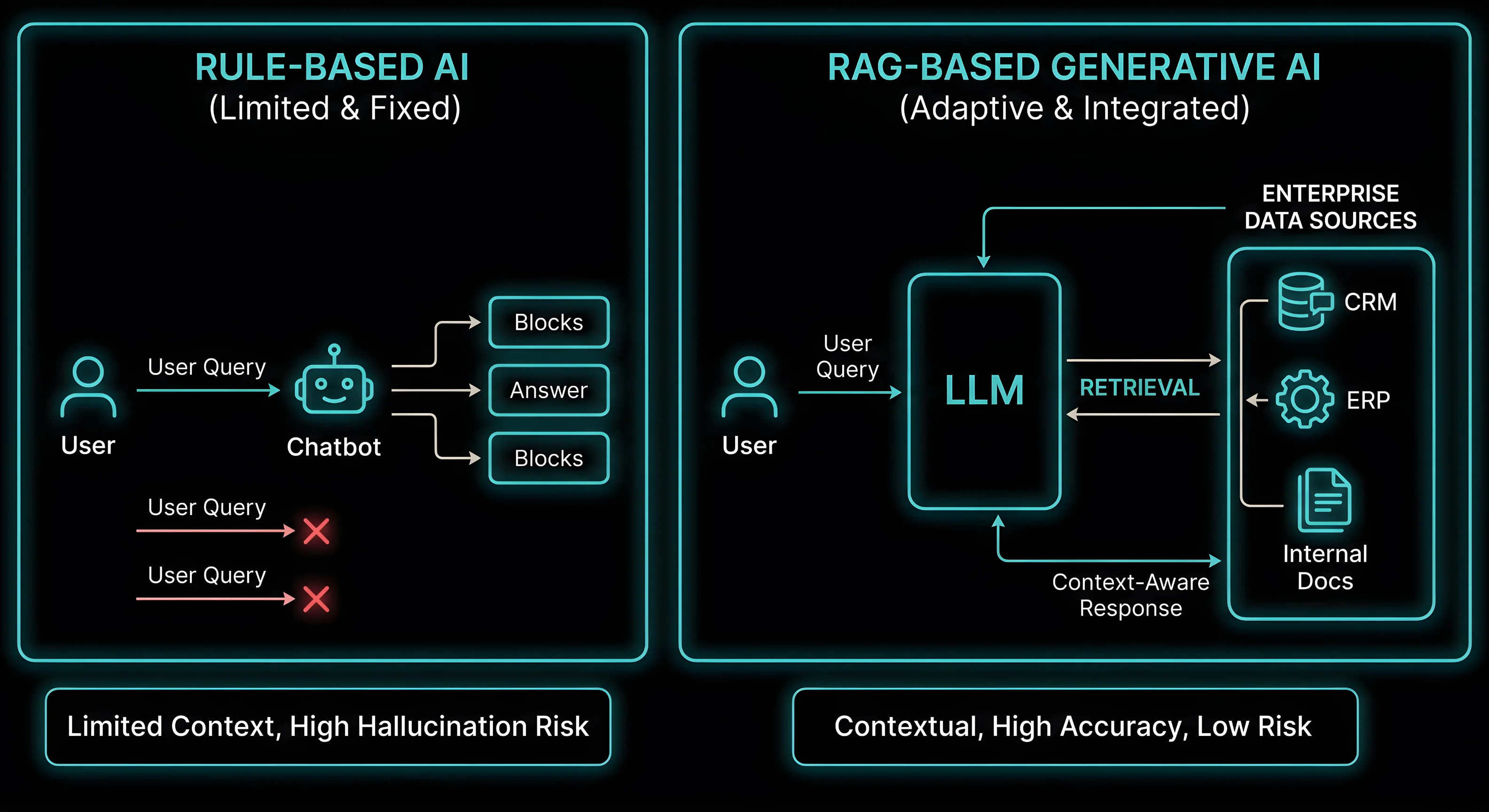
Why RAG-based Architectures improve ROI
One of the most important architectural decisions in 2026 is whether to implement Retrieval-Augmented Generation (RAG).
RAG systems connect LLMs to internal data sources that allows them to generate responses based on real business context.
From a cost perspective, RAG offers several advantages:
- Reduces dependency on expensive fine-tuning
- Improves accuracy, lowering rework and support costs
- Enables reuse of existing enterprise data
- Minimizes hallucinations, reducing operational risk
RAG introduces some upfront complexity. But it improves long-term ROI by making AI systems more reliable and scalable, ultimately optimizing chatbot development cost in USA.
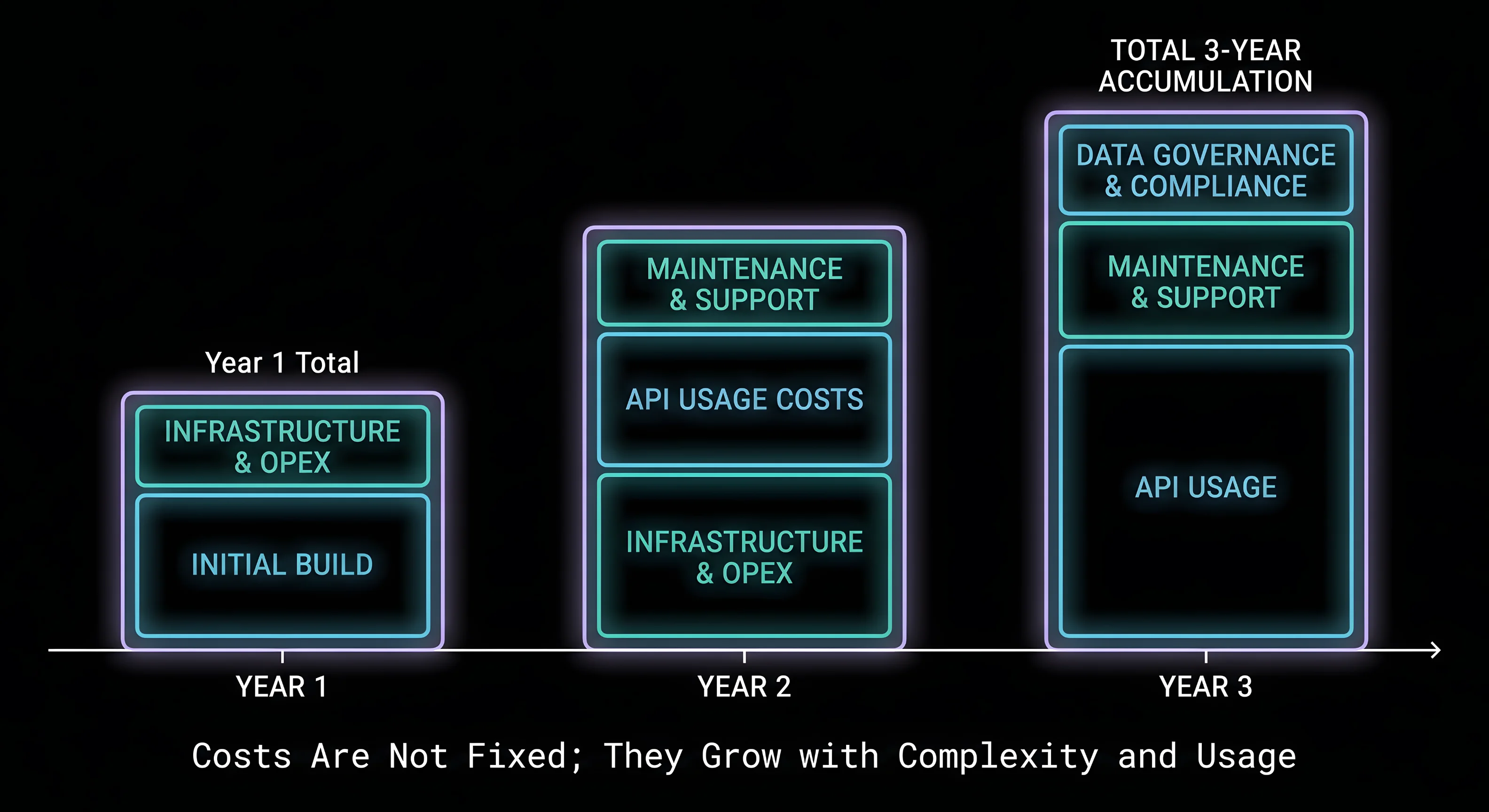
Estimating TCO
It is important to look beyond development to understand the full investment.
A typical enterprise AI chatbot TCO (Total Cost of Ownership) includes:
Initial Development
- Architecture design
- Model integration
- Backend and frontend development
Ongoing Costs
- API usage and compute
- Infrastructure scaling
- Maintenance and updates
Operational Costs
- Monitoring and support
- Compliance and governance
- Data pipeline management
Over a 3-year period, total costs can be 2-3x the initial development investment. This is why planning for AI total cost of ownership is essential from the beginning.
Budgeting the Right Way
Instead of asking “How much does it cost to build a chatbot?” the better question is that “How much should we invest to make AI effective in our business?”
A practical budgeting approach includes:
- Allocating 40-50% for initial development
- Planning 30-40% for ongoing operations
- Reserving 10-20% for optimization and scaling
This ensures the system remains sustainable and continues to deliver value while managing AI chatbot development cost effectively.
Aligning Cost with Business Value
The goal is not to minimize cost. It is to maximize return.
Well-designed AI systems deliver value through:
- Reduced operational workload
- Faster customer response times
- Improved decision-making
- Scalable automation across teams
The ROI of AI systems outweighs their cost when aligned correctly, justifying overall AI chatbot cost.
Where Engineering Meets Strategy
Building an enterprise AI chatbot requires more than technical execution.
It requires alignment across:
AI & Machine Learning Services for model design and optimization
Custom Software Development for tailored workflows and integrations
Scalable infrastructure to support growth and reliability
These elements make sure that the system is functional as well as sustainable and aligned with effective AI chatbot pricing, optimized AI chatbot cost, and successful custom AI chatbot development.
Final Take
The cost of building an AI chatbot is not defined by the tool you choose in 2026.
It is defined by how deeply it integrates into your business. The real investment is not in the chatbot itself. It is in building a system that can think, adapt and scale with your operations.
At Seaflux, a custom software development company, we help businesses build scalable systems through custom AI solutions and chatbot development services. From custom chatbot development to enterprise AI, the focus is on delivering real business value.
Schedule a call to discuss your AI strategy.

Krunal Bhimani
Business Development Executive