 Retail & E-commerce
 USA
USA 4 Weeks
Luxury Brand AWS Cloud Migration with Automated Deployment Using Terraform
Seaflux helped a luxury brand with AWS cloud migration, infrastructure as code Terraform, automated deployment Jenkins, and high availability AWS solutions.
Overview
At A Glance
Industry
Retail & E-commerce
Region
USA
Duration
4 Weeks
Technical Stack
 docker
 AWS
AWS Elasticsearch
 AWS EC2
 AWS RDS
 HashiCorp Terraform
 AWS ECR
 AWS ECS
 AWS VPC
 Redis
RedisClient Profile
The client is a leading global provider of luxury products, tailored and customized according to the preferences and regulations of specific countries. Their business model focuses on delivering a highly personalized shopping experience, where content and offerings are dynamically presented based on the customer’s geographic location. This requires advanced technology integration to ensure that websites are fast, secure, and scalable to handle large volumes of international traffic while maintaining a consistent luxury brand experience.
Challenge
The client initially managed their entire infrastructure through on-premises deployments, where each website was hosted, deployed, and maintained individually. This approach introduced several challenges:
- Security Concerns:
With on-prem infrastructure, ensuring robust security was a constant challenge. The management of sensitive information, such as database credentials and PEM files for server connections, posed significant risks. Any mismanagement could lead to unauthorized access or data breaches.
- Scalability Issues:
The websites received bursts of traffic during holidays and promotions. The on-prem environment did not allow for any auto-scaling functions, and frequently crashed or temporarily went offline. This experience was damaging to the customer experience, which could have impacted revenue.
- Exorbitant Operational Expenses:
In-house infrastructure demands a lot of money on servers, network equipment, storage systems, and backup solutions. To maintain, monitor, and troubleshoot everything, more money must flow in through labor than hardware.
- Time-Consuming Release Cycles:
Besides, because each website was deployed manually, it became tedious, error-prone, and took much too long a repetitive cycle. Where automation would have accelerated and simplified the process, in this instance, it slowed the entire release cycle for the client to respond to the market.
- CI/CD Pipeline Inefficiencies:
The existing Jenkins infrastructure was inefficient, which caused delays in the code that was being deployed. The process of pulling down the latest code, staging changes, and keeping things consistent across environments became cumbersome and draining.
Solution
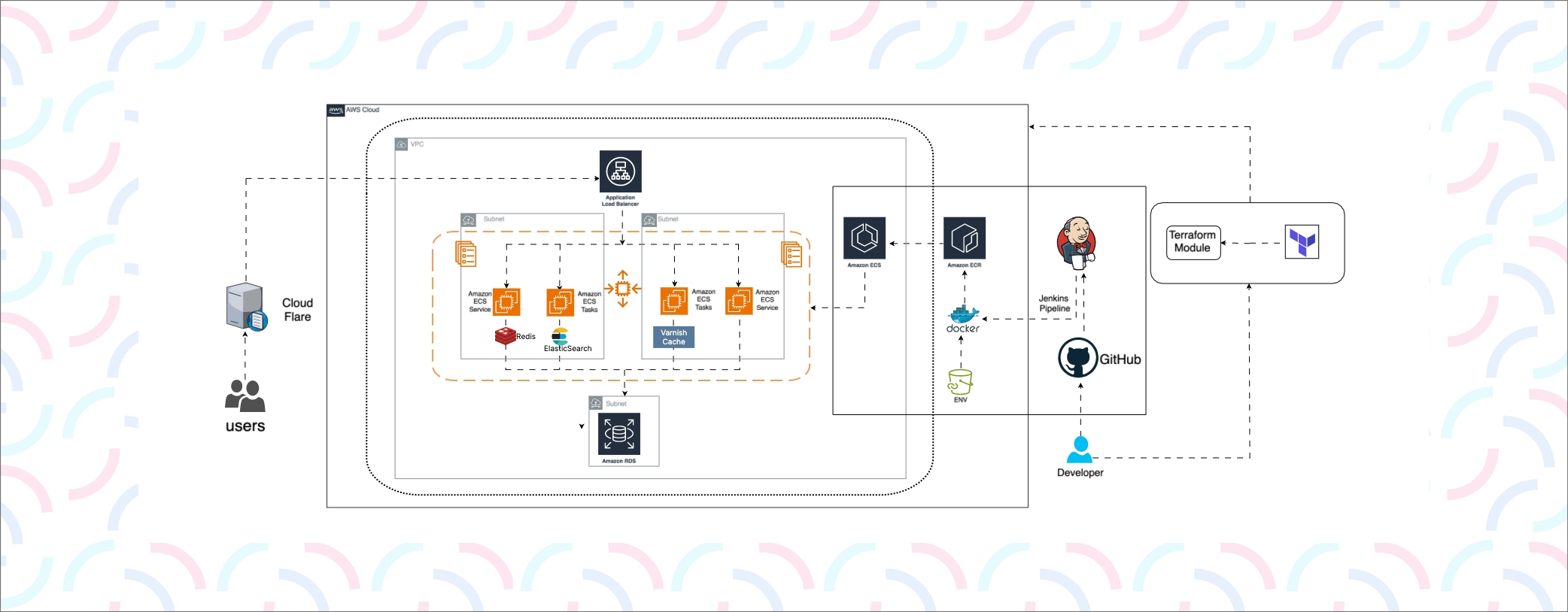
Seaflux, one of the leading cloud migration service providers, provided a comprehensive AWS Cloud Migration and automation solution, leveraging AWS, infrastructure as code Terraform, Jenkins, and containerized deployments. The transformation process included the following steps:
- AWS Cloud Migration:
The whole infrastructure was moved from on-premises to Amazon Web Services (AWS) to eliminate costs associated with physical hardware and allow the client to take advantage of scalable, secure, and globally available services with high-availability AWS architecture, ensuring minimal downtime and uninterrupted service.
- Infrastructure as Code using Terraform:
Seaflux found that automated infrastructure provisioning with Terraform scripts created a considerable reduction in the manual effort to deploy. This led not only to reduced deployment time but also consistently across environments, thanks to human error being removed from the process.
- Magento-Based Architecture:
To manage the diverse set of websites across multiple environments, Seaflux implemented a Magento architecture. This architecture allowed flexible resource allocation and customization, ensuring that each country-specific website could be tailored to its unique requirements.
- Elastic Container Service (ECS) Deployment:
We created a task definition and made an EC2 service for easy deployment with Amazon Elastic Container Service (ECS). Containerization improved resource utilization, speed of deployment, and availability.
- Enhanced Security with AWS Secrets Manager & S3:
- AWS Secrets Manager was implemented to manage and store sensitive database credentials securely. This eliminated the risks of hardcoding credentials or mismanagement.
- An S3 bucket was established to store PEM files required for secure server connections. Access policies were enforced to ensure controlled and secure usage, all managed via infrastructure as code Terraform automation.
- CI/CD Pipeline Optimization with Jenkins:
Seaflux thoroughly analyzed the client’s existing architecture and enhanced the automated deployment Jenkins pipeline scripts. By optimizing the Jenkinsfile, the system was able to automatically pull the latest code during new deployments and deploy site-specific updates directly over the ECS environment. This streamlined the release process and minimized downtime.
Key Benefits
1. Overall Improvement of 8%
The entire system has improved by 8%, so storage and retrieval of objects are less problematic for the user during the transaction. Users experienced faster and more stable websites, improved overall experience, and reduced failures during peak usage.
2. Strengthened Security
Using AWS Secrets Manager for credentials and S3 for management of the PEM files, the solution increased the client's security posture, lowering vulnerabilities and the risk of a data breach.
3. Centralized Governance Using Terraform
Using Terraform's Infrastructure as Code provided centralized management of many Magento-based sites across environments. The centralized model offered simplified provisioning, decreasing errors with deployments, and increasing speed to market.
4. Cost Savings
In migrating to AWS, the costs of on-premises infrastructure disappeared. The client took advantage of AWS’s relatively budget-friendly model that was based on pay-as-you-go for resources, making AWS Cloud Migration a cost-effective strategic move.
5. Quicker & Automated Deployments
The use of Jenkins in combination with Terraform and ECS allowed for the automation of the end-to-end deployment pipeline while also creating less manual involvement, which in turn promoted faster deployments of updates by the client.
6. Scalability & Reliability
At this stage of the project, with the new infrastructure that was built on AWS following AWS best practices, the client could easily support increases in traffic during festive times with downtime prevention, ensuring their users' experiences were not impacted and brand reputation remained intact.
Develop Your Idea
Let’s transform your idea into a real product with scalable solutions.